Thank you for visiting SNEWPapers!
Sign up free
Story
October 10, 1829
The Delaware Register, Or, Farmers', Manufacturers' & Mechanics' Advocate
Wilmington, New Castle County, Delaware
What is this article about?
Historical account of anti-Quaker laws in Massachusetts Bay Colony (1654-1658), including fines for books, entertainment penalties, banishment, and death for return, leading to hangings, compared to Salem Witches.
Clipping
OCR Quality
98%
Excellent
Full Text
Old Times.
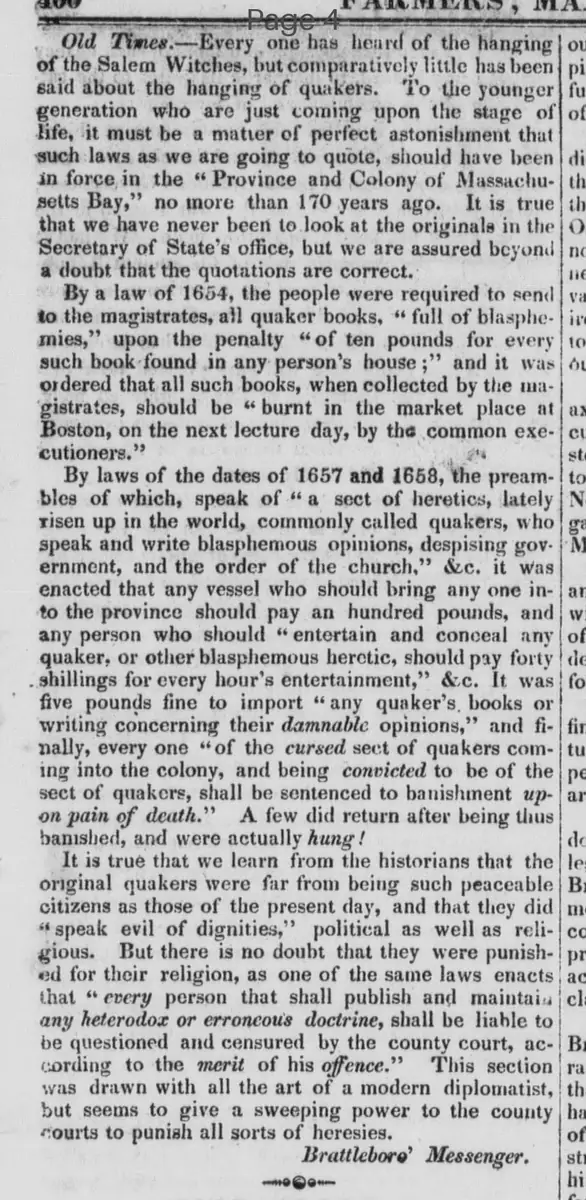
Every one has heard of the hanging of the Salem Witches, but comparatively little has been said about the hanging of quakers. To the younger generation who are just coming upon the stage of life, it must be a matter of perfect astonishment that such laws as we are going to quote, should have been in force in the "Province and Colony of Massachusetts Bay," no more than 170 years ago. It is true that we have never been to look at the originals in the Secretary of State's office, but we are assured beyond a doubt that the quotations are correct.
By a law of 1654, the people were required to send to the magistrates, all quaker books, "full of blasphemies," upon the penalty "of ten pounds for every such book found in any person's house;" and it was ordered that all such books, when collected by the magistrates, should be "burnt in the market place at Boston, on the next lecture day, by the common executioner."
By laws of the dates of 1657 and 1658, the preambles of which, speak of "a sect of heretics, lately risen up in the world, commonly called quakers, who speak and write blasphemous opinions, despising government, and the order of the church," &c. it was enacted that any vessel who should bring any one into the province should pay an hundred pounds, and any person who should "entertain and conceal any quaker, or other blasphemous heretic, should pay forty shillings for every hour's entertainment," &c. It was five pounds fine to import "any quaker's, books or writing concerning their damnable opinions," and finally, every one "of the cursed sect of quakers coming into the colony, and being convicted to be of the sect of quakers, shall be sentenced to banishment upon pain of death." A few did return after being thus banished, and were actually hung!
It is true that we learn from the historians that the original quakers were far from being such peaceable citizens as those of the present day, and that they did "speak evil of dignities," political as well as religious. But there is no doubt that they were punished for their religion, as one of the same laws enacts that "every person that shall publish and maintain any heterodox or erroneous doctrine, shall be liable to be questioned and censured by the county court, according to the merit of his offence."
This section was drawn with all the art of a modern diplomatist, but seems to give a sweeping power to the county courts to punish all sorts of heresies.
Brattleboro' Messenger.
Every one has heard of the hanging of the Salem Witches, but comparatively little has been said about the hanging of quakers. To the younger generation who are just coming upon the stage of life, it must be a matter of perfect astonishment that such laws as we are going to quote, should have been in force in the "Province and Colony of Massachusetts Bay," no more than 170 years ago. It is true that we have never been to look at the originals in the Secretary of State's office, but we are assured beyond a doubt that the quotations are correct.
By a law of 1654, the people were required to send to the magistrates, all quaker books, "full of blasphemies," upon the penalty "of ten pounds for every such book found in any person's house;" and it was ordered that all such books, when collected by the magistrates, should be "burnt in the market place at Boston, on the next lecture day, by the common executioner."
By laws of the dates of 1657 and 1658, the preambles of which, speak of "a sect of heretics, lately risen up in the world, commonly called quakers, who speak and write blasphemous opinions, despising government, and the order of the church," &c. it was enacted that any vessel who should bring any one into the province should pay an hundred pounds, and any person who should "entertain and conceal any quaker, or other blasphemous heretic, should pay forty shillings for every hour's entertainment," &c. It was five pounds fine to import "any quaker's, books or writing concerning their damnable opinions," and finally, every one "of the cursed sect of quakers coming into the colony, and being convicted to be of the sect of quakers, shall be sentenced to banishment upon pain of death." A few did return after being thus banished, and were actually hung!
It is true that we learn from the historians that the original quakers were far from being such peaceable citizens as those of the present day, and that they did "speak evil of dignities," political as well as religious. But there is no doubt that they were punished for their religion, as one of the same laws enacts that "every person that shall publish and maintain any heterodox or erroneous doctrine, shall be liable to be questioned and censured by the county court, according to the merit of his offence."
This section was drawn with all the art of a modern diplomatist, but seems to give a sweeping power to the county courts to punish all sorts of heresies.
Brattleboro' Messenger.
What sub-type of article is it?
Historical Event
Curiosity
What themes does it cover?
Crime Punishment
Misfortune
What keywords are associated?
Quaker Persecution
Massachusetts Laws
Historical Hangings
Religious Heresy
Where did it happen?
Province And Colony Of Massachusetts Bay, Boston
Story Details
Location
Province And Colony Of Massachusetts Bay, Boston
Event Date
1654 1658
Story Details
Recounts laws against Quakers including book burning, fines for importation and entertainment, banishment with death penalty for return, leading to actual hangings; notes Quakers' disruptive behavior but affirms punishment for religion.