Thank you for visiting SNEWPapers!
Sign up free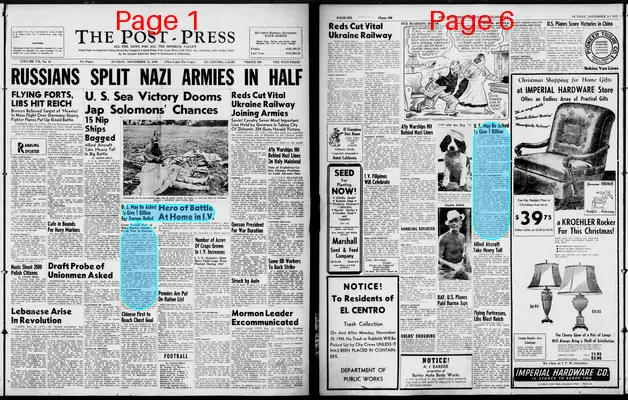
Imperial Valley Press
El Centro, Imperial County, California
What is this article about?
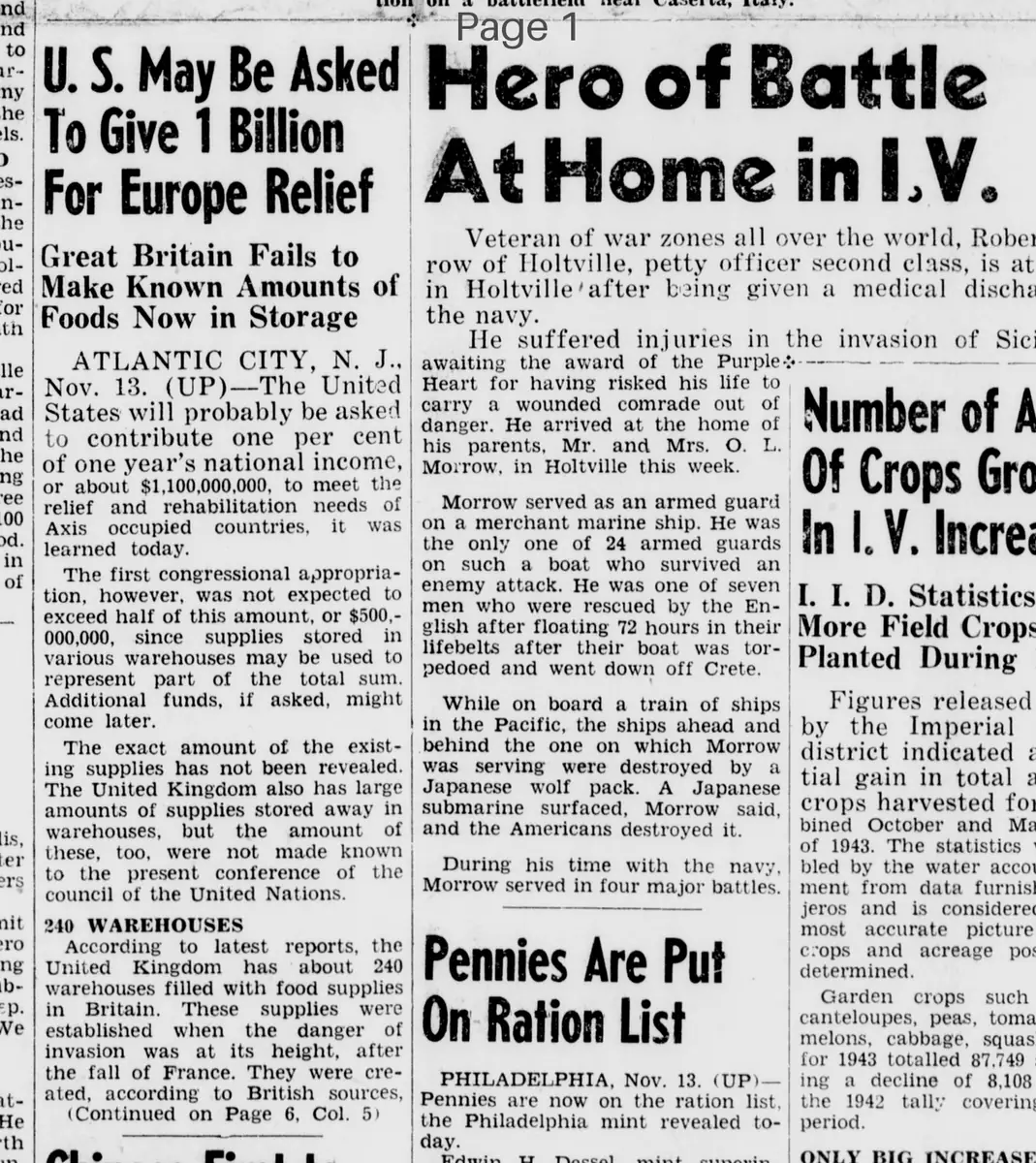
At the UNRRA conference in Atlantic City on Nov. 13, the US may be asked to contribute $1.1 billion (1% of national income) for relief in Axis-occupied Europe, with initial funding of $500 million using stored supplies. The UK has undisclosed food stocks in 240 warehouses but has not revealed amounts, hindering planning.
Merged-components note: Merged headline (reading order 15), body (reading order 16) on page 1, and continuation on page 6 column 5 of the foreign news story about U.S. relief contributions for Europe; relabeled the page 6 part from 'story' to 'foreign_news'.
Clippings
1 of 2
OCR Quality
Full Text
ATLANTIC CITY, N. J., Nov. 13. (UP)--The United States will probably be asked to contribute one per cent of one year's national income, or about $1,100,000,000, to meet the relief and rehabilitation needs of Axis occupied countries, it was learned today.
The first congressional appropriation, however, was not expected to exceed half of this amount, or $500,000,000, since supplies stored in various warehouses may be used to represent part of the total sum.
Additional funds, if asked, might come later.
The exact amount of the existing supplies has not been revealed.
The United Kingdom also has large amounts of supplies stored away in warehouses, but the amount of these, too, were not made known to the present conference of the council of the United Nations.
240 WAREHOUSES According to latest reports, the United Kingdom has about 240 warehouses filled with food supplies in Britain. These supplies were established when the danger of invasion was at its height, after the fall of France. They were created, according to British sources, to establish a supply of essential foodstuffs in all parts of the island so that, if communications were cut, the populace would have supplies.
It was known that some of the food has been removed from time to time, but supposedly to be replaced by other. It would provide a front line of a relief drive were the Axis to collapse in Europe and the need arise of rushing in emergency supplies.
Failure of the British to reveal the amounts on hand was said by some American observers to handicap UNRRA's planning to meet the needs of Europe after the war.
POINTS OF DIFFERENCE
The situation prevailing on the eve of the conference's getting down to work indicated that there will be many points of difference as the committees deal with important problems involving relief for the masses of Europe.
Some countries have indicated indirectly that they were here to find ways of using the relief needs of the United Nations to stimulate business after the war. Some United States industries have taken a purely business attitude toward manufacturing of required supplies, which would necessarily be inferior in quality to normal domestic demands.
Before the conference, it was said that the meeting might prove a test of the ability of the United Nations to carry out international cooperation to maintain the peace. But some members already have read symptoms of politics into the procedure. One delegate said that it reminded him of the conference of Versailles, noted for its sharp bargaining practices and its failure to establish machinery to maintain world peace.
What sub-type of article is it?
What keywords are associated?
Where did it happen?
Foreign News Details
Primary Location
Atlantic City, N. J.
Event Date
Nov. 13
Outcome
us proposed contribution: $1,100,000,000 total, initial $500,000,000; uk: 240 warehouses with undisclosed food supplies
Event Details
The United States will probably be asked to contribute one per cent of one year's national income, or about $1,100,000,000, to meet relief and rehabilitation needs of Axis occupied countries. First congressional appropriation not expected to exceed $500,000,000, using stored supplies. United Kingdom has large amounts of supplies in about 240 warehouses in Britain, established after fall of France for invasion preparedness, but amounts not revealed to UNRRA conference, handicapping planning. Conference indicates points of difference, including business stimulation and political symptoms reminiscent of Versailles.