Thank you for visiting SNEWPapers!
Sign up free
Gazette Of The United States, & Philadelphia Daily Advertiser
Philadelphia, Philadelphia County, Pennsylvania
What is this article about?
In the U.S. House of Representatives on January 16, Mr. Swanwick advocates for a direct land tax to establish reliable revenue, reduce the $80 million public debt, and prepare for possible war, criticizing indirect taxes as unequal and unreliable.
Merged-components note: These components continue the same report on the congressional debate, with Mr. Swanwick's speech flowing directly.
Clipping
OCR Quality
Full Text
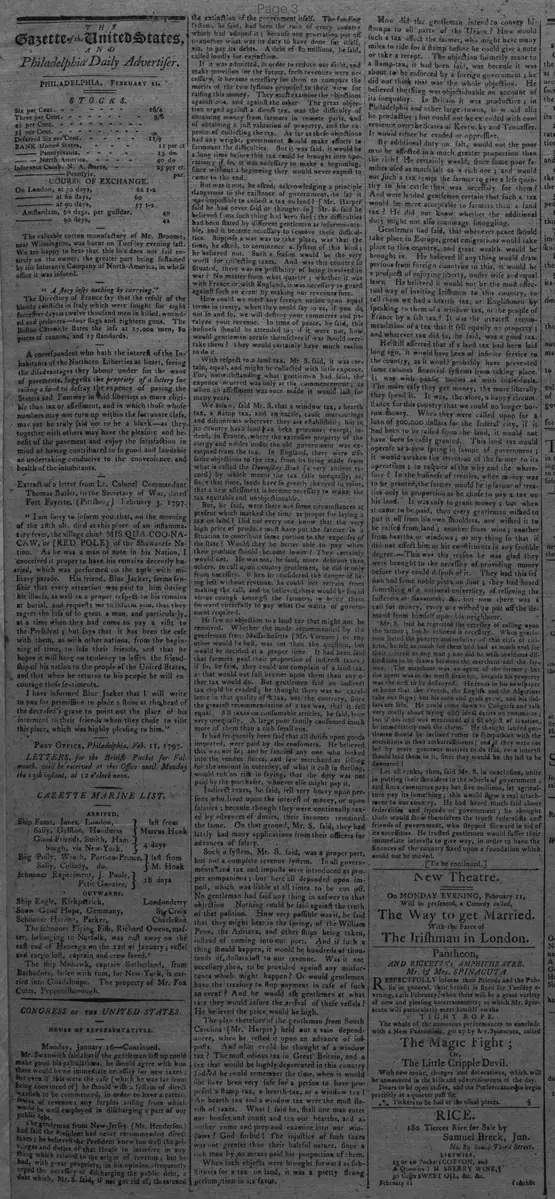
HOUSE OF REPRESENTATIVES.
Monday, January 16—Continued.
Mr. Swanwick said that if the gentleman last up could make good his calculations, he should agree with him there would be no immediate necessity for new taxes; but even if this were the case (which he was far from being convinced of) he should wish a system of direct taxation to be commenced, in order to have a certain source of revenue: any surplus arising from which would be well employed in discharging a part of our public debt.
The gentleman from New-Jersey (Mr. Henderson) had said the President had never recommended direct taxes; he believed the President knew too well the privileges and duties of that House to interfere in anything which related to the origin of revenue; but he had, with great propriety, in his opinion, frequently urged the necessity of discharging the public debt, a debt which, Mr. S. said, if not got rid of, threatened the extinction of the government itself. The funding system, he said, had been the ruin of every country which had adopted it; because one generation put off to another what was its duty to have done for itself, viz. to pay its debts. A debt of 80 millions, he said, called loudly for extinction.
If it was admitted, in order to reduce our debt, and make provision for the future, fresh revenues were necessary, it became necessary for them to compare the merits of the two systems proposed to their view for raising this money. They must examine the objections against one, and against the other. The great objection urged against a direct tax, was the difficulty of obtaining money from farmers in remote parts, and of obtaining a just valuation of property, and the expense of collecting the tax. As far as these objections had any weight, government should make efforts to surmount the difficulties. But it was said, it would be a long time before this tax could be brought into operation; if so, it was necessary to make a beginning, since without a beginning they would never expect to come to the end.
But was it not, he asked, acknowledging a principle dangerous to the existence of government, to say it was impossible to collect a tax on land? Mr. Harper said he had never said or thought so. Mr. S. said he believed no such thing had been said; the difficulties had been stated by different gentlemen as insurmountable, and it became necessary to remove these difficulties. Suppose a war was to take place, was that the time, he asked, to commence a system of this kind; he believed not. Such a season would be the very worst for collecting taxes. And was this country so situated, there was no possibility of being involved in war? No matter from what quarter; whether it was with France or with England, it was necessary to guard against such an event by making our revenues sure.
How could we meet any foreign nation upon equal terms in treaty, when they could say to us, if you do not so and so, we will destroy your commerce and paralyze your revenue. In time of peace, he said, this business should be attended to; if it were not, how would gentleman excuse themselves if war should overtake them? They would certainly have much reason to do it.
With respect to a land tax, Mr. S. said, it was certain, equal, and might be collected with little expense. For, notwithstanding what gentlemen had said, the expense incurred was only at the commencement; as when an assessment was once made it would last for many years.
We know, said Mr. S. that a window tax, a hearth tax, a stamp tax, and an excise, cause murmurings and discontents wherever they are established; but in no country has a land tax been grievous; except, indeed, in France, where the extensive property of the clergy and nobles under the old government was exempted from the tax. In England, there were also some objections to the tax, from its being made from what is called the Doomsday Book (a very ancient record) by which means the tax falls unequally, as, since that time, lands have so greatly changed in value, that a new assessment is become necessary to make the tax equitable and unobjectionable.
But, he said, were there not some circumstances at present which marked the time as proper for laying a tax on land? Did not every one know that the very high price of produce must have put the farmer in a situation to contribute some portion to the expenses of the state? Would they be better able to pay when their produce should become lower? They certainly would not. He was not, he said, more desirous than others, to call upon country gentlemen, he did it only from necessity. When he considered the danger of being left without revenue, he could not refrain from making the call, and—he believed there would be found virtue enough amongst the farmers, to bring them forward cheerfully to pay what the wants of government required.
He saw no objection to a land tax that might not be removed. Whether the mode recommended by the gentleman from Massachusetts (Mr. Varnum) or any other would be best, was not then the question, but would be decided at a proper time. It had been said that farmers paid their proportion of indirect taxes; if so, he said, they could not complain of a land tax, as that would not fall heavier upon them than any other tax would do. But gentlemen said an indirect tax could be evaded; he thought there was no excellence in that quality of a tax, but the contrary, since the greatest recommendation of a tax was, that it fell equal. All taxes on consumable articles, he said, bore very unequally. A large poor family consumed much more of them than a rich small one.
It had frequently been said that all duties upon goods imported, were paid by the consumers. He believed this was not so; and he fancied any one who looked into the vendue stores, and saw merchandise selling for the amount in currency, of what it cost in sterling, would run no risk in saying, that the duty was not paid by the purchaser, whoever else might pay it.
Indirect taxes, he said, fell very heavy upon persons who lived upon the interest of money, or upon salaries; because though they were continually taxed by advances of duties, their incomes remained the same. On that ground, Mr. S. said, they had lately had many applications from their officers for advances of salary.
Such a system, Mr. S. said, was a proper part, but not a complete revenue system. In all governments direct and indirect taxes and imposts were introduced as proper companions; but here all depended upon impost, which was liable at all times to be cut off.
No gentleman had said anything in answer to that objection. Nothing could be said against the truth of that position. How very possible was it, he said, that they might hear in the spring, of the William Penn, the Adriana, and other ships being taken, instead of coming into our port. And if such a thing should happen, it would be hundreds of thousands of dollars lost to our revenue. Was it not necessary then, to be provided against any misfortunes which might happen? Or would gentlemen have the treasury to stop payment in case of such an event? And he would ask gentlemen at what rate they would insure the arrival of these vessels? He believed the price would be high.
The plan therefore of the gentleman from South Carolina (Mr. Harper) held out a vain dependence, when he rested it upon an advance of imposts. And what could be thought of a window tax? The most odious tax in Great Britain, and a tax that would be highly deprecated in this country. Indeed he could remember the time, when it would not have been very safe for a person to have proposed a stamp-tax, a hearth-tax, or a window tax!
A hearth tax and a window tax were the most lavish of taxes. What! said he, shall one man enter our houses and count and tax our hearths, and another come and peep and examine into our windows? God forbid! The injustice of such taxes was not greater than their baleful nature, since a rich man by no means paid his proportion of them.
When such objects were brought forward as substitutes for a tax on land, it was a pretty strong presumption in its favor.
How did the gentleman intend to convey his stamps to all parts of the Union? How would such a tax affect the farmer, who might have many miles to ride for a stamp before he could give a note or take a receipt. The objection formerly made to a stamp-tax, it had been said, was because it was about to be enforced by a foreign government; he did not think that was the whole objection. He believed the thing was objectionable on account of its inequality. In Britain it was productive; in Philadelphia and other large towns, it would also be productive; but could not be extended with convenience over the States of Kentucky and Tennessee. It would either be evaded or oppressive.
By additional duty on salt, would not the poor man be affected in a much greater proportion than the rich! He certainly would, since some poor families used as much salt as a rich one; and would not such a tax tempt the farmer to give a less quantity to his cattle than was necessary for them?
And were landed gentlemen certain that such a tax would be more acceptable to farmers than a land tax? He did not know whether the additional duty might not also encourage smuggling.
Gentlemen had said, that whenever peace should take place in Europe, great emigrations would take place to this country, and great wealth would be brought in. He believed if anything would draw persons from foreign countries to this, it would be a prospect of enjoying liberty, under wise and equal laws. He believed it would not be the most effectual way of inviting Irishmen to this country, to speak to them of a hearth tax, or Englishmen by speaking to them of a window tax, or the people of France by a salt tax! It was the greatest recommendation of a tax that it fell equally on property; and whatever tax did so, he said, was a good tax.
He still asserted that if a land tax had been laid long ago, it would have been of infinite service to the country, as it would probably have prevented some ruinous financial systems from taking place.
It was with public bodies as with individuals. The more easy they get money, the more liberally they spend it. It was, therefore, a happy circumstance for this country that we could no longer borrow money. When they were called upon for a loan of 200,000 dollars for the federal city, if it had been to be raised from the land, it would not have been so easily granted. This land tax would operate as a new spring in favour of government; it would awaken the attention of the farmer to its operations; to enquire of the why and the wherefore? In the business of treaties, when money was to be granted, the farmer would be in favour of treaties only in proportion as he chose to pay a tax on his land. It was easy to grant money; but when it came to be paid, then every gentleman wished to put it off from his own shoulders, one wished it to be raised from land; another from wine; another from hearths or windows; or anything so that it did not affect him or his constituents in any sensible degree. This was the reason he was glad they were brought to the necessity of providing money before they could dispose of it. They had this session had some noble plans on foot: they had heard something of a national university, of relieving the sufferers at Savannah, &c. but now there was a call for money, everyone wished to put off the demand from himself upon his neighbour.
Mr. S. said he regretted the necessity of calling upon the farmer; but he believed it necessary. When gentlemen stated the poverty and industry of that class of citizens, he felt as much for them and had as much zeal for their interest as any man; nor did he wish invidious distinctions to be drawn between the merchant and the farmer. The merchant was an agent of the farmer; but the agent was in the worst situation, because his property was the first to be destroyed. He reads in his newspaper at home that the French, the English and the Algerines take our ships; but his corn and grass grow, and his dollars are safe. He could come down to Congress and talk very coolly about laying additional duties on commerce; but if his land was mentioned as a fit object of taxation, he immediately took the alarm. He thought landed gentlemen should be inclined rather to sympathize with the merchants in their embarrassments; and if they were not led by more generous motives to do this, even interest should lead them to it, since they would be the last to be devoured!
Let all ranks, then, said Mr. S. in conclusion, unite in putting their shoulders to the wheels of government; and since commerce pays her five millions, let agriculture pay its something; this would show a real attachment to our country. He had heard much said about federalism and friends of government; he thought those would show themselves the truest federalists and friends of government, who stepped forward in aid of its necessities. He trusted gentlemen would suffer their immediate interests to give way, in order to have the finances of the country fixed upon a foundation which could not be moved.
[To be continued.]
What sub-type of article is it?
What keywords are associated?
What entities or persons were involved?
Where did it happen?
Domestic News Details
Primary Location
United States House Of Representatives
Event Date
Monday, January 16
Key Persons
Outcome
ongoing debate on taxation systems; speech advocates for direct land tax to address public debt and ensure stable revenue amid potential war risks.
Event Details
Mr. Swanwick delivers a speech supporting the implementation of a direct land tax as a reliable revenue source to reduce the public debt of 80 million dollars, critiques indirect taxes like imposts, stamps, windows, and hearths for being unequal and unreliable, and urges preparation for possible conflicts with foreign powers.