Thank you for visiting SNEWPapers!
Sign up free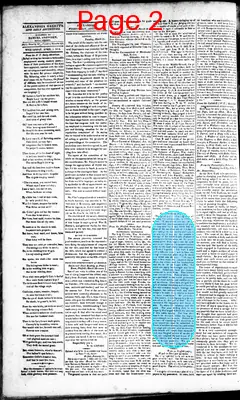
Editorial
April 1, 1818
Alexandria Gazette & Daily Advertiser
Alexandria, Virginia
What is this article about?
Editorial from Salem Register quotes Josiah Quincy's 1774 address urging Americans to unite across classes against oppression, reject over-reliance on commerce for liberty, and exercise independent judgment for public freedom.
Clipping
OCR Quality
95%
Excellent
Full Text
From the Salem Register.
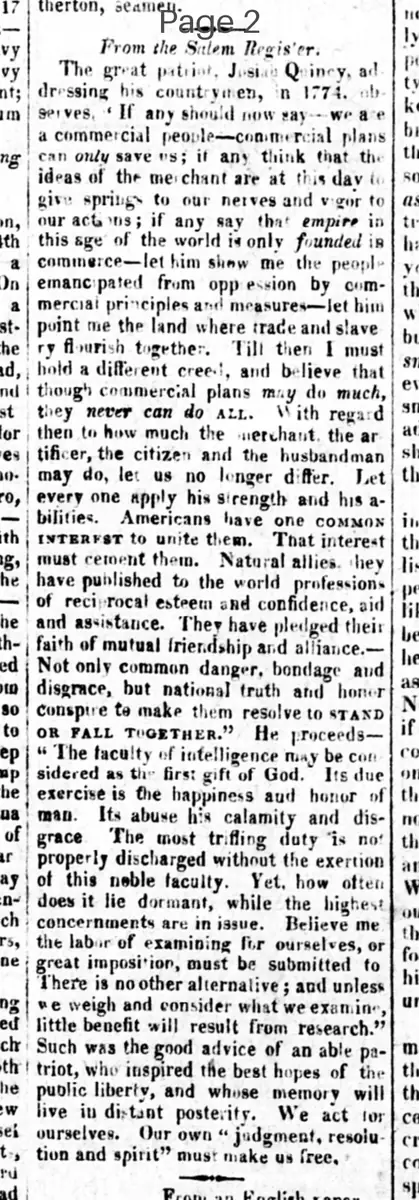
The great patriot, Josiah Quincy, addressing his countrymen, in 1774, observes, 'If any should now say—we are a commercial people—commercial plans can only save us; if any think that the ideas of the merchant are at this day to give springs to our nerves and vigor to our actions; if any say that empire in this age of the world is only founded in commerce—let him show me the people emancipated from oppression by commercial principles and measures—let him point me the land where trade and slavery flourish together. Till then I must hold a different creed, and believe that though commercial plans may do much, they never can do all. With regard then to how much the merchant, the artificer, the citizen and the husbandman may do, let us no longer differ. Let every one apply his strength and his abilities. Americans have one common interest to unite them. That interest must cement them. Natural allies, they have published to the world professions of reciprocal esteem and confidence, aid and assistance. They have pledged their faith of mutual friendship and alliance.— Not only common danger, bondage and disgrace, but national truth and honor conspire to make them resolve to stand OR FALL TOGETHER.' He proceeds—
'The faculty of intelligence may be considered as the first gift of God.' Its due exercise is the happiness and honor of man. Its abuse his calamity and disgrace. The most trifling duty is not properly discharged without the exertion of this noble faculty. Yet, how often does it lie dormant, while the highest concernments are in issue. Believe me the labor of examining for ourselves, or great imposition, must be submitted to. There is no other alternative; and unless we weigh and consider what we examine little benefit will result from research.'
Such was the good advice of an able patriot, who inspired the best hopes of the public liberty, and whose memory will live in distant posterity. We act for ourselves. Our own 'judgment, resolution and spirit' must make us free.
The great patriot, Josiah Quincy, addressing his countrymen, in 1774, observes, 'If any should now say—we are a commercial people—commercial plans can only save us; if any think that the ideas of the merchant are at this day to give springs to our nerves and vigor to our actions; if any say that empire in this age of the world is only founded in commerce—let him show me the people emancipated from oppression by commercial principles and measures—let him point me the land where trade and slavery flourish together. Till then I must hold a different creed, and believe that though commercial plans may do much, they never can do all. With regard then to how much the merchant, the artificer, the citizen and the husbandman may do, let us no longer differ. Let every one apply his strength and his abilities. Americans have one common interest to unite them. That interest must cement them. Natural allies, they have published to the world professions of reciprocal esteem and confidence, aid and assistance. They have pledged their faith of mutual friendship and alliance.— Not only common danger, bondage and disgrace, but national truth and honor conspire to make them resolve to stand OR FALL TOGETHER.' He proceeds—
'The faculty of intelligence may be considered as the first gift of God.' Its due exercise is the happiness and honor of man. Its abuse his calamity and disgrace. The most trifling duty is not properly discharged without the exertion of this noble faculty. Yet, how often does it lie dormant, while the highest concernments are in issue. Believe me the labor of examining for ourselves, or great imposition, must be submitted to. There is no other alternative; and unless we weigh and consider what we examine little benefit will result from research.'
Such was the good advice of an able patriot, who inspired the best hopes of the public liberty, and whose memory will live in distant posterity. We act for ourselves. Our own 'judgment, resolution and spirit' must make us free.
What sub-type of article is it?
Constitutional
Moral Or Religious
What keywords are associated?
Josiah Quincy
American Unity
Public Liberty
Patriotism
Judgment
Commerce
Oppression
What entities or persons were involved?
Josiah Quincy
Americans
Editorial Details
Primary Topic
American Unity And Independent Judgment For Liberty
Stance / Tone
Patriotic Exhortation
Key Figures
Josiah Quincy
Americans
Key Arguments
Commerce Cannot Fully Emancipate From Oppression
All Classes Must Unite In Common Interest
Exercise Intelligence And Judgment To Avoid Imposition
Stand Or Fall Together In National Honor