Thank you for visiting SNEWPapers!
Sign up free
Gazette Of The United States
Philadelphia, Philadelphia County, Pennsylvania
What is this article about?
Proceedings of the U.S. House of Representatives on April 28, including petitions on court locations and the British treaty from various regions, bills on snuff drawbacks and land locations, presidential messages on public credit and attorney salaries, a resolution on quarantines, and debate on implementing the British treaty, ending in adjournment.
Clipping
OCR Quality
Full Text
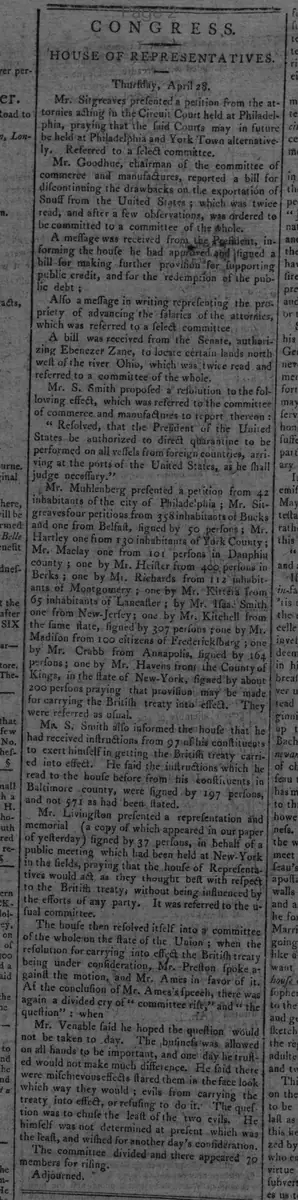
HOUSE OF REPRESENTATIVES.
Thursday, April 28.
Mr. Sitgreaves presented a petition from the attorneys acting in the Circuit Court held at Philadelphia, praying that the said Courts may in future be held at Philadelphia and York Town alternately. Referred to a select committee.
Mr. Goodhue, chairman of the committee of commerce and manufactures, reported a bill for discontinuing the drawbacks on the exportation of Snuff from the United States; which was twice read, and after a few observations, was ordered to be committed to a committee of the whole.
A message was received from the President, informing the house he had approved and signed a bill for making further provision for supporting public credit, and for the redemption of the public debt.
Also a message in writing representing the propriety of advancing the salaries of the attorneys, which was referred to a select committee.
A bill was received from the Senate, authorizing Ebenezer Zane, to locate certain lands northwest of the river Ohio, which was twice read and referred to a committee of the whole.
Mr. S. Smith proposed a resolution to the following effect, which was referred to the committee of commerce and manufactures to report thereon:
"Resolved, that the President of the United States be authorized to direct quarantine to be performed on all vessels from foreign countries, arriving at the ports of the United States, as he shall judge necessary."
Mr. Muhlenberg presented a petition from 42 inhabitants of the city of Philadelphia; Mr. Sitgreaves four petitions from 358 inhabitants of Bucks and one from Belfast, signed by 20 persons; Mr. Hartley one from 130 inhabitants of York County; Mr. Maclay one from 101 persons in Dauphin county; one by Mr. Heister from 400 persons in Berks; one by Mr. Richards from 112 inhabitants of Montgomery; one by Mr. Kittera from 65 inhabitants of Lancaster; by Mr. Isaac Smith one from New-Jersey: one by Mr. Kitchell from the same state, signed by 307 persons; one by Mr. Madison from 100 citizens of Fredericksburg; one by Mr. Crabb from Annapolis, signed by 164 persons; one by Mr. Havens from the County of Kings, in the state of New-York, signed by about 200 persons praying that provision may be made for carrying the British treaty into effect. They were referred as usual.
Mr. S. Smith also informed the house that he had received instructions from 97 of his constituents to exert himself in getting the British treaty carried into effect. He said the instructions which he read to the house before from his constituents in Baltimore county, were signed by 197 persons, and not 571 as had been stated.
Mr. Livingston presented a representation and memorial (a copy of which appeared in our paper of yesterday) signed by 37 persons, in behalf of a public meeting which had been held at New-York in the fields, praying that the house of Representatives would act, as they thought best with respect to the British treaty; without being influenced by the efforts of any party. It was referred to the usual committee.
The house then resolved itself into a committee of the whole on the state of the Union; when the resolution for carrying into effect the British treaty being under consideration, Mr. Preston spoke against the motion, and Mr. Ames in favor of it.
At the conclusion of Mr. Ames's speech, there was again a divided cry of "committee rise," and "the question": when
Mr. Venable said he hoped the question would not be taken to-day. The business was allowed on all hands to be important, and one day he trusted would not make much difference. He said there were mischievous effects stared them in the face look which way they would; evils from carrying the treaty into effect, or refusing to do it. The question was to choose the least of the two evils. He himself was not determined at present which was the least, and wished for another day's consideration.
The committee divided and there appeared 70 members for rising.
Adjourned.
What sub-type of article is it?
What keywords are associated?
What entities or persons were involved?
Domestic News Details
Event Date
Thursday, April 28.
Key Persons
Outcome
bills and petitions referred to committees; messages from president approved and referred; debate on british treaty resolution continued, committee rose with 70 members voting to rise; house adjourned.
Event Details
The House considered petitions on court locations and the British treaty from various locations, reported and referred bills on snuff export drawbacks and Ohio land locations, received presidential messages on public credit and attorney salaries, proposed a quarantine resolution, presented multiple petitions and instructions supporting the British treaty, and debated its implementation in committee of the whole before adjourning.