Thank you for visiting SNEWPapers!
Sign up free
The Citizen
Berea, Madison County, Kentucky
What is this article about?
An opinion piece arguing against retirement, stating it equates to dying and leads to misery. It emphasizes that activity sustains life and spirit, citing examples of productive elderly figures like Judge Roger A. Pryor, Darwin, Beethoven, Gladstone, and Victor Hugo who achieved great works in old age.
Clipping
OCR Quality
Full Text
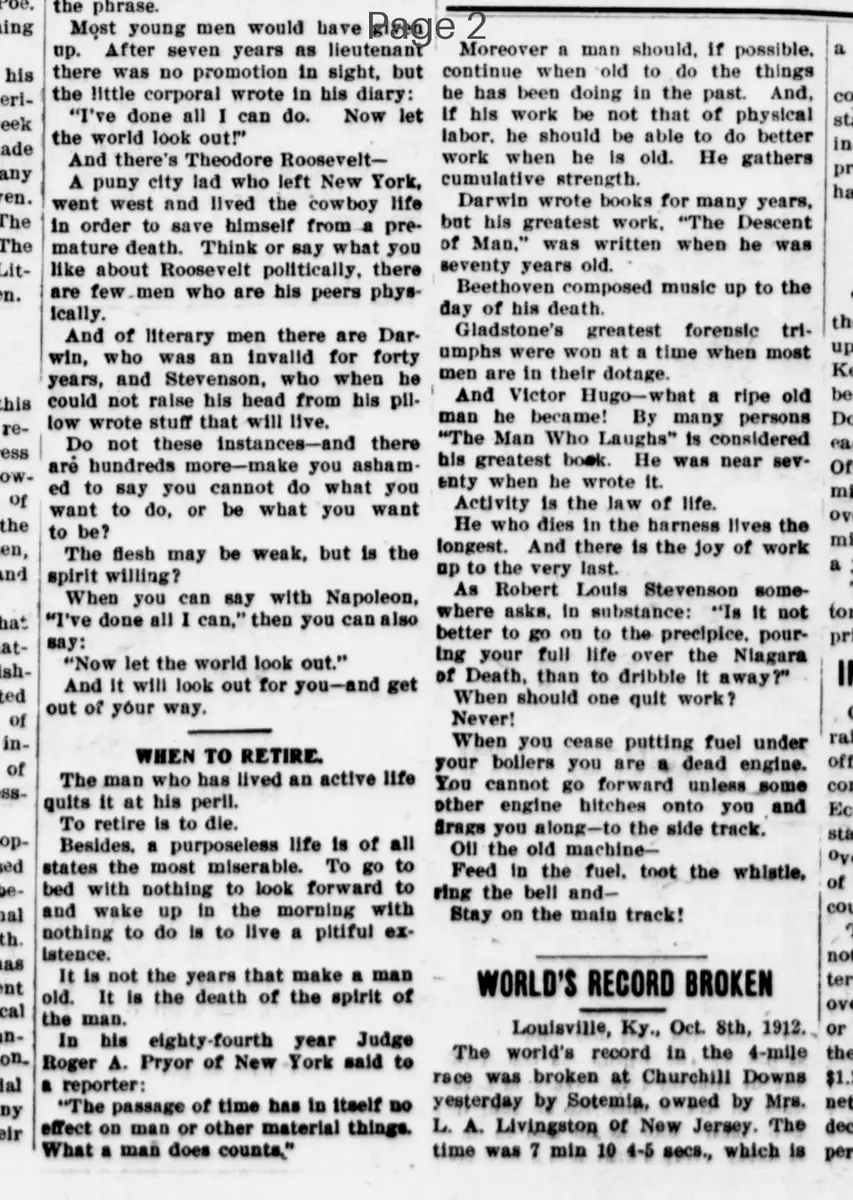
The man who has lived an active life quits it at his peril.
To retire is to die.
Besides, a purposeless life is of all states the most miserable. To go to bed with nothing to look forward to and wake up in the morning with nothing to do is to live a pitiful existence.
It is not the years that make a man old. It is the death of the spirit of the man.
In his eighty-fourth year Judge Roger A. Pryor of New York said to a reporter:
"The passage of time has in itself no effect on man or other material things. What a man does counts."
Moreover a man should, if possible, continue when old to do the things he has been doing in the past. And, if his work be not that of physical labor, he should be able to do better work when he is old. He gathers cumulative strength.
Darwin wrote books for many years, but his greatest work, "The Descent of Man," was written when he was seventy years old.
Beethoven composed music up to the day of his death.
Gladstone's greatest forensic triumphs were won at a time when most men are in their dotage.
And Victor Hugo—what a ripe old man he became!
By many persons "The Man Who Laughs" is considered his greatest book. He was near seventy when he wrote it.
Activity is the law of life.
He who dies in the harness lives the longest. And there is the joy of work up to the very last.
As Robert Louis Stevenson somewhere asks, in substance: "Is it not better to go on to the precipice, pouring your full life over the Niagara of Death, than to dribble it away?"
When should one quit work?
Never!
When you cease putting fuel under your boilers you are a dead engine.
You cannot go forward unless some other engine hitches onto you and drags you along—to the side track.
Off the old machine—
Feed in the fuel, toot the whistle, ring the bell and—
Stay on the main track!
What sub-type of article is it?
What themes does it cover?
What keywords are associated?
What entities or persons were involved?
Where did it happen?
Story Details
Key Persons
Location
New York
Story Details
The article argues that retiring from an active life is dangerous and leads to spiritual death and misery, advocating continued work for purpose and longevity. It quotes Judge Pryor at 84 on the importance of action over time, and cites Darwin writing his greatest book at 70, Beethoven composing until death, Gladstone's late triumphs, and Hugo's 'The Man Who Laughs' near 70, concluding one should never quit work.