Thank you for visiting SNEWPapers!
Sign up free
Daily National Intelligencer
Washington, District Of Columbia
What is this article about?
Historical account of Corsican kings Theodore and his son Frederick's misfortunes in England: Theodore, imprisoned and destitute despite British ties, dies in poverty; Frederick, a colonel turned author, commits suicide after rejection by George III. Theodore's wife Isabella survives in Edinburgh.
Clipping
OCR Quality
Full Text
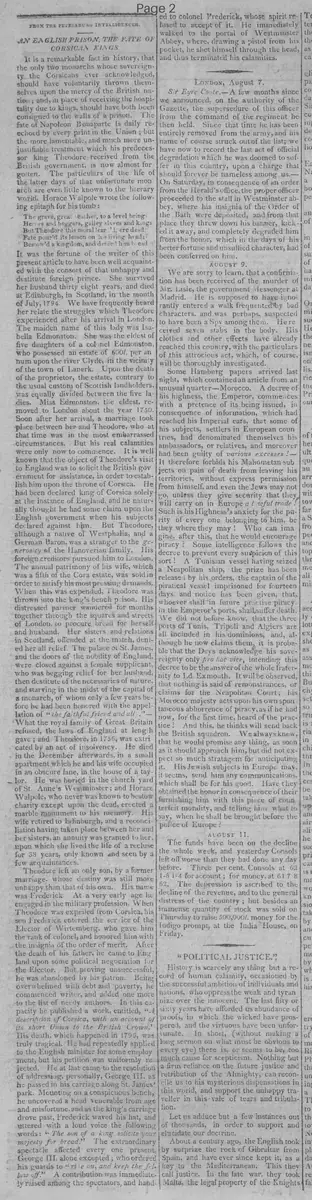
AN ENGLISH PRISON, THE FATE OF CORSICAN KINGS
It is a remarkable fact in history, that the only two monarchs whose sovereignty the Corsicans ever acknowledged, should have voluntarily thrown themselves upon the mercy of the British nation; and, in place of receiving the hospitality due to kings, should have both been consigned to the walls of a prison. The fate of Napoleon Bonaparte is daily re-echoed by every print in the Union; but the more lamentable, and much more unjustifiable treatment which his predecessor king Theodore received from the British government, is now almost forgotten. The particulars of the life of the latter days of that unfortunate monarch are even little known to the literary world. Horace Walpole wrote the following epitaph for his tomb:
The grave, great teacher, to a level brings
Her heroes and beggars, galley slaves and kings.
But Theodore this moral learn'd, ere dead;
Fate pour'd its lesson on his living head;
Bestow'd a kingdom, and denied him bread.
It was the fortune of the writer of this present article to have been well acquainted with the consort of that unhappy and destitute foreign prince. She survived her husband thirty-eight years, and died at Edinburgh, in Scotland, in the month of July, 1794. We have frequently heard her relate the struggles which Theodore experienced after his arrival in London. The maiden name of this lady was Isabella Edmonston. She was the eldest of five daughters of a colonel Edmonston, who possessed an estate of £600 per annum upon the river Clyde, in the vicinity of the town of Lanark. Upon the death of the proprietor, the estate, contrary to the usual custom of Scottish landholders, was equally divided between the five ladies. Miss Edmonston, the eldest, removed to London about the year 1750. Soon after her arrival, a marriage took place between her and Theodore, who at that time was in the most embarrassed circumstances. But his real calamities were only now to commence. It is well known that the object of Theodore's visit to England was to solicit the British government for assistance, in order to establish him upon the throne of Corsica. He had been declared king of Corsica solely at the instance of England, and he naturally thought he had some claim upon the English government when his subjects declared against him. But Theodore, although a native of Westphalia, and a German Baron, was a stranger to the generosity of the Hanoverian family. His foreign creditors pursued him to London. The annual patrimony of his wife, which was a fifth of the Cora estate, was sold in order to satisfy his most pressing demands. When this was expended, Theodore was thrown into the king's bench prison. His distressed partner wandered for months together through the squares and streets of London, to procure bread for herself and husband. Her sisters and relations in Scotland, offended at the match, denied her all relief. The palace of St. James, and the doors of the nobility of England, were closed against a female supplicant, who was begging relief for her husband, then destitute of the necessaries of nature, and starving in the midst of the capital of a monarch, of whom only a few years before he had been honored with the appellation of "the faithful friend and ally." What the royal family of Great Britain refused, the laws of England at length gave; and Theodore, in 1756, was extricated by an act of insolvency. He died in the December afterwards, in a small apartment which he and his wife occupied in an obscure lane, in the house of a tailor. He was buried in the church yard of St. Anne's Westminster; and Horace Walpole, who never was known to bestow charity except upon the dead, erected a marble monument to his memory. His wife retired to Edinburgh, and a reconciliation having taken place between her and her sisters, an annuity was granted to her, upon which she lived the life of a recluse for 38 years, only known and seen by a few acquaintances.
Theodore left an only son, by a former marriage, whose destiny was still more unhappy than that of his own. His name was Frederick. At a very early age he engaged in the military profession. When Theodore was expelled from Corsica, his son Frederick entered the service of the Elector of Wirtemberg, who gave him the rank of colonel, and honored him with the insignia of the order of merit. After the death of his father, he came to England upon some political negotiation for the Elector. But proving unsuccessful, he was abandoned by his patron. Being overwhelmed with debt and poverty, he commenced writer, and added one more to the list of needy authors. In this capacity he published a work, entitled, "A description of Corsica, with an account of its short Union to the British Crown."
His death, which happened in 1796, was truly tragical. He had repeatedly applied to the English minister for some employment, but his petition was uniformly rejected. He at last came to the resolution of addressing, personally, George III. as he passed in his carriage along St. James park. Mounting on a conspicuous bench, he uncovered a head venerable from age and misfortune, and as the king's carriage drove past, Frederick waved his hat, and uttered with a loud voice the following words: "The son of a king solicits your majesty for bread." The extraordinary spectacle affected every one present, George III. alone excepted; who ordered his guards to "ride on, and keep the fellow off." A contribution was immediately raised among the spectators, and handed to colonel Frederick, whose spirit refused to accept of it. He immediately walked to the portal of Westminster Abbey, where, drawing a pistol from his pocket, he shot himself through the head, and thus terminated his calamities.
What sub-type of article is it?
What themes does it cover?
What keywords are associated?
What entities or persons were involved?
Where did it happen?
Story Details
Key Persons
Location
London, England; Edinburgh, Scotland; Corsica
Event Date
1750 1796
Story Details
Theodore, King of Corsica, seeks British aid but faces imprisonment and poverty in London, dying destitute in 1756; his wife Isabella begs for aid and later lives reclusively in Edinburgh until 1794. Their son Frederick, a colonel, falls into poverty, publishes on Corsica, and suicides in 1796 after rejection by George III.