Thank you for visiting SNEWPapers!
Sign up free
Letter to Editor
March 6, 1806
Alexandria Daily Advertiser
Alexandria, Virginia
What is this article about?
A fragment titled 'FABRICIUS' from Washington's administration argues that direct democracy is impracticable for large nations, necessitating representation. It urges citizens to trust elected officials of integrity rather than meddlers, warning that calumny drives away virtuous leaders, leading to ruinous governance.
Clipping
OCR Quality
95%
Excellent
Full Text
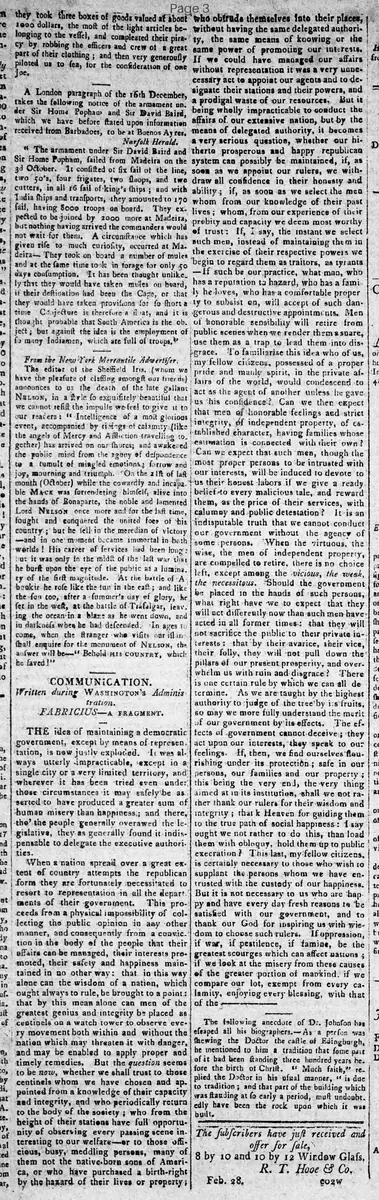
COMMUNICATION.
Written during WASHINGTON's Administration.
FABRICIUS - A FRAGMENT
THE idea of maintaining a democratic government, except by means of representation, is now justly exploded. It was always utterly impracticable, except in a single city or a very limited territory, and wherever it has been tried even under those circumstances it may safely be asserted to have produced a greater sum of human misery than happiness; and there, tho' the people generally overawed the legislative, they as generally found it indispensable to delegate the executive authorities.
When a nation spread over a great extent of country attempts the republican form they are fortunately necessitated to resort to representation in all the departments of their government. This proceeds from a physical impossibility of collecting the public opinion in any other manner, and consequently from a conviction in the body of the people that their affairs can be managed, their interests promoted, their safety and happiness maintained in no other way: that in this way alone can the wisdom of a nation, which ought always to rule, be brought to a point: that by this means alone can men of the greatest genius and integrity be placed as centinels on a watch-tower to observe every movement both within and without the nation which may threaten it with danger, and may be enabled to apply proper and timely remedies. But the question seems to be now, whether we shall trust to those centinels whom we have chosen and appointed from a knowledge of their capacity and integrity, and who periodically return to the body of the society; who from the height of their stations have full opportunity of observing every passing scene interesting to our welfare -- or to those officious, busy, meddling persons, many of them not the native-born sons of America, or who have purchased a birth-right by the hazard of their lives or property: who obtrude themselves into their places, without having the same delegated authority, the same means of knowing or the same power of promoting our interests.
If we could have managed our affairs without representation it was a very unnecessary act to appoint our agents and to designate their stations and their powers, and a prodigal waste of our resources. But it being wholly impracticable to conduct the affairs of our extensive nation, but by the means of delegated authority, it becomes a very serious question, whether our hitherto prosperous and happy republican system can possibly be maintained, if, as soon as we appoint our rulers, we withdraw all confidence in their honesty and ability; if, as soon as we select the men whom from our knowledge of their past lives; whom, from our experience of their probity and capacity we deem most worthy of trust: If, I say, the instant we select such men, instead of maintaining them in the exercise of their respective powers we begin to regard them as traitors, as tyrants -- If such be our practice, what man, who has a reputation to hazard, who has a family he loves, who has a comfortable property to subsist on, will accept of such dangerous and destructive appointments. Men of honorable sensibility will retire from public scenes when we render them snares, use them as a trap to lead them into disgrace. To familiarise this idea who of us, my fellow citizens, possessed of a proper pride and manly spirit, in the private affairs of the world, would condescend to act as the agent of another unless he gave us his confidence? Can we then expect that men of honorable feelings and strict integrity, of independent property, of established character, having families whose estmation is connected with their own Can we expect that such men, though the most proper persons to be intrusted with our interests, will be induced to devote to us their honest labors if we give a ready belief to every malicious tale, and reward them, as the price of their services, with calumny and public detestation? It is an indisputable truth that we cannot conduct our government without the agency of some persons. When the virtuous, the wise, the men of independent property, are compelled to retire, there is no choice left, except among the vicious, the weak, the necessitous. Should the government be placed in the hands of such persons, what right have we to expect that they will act differently now than such men have acted in all former times: that they will not sacrifice the public to their private interests: that by their avarice, their vice, their folly, they will not pull down the pillars of our present prosperity, and overwhelm us with ruin and disgrace? There is one certain rule by which we can all determine. As we are taught by the highest authority to judge of the tree by its fruits, so may we more fully understand the merit of our government by its effects. The effects of government cannot deceive; they act upon our interests, they speak to our feelings. If, then, we find ourselves flourishing under its protection; safe in our persons, our families and our property; this being the very end, the very thing aimed at in its institution, shall we not rather thank our rulers for their wisdom and integrity; that k Heaven for guiding them to the true path of social happiness: I say ought we not rather to do this, than load them with obloquy, hold them up to public execration? This last, my fellow citizens, is certainly necessary to those who wish to supplant the persons whom we have entrusted with the custody of our happiness. But it is not necessary to us who are happy and have every day fresh reasons to be satisfied with our government, and to thank our God for inspiring us with wisdom to choose such rulers. If oppression, if war, if pestilence, if famine, be the greatest scourges which can affect nations; if we look at the misery from these causes of the greater portion of mankind, if we compare our lot, exempt from every calamity, enjoying every blessing, with that of the
Written during WASHINGTON's Administration.
FABRICIUS - A FRAGMENT
THE idea of maintaining a democratic government, except by means of representation, is now justly exploded. It was always utterly impracticable, except in a single city or a very limited territory, and wherever it has been tried even under those circumstances it may safely be asserted to have produced a greater sum of human misery than happiness; and there, tho' the people generally overawed the legislative, they as generally found it indispensable to delegate the executive authorities.
When a nation spread over a great extent of country attempts the republican form they are fortunately necessitated to resort to representation in all the departments of their government. This proceeds from a physical impossibility of collecting the public opinion in any other manner, and consequently from a conviction in the body of the people that their affairs can be managed, their interests promoted, their safety and happiness maintained in no other way: that in this way alone can the wisdom of a nation, which ought always to rule, be brought to a point: that by this means alone can men of the greatest genius and integrity be placed as centinels on a watch-tower to observe every movement both within and without the nation which may threaten it with danger, and may be enabled to apply proper and timely remedies. But the question seems to be now, whether we shall trust to those centinels whom we have chosen and appointed from a knowledge of their capacity and integrity, and who periodically return to the body of the society; who from the height of their stations have full opportunity of observing every passing scene interesting to our welfare -- or to those officious, busy, meddling persons, many of them not the native-born sons of America, or who have purchased a birth-right by the hazard of their lives or property: who obtrude themselves into their places, without having the same delegated authority, the same means of knowing or the same power of promoting our interests.
If we could have managed our affairs without representation it was a very unnecessary act to appoint our agents and to designate their stations and their powers, and a prodigal waste of our resources. But it being wholly impracticable to conduct the affairs of our extensive nation, but by the means of delegated authority, it becomes a very serious question, whether our hitherto prosperous and happy republican system can possibly be maintained, if, as soon as we appoint our rulers, we withdraw all confidence in their honesty and ability; if, as soon as we select the men whom from our knowledge of their past lives; whom, from our experience of their probity and capacity we deem most worthy of trust: If, I say, the instant we select such men, instead of maintaining them in the exercise of their respective powers we begin to regard them as traitors, as tyrants -- If such be our practice, what man, who has a reputation to hazard, who has a family he loves, who has a comfortable property to subsist on, will accept of such dangerous and destructive appointments. Men of honorable sensibility will retire from public scenes when we render them snares, use them as a trap to lead them into disgrace. To familiarise this idea who of us, my fellow citizens, possessed of a proper pride and manly spirit, in the private affairs of the world, would condescend to act as the agent of another unless he gave us his confidence? Can we then expect that men of honorable feelings and strict integrity, of independent property, of established character, having families whose estmation is connected with their own Can we expect that such men, though the most proper persons to be intrusted with our interests, will be induced to devote to us their honest labors if we give a ready belief to every malicious tale, and reward them, as the price of their services, with calumny and public detestation? It is an indisputable truth that we cannot conduct our government without the agency of some persons. When the virtuous, the wise, the men of independent property, are compelled to retire, there is no choice left, except among the vicious, the weak, the necessitous. Should the government be placed in the hands of such persons, what right have we to expect that they will act differently now than such men have acted in all former times: that they will not sacrifice the public to their private interests: that by their avarice, their vice, their folly, they will not pull down the pillars of our present prosperity, and overwhelm us with ruin and disgrace? There is one certain rule by which we can all determine. As we are taught by the highest authority to judge of the tree by its fruits, so may we more fully understand the merit of our government by its effects. The effects of government cannot deceive; they act upon our interests, they speak to our feelings. If, then, we find ourselves flourishing under its protection; safe in our persons, our families and our property; this being the very end, the very thing aimed at in its institution, shall we not rather thank our rulers for their wisdom and integrity; that k Heaven for guiding them to the true path of social happiness: I say ought we not rather to do this, than load them with obloquy, hold them up to public execration? This last, my fellow citizens, is certainly necessary to those who wish to supplant the persons whom we have entrusted with the custody of our happiness. But it is not necessary to us who are happy and have every day fresh reasons to be satisfied with our government, and to thank our God for inspiring us with wisdom to choose such rulers. If oppression, if war, if pestilence, if famine, be the greatest scourges which can affect nations; if we look at the misery from these causes of the greater portion of mankind, if we compare our lot, exempt from every calamity, enjoying every blessing, with that of the
What sub-type of article is it?
Persuasive
Philosophical
Political
What themes does it cover?
Politics
Constitutional Rights
Morality
What keywords are associated?
Representation
Republican Government
Trust In Rulers
Washington Administration
Democratic Impracticability
Political Integrity
Public Calumny
What entities or persons were involved?
Fabricius
Letter to Editor Details
Author
Fabricius
Main Argument
direct democracy is impracticable for large nations; citizens must trust elected representatives of proven integrity to maintain the republican government, rather than undermining them with calumny, which would leave power to unworthy men and lead to ruin.
Notable Details
Written During Washington's Administration
Compares Democratic Vs. Republican Government
References Physical Impossibility Of Direct Rule
Warns Against Officious Meddlers
Judges Government By Its Fruits
Contrasts American Prosperity With Global Misery