Thank you for visiting SNEWPapers!
Sign up free
Story
September 9, 1833
Phenix Gazette
Alexandria, Virginia
What is this article about?
A British commentary criticizes imprisonment for debt as unjust, arguing it prevents payment, ruins families, and harms all creditors, urging reform to abolish it for greater relief than anti-slavery efforts.
Clipping
OCR Quality
95%
Excellent
Full Text
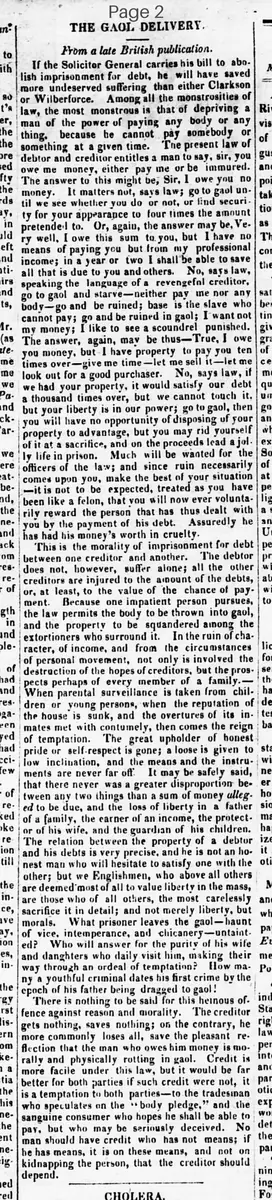
THE GAOL DELIVERY.
From a late British publication.
If the Solicitor General carries his bill to abolish imprisonment for debt, he will have saved more undeserved suffering than either Clarkson or Wilberforce. Among all the monstrosities of law, the most monstrous is that of depriving a man of the power of paying any body or any thing, because he cannot pay somebody or something at a given time. The present law of debtor and creditor entitles a man to say, sir, you owe me money, either pay me or be immured. The answer to this might be; Sir, I owe you no money. It matters not, says law; go to gaol until we see whether you do or not, or find security for your appearance to four times the amount pretended to. Or, again, the answer may be, Very well, I owe this sum to you, but I have no means of paying you but from my professional income; in a year or two I shall be able to save all that is due to you and others. No, says law, speaking the language of a revengeful creditor, go to gaol and starve—neither pay me nor any body—go and be ruined; base is the slave who cannot pay; go and be ruined in gaol; I want not my money; I like to see a scoundrel punished. The answer, again, may be thus—True, I owe you money, but—I have property to pay you ten times over—give me time—let me sell it—let me look out for a good purchaser. No, says law, if we had your property, it would satisfy our debt a thousand times over, but we cannot touch it. but your liberty is in our power; go to gaol, then you will have no opportunity of disposing of your property to advantage, but you may rid yourself of it at a sacrifice, and on the proceeds lead a jolly life in prison. Much will be wanted for the officers of the law; and since ruin necessarily comes upon you, make the best of your situation—it is not to be expected, treated as you have been like a felon, that you will now ever voluntarily reward the person that has thus dealt with you by the payment of his debt. Assuredly he has had his money's worth in cruelty.
This is the morality of imprisonment for debt between one creditor and another. The debtor does not, however, suffer alone; all the other creditors are injured to the amount of the debts, or, at least, to the value of the chance of payment. Because one impatient person pursues, the law permits the body to be thrown into gaol, and the property to be squandered among the extortioners who surround it. In the ruin of character, of income, and from the circumstances of personal movement, not only is involved the destruction of the hopes of creditors, but the prospects perhaps of every member of a family.—When parental surveillance is taken from children or young persons, when the reputation of the house is sunk, and the overtures of its inmates met with contumely, then comes the reign of temptation. The great upholder of honest pride or self-respect is gone; a loose is given to low inclination, and the means and the instruments are never far off. It may be safely said, that there never was a greater disproportion between any two things than a sum of money alleged to be due, and the loss of liberty in a father of a family, the earner of an income, the protector of his wife, and the guardian of his children.
The relation between the property of a debtor and his debts is very precise, and he is not an honest man who will hesitate to satisfy one with the other; but we Englishmen, who above all others are deemed most of all to value liberty in the mass, are those who of all others, the most carelessly sacrifice it in detail; and not merely liberty, but morals. What prisoner leaves the gaol—haunt of vice, intemperance, and chicanery—untainted? Who will answer for the purity of his wife and daughters who daily visit him, making their way through an ordeal of temptation? How many a youthful criminal dates his first crime by the epoch of his father being dragged to gaol!
There is nothing to be said for this heinous offence against reason and morality. The creditor gets nothing, saves nothing; on the contrary, he more commonly loses all, save the pleasant reflection that the man who owes him money is morally and physically rotting in gaol. Credit is more facile under this law, but it would be far better for both parties if such credit were not, it is a temptation to both parties—to the tradesman who speculates on the "body pledge," and the sanguine consumer who hopes he shall be able to pay, but who may be seriously deceived. No man should have credit who has not means: if he has means, it is on these means, and not on kidnapping the person, that the creditor should depend.
From a late British publication.
If the Solicitor General carries his bill to abolish imprisonment for debt, he will have saved more undeserved suffering than either Clarkson or Wilberforce. Among all the monstrosities of law, the most monstrous is that of depriving a man of the power of paying any body or any thing, because he cannot pay somebody or something at a given time. The present law of debtor and creditor entitles a man to say, sir, you owe me money, either pay me or be immured. The answer to this might be; Sir, I owe you no money. It matters not, says law; go to gaol until we see whether you do or not, or find security for your appearance to four times the amount pretended to. Or, again, the answer may be, Very well, I owe this sum to you, but I have no means of paying you but from my professional income; in a year or two I shall be able to save all that is due to you and others. No, says law, speaking the language of a revengeful creditor, go to gaol and starve—neither pay me nor any body—go and be ruined; base is the slave who cannot pay; go and be ruined in gaol; I want not my money; I like to see a scoundrel punished. The answer, again, may be thus—True, I owe you money, but—I have property to pay you ten times over—give me time—let me sell it—let me look out for a good purchaser. No, says law, if we had your property, it would satisfy our debt a thousand times over, but we cannot touch it. but your liberty is in our power; go to gaol, then you will have no opportunity of disposing of your property to advantage, but you may rid yourself of it at a sacrifice, and on the proceeds lead a jolly life in prison. Much will be wanted for the officers of the law; and since ruin necessarily comes upon you, make the best of your situation—it is not to be expected, treated as you have been like a felon, that you will now ever voluntarily reward the person that has thus dealt with you by the payment of his debt. Assuredly he has had his money's worth in cruelty.
This is the morality of imprisonment for debt between one creditor and another. The debtor does not, however, suffer alone; all the other creditors are injured to the amount of the debts, or, at least, to the value of the chance of payment. Because one impatient person pursues, the law permits the body to be thrown into gaol, and the property to be squandered among the extortioners who surround it. In the ruin of character, of income, and from the circumstances of personal movement, not only is involved the destruction of the hopes of creditors, but the prospects perhaps of every member of a family.—When parental surveillance is taken from children or young persons, when the reputation of the house is sunk, and the overtures of its inmates met with contumely, then comes the reign of temptation. The great upholder of honest pride or self-respect is gone; a loose is given to low inclination, and the means and the instruments are never far off. It may be safely said, that there never was a greater disproportion between any two things than a sum of money alleged to be due, and the loss of liberty in a father of a family, the earner of an income, the protector of his wife, and the guardian of his children.
The relation between the property of a debtor and his debts is very precise, and he is not an honest man who will hesitate to satisfy one with the other; but we Englishmen, who above all others are deemed most of all to value liberty in the mass, are those who of all others, the most carelessly sacrifice it in detail; and not merely liberty, but morals. What prisoner leaves the gaol—haunt of vice, intemperance, and chicanery—untainted? Who will answer for the purity of his wife and daughters who daily visit him, making their way through an ordeal of temptation? How many a youthful criminal dates his first crime by the epoch of his father being dragged to gaol!
There is nothing to be said for this heinous offence against reason and morality. The creditor gets nothing, saves nothing; on the contrary, he more commonly loses all, save the pleasant reflection that the man who owes him money is morally and physically rotting in gaol. Credit is more facile under this law, but it would be far better for both parties if such credit were not, it is a temptation to both parties—to the tradesman who speculates on the "body pledge," and the sanguine consumer who hopes he shall be able to pay, but who may be seriously deceived. No man should have credit who has not means: if he has means, it is on these means, and not on kidnapping the person, that the creditor should depend.
What sub-type of article is it?
Legal Commentary
Social Critique
What themes does it cover?
Justice
Misfortune
Moral Virtue
What keywords are associated?
Imprisonment For Debt
Legal Reform
Debtor Rights
Creditor Injustice
Family Ruin
Moral Decay
What entities or persons were involved?
Solicitor General
Clarkson
Wilberforce
Where did it happen?
Britain
Story Details
Key Persons
Solicitor General
Clarkson
Wilberforce
Location
Britain
Story Details
Critique of imprisonment for debt law, arguing it prevents repayment, ruins debtors and families, harms other creditors, and promotes immorality; calls for abolition to protect liberty and morals.