Thank you for visiting SNEWPapers!
Sign up free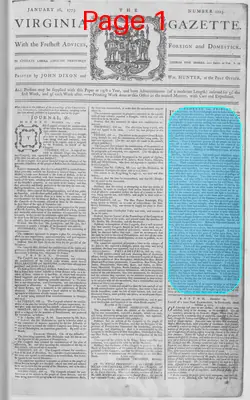
Editorial
January 28, 1775
The Virginia Gazette
Richmond, Williamsburg, Richmond County, Virginia
What is this article about?
Editorial warns monarchs of risks from corrupt ministers who betray both ruler and people, illustrated by the suicide of China's last Emperor Junchin amid rebellion sparked by ministerial oppression and treachery.
Clipping
OCR Quality
98%
Excellent
Full Text
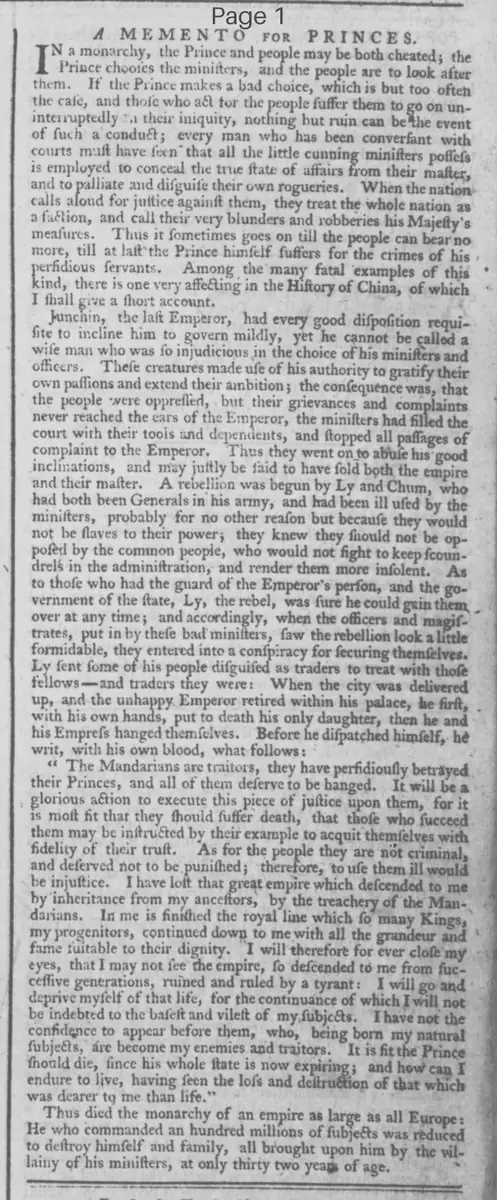
A MEMENTO FOR PRINCES.
IN a monarchy, the Prince and people may be both cheated; the Prince chooses the ministers, and the people are to look after them. If the Prince makes a bad choice, which is but too often the case, and those who act for the people suffer them to go on uninterruptedly in their iniquity, nothing but ruin can be the event of such a conduct; every man who has been conversant with courts must have seen that all the little cunning ministers possess is employed to conceal the true state of affairs from their master, and to palliate and disguise their own rogueries. When the nation calls aloud for justice against them, they treat the whole nation as a faction, and call their very blunders and robberies his Majesty's measures. Thus it sometimes goes on till the people can bear no more, till at last the Prince himself suffers for the crimes of his perfidious servants. Among the many fatal examples of this kind, there is one very affecting in the History of China, of which I shall give a short account.
Junchin, the last Emperor, had every good disposition requisite to incline him to govern mildly, yet he cannot be called a wise man who was so injudicious in the choice of his ministers and officers. These creatures made use of his authority to gratify their own passions and extend their ambition; the consequence was, that the people were oppressed, but their grievances and complaints never reached the ears of the Emperor, the ministers had filled the court with their tools and dependents, and stopped all passages of complaint to the Emperor. Thus they went on to abuse his good inclinations, and may justly be said to have sold both the empire and their master. A rebellion was begun by Ly and Chum, who had both been Generals in his army, and had been ill used by the ministers, probably for no other reason but because they would not be slaves to their power; they knew they should not be opposed by the common people, who would not fight to keep scoundrels in the administration, and render them more insolent. As to those who had the guard of the Emperor's person, and the government of the state, Ly, the rebel, was sure he could gain them over at any time; and accordingly, when the officers and magistrates, put in by these bad ministers, saw the rebellion look a little formidable, they entered into a conspiracy for securing themselves. Ly sent some of his people disguised as traders to treat with those fellows—and traders they were: When the city was delivered up, and the unhappy Emperor retired within his palace, he first, with his own hands, put to death his only daughter, then he and his Empress hanged themselves. Before he dispatched himself, he writ, with his own blood, what follows:
"The Mandarins are traitors, they have perfidiously betrayed their Prince, and all of them deserve to be hanged. It will be a glorious action to execute this piece of justice upon them, for it is most fit that they should suffer death, that those who succeed them may be instructed by their example to acquit themselves with fidelity of their trust. As for the people they are not criminal, and deserved not to be punished; therefore, to use them ill would be injustice. I have lost that great empire which descended to me by inheritance from my ancestors, by the treachery of the Mandarins. In me is finished the royal line which so many Kings, my progenitors, continued down to me with all the grandeur and fame suitable to their dignity. I will therefore for ever close my eyes, that I may not see the empire, so descended to me from successive generations, ruined and ruled by a tyrant: I will go and deprive myself of that life, for the continuance of which I will not be indebted to the basest and vilest of my subjects. I have not the confidence to appear before them, who, being born my natural subjects, are become my enemies and traitors. It is fit the Prince should die, since his whole state is now expiring; and how can I endure to live, having seen the loss and destruction of that which was dearer to me than life."
IN a monarchy, the Prince and people may be both cheated; the Prince chooses the ministers, and the people are to look after them. If the Prince makes a bad choice, which is but too often the case, and those who act for the people suffer them to go on uninterruptedly in their iniquity, nothing but ruin can be the event of such a conduct; every man who has been conversant with courts must have seen that all the little cunning ministers possess is employed to conceal the true state of affairs from their master, and to palliate and disguise their own rogueries. When the nation calls aloud for justice against them, they treat the whole nation as a faction, and call their very blunders and robberies his Majesty's measures. Thus it sometimes goes on till the people can bear no more, till at last the Prince himself suffers for the crimes of his perfidious servants. Among the many fatal examples of this kind, there is one very affecting in the History of China, of which I shall give a short account.
Junchin, the last Emperor, had every good disposition requisite to incline him to govern mildly, yet he cannot be called a wise man who was so injudicious in the choice of his ministers and officers. These creatures made use of his authority to gratify their own passions and extend their ambition; the consequence was, that the people were oppressed, but their grievances and complaints never reached the ears of the Emperor, the ministers had filled the court with their tools and dependents, and stopped all passages of complaint to the Emperor. Thus they went on to abuse his good inclinations, and may justly be said to have sold both the empire and their master. A rebellion was begun by Ly and Chum, who had both been Generals in his army, and had been ill used by the ministers, probably for no other reason but because they would not be slaves to their power; they knew they should not be opposed by the common people, who would not fight to keep scoundrels in the administration, and render them more insolent. As to those who had the guard of the Emperor's person, and the government of the state, Ly, the rebel, was sure he could gain them over at any time; and accordingly, when the officers and magistrates, put in by these bad ministers, saw the rebellion look a little formidable, they entered into a conspiracy for securing themselves. Ly sent some of his people disguised as traders to treat with those fellows—and traders they were: When the city was delivered up, and the unhappy Emperor retired within his palace, he first, with his own hands, put to death his only daughter, then he and his Empress hanged themselves. Before he dispatched himself, he writ, with his own blood, what follows:
"The Mandarins are traitors, they have perfidiously betrayed their Prince, and all of them deserve to be hanged. It will be a glorious action to execute this piece of justice upon them, for it is most fit that they should suffer death, that those who succeed them may be instructed by their example to acquit themselves with fidelity of their trust. As for the people they are not criminal, and deserved not to be punished; therefore, to use them ill would be injustice. I have lost that great empire which descended to me by inheritance from my ancestors, by the treachery of the Mandarins. In me is finished the royal line which so many Kings, my progenitors, continued down to me with all the grandeur and fame suitable to their dignity. I will therefore for ever close my eyes, that I may not see the empire, so descended to me from successive generations, ruined and ruled by a tyrant: I will go and deprive myself of that life, for the continuance of which I will not be indebted to the basest and vilest of my subjects. I have not the confidence to appear before them, who, being born my natural subjects, are become my enemies and traitors. It is fit the Prince should die, since his whole state is now expiring; and how can I endure to live, having seen the loss and destruction of that which was dearer to me than life."
What sub-type of article is it?
Moral Or Religious
What keywords are associated?
Monarchy
Treacherous Ministers
Chinese Emperor
Betrayal
Rebellion
Suicide
Fidelity
Governance
What entities or persons were involved?
Junchin
Ly
Chum
Mandarins
Editorial Details
Primary Topic
Warning To Princes About Treacherous Ministers Using Chinese History
Stance / Tone
Cautionary Moral Exhortation
Key Figures
Junchin
Ly
Chum
Mandarins
Key Arguments
In Monarchy, Prince Chooses Ministers But People Must Oversee Them
Bad Ministers Conceal Affairs And Disguise Rogueries From The Prince
Ministers Treat Public Outcry As Factionalism And Attribute Errors To The Prince
Example Of Chinese Emperor Junchin Betrayed By Ministers Leading To Rebellion And Suicide
Mandarins Are Traitors Deserving Death To Instruct Successors In Fidelity
People Are Innocent And Should Not Be Punished
Emperor Suicides To Avoid Seeing Empire Ruined By Tyrants