Thank you for visiting SNEWPapers!
Sign up free
The Anaconda Standard
Anaconda, Deer Lodge County, Montana
What is this article about?
In Philadelphia on Oct. 3, 1898, warrants are issued for U.S. Senator Matthew Stanley Quay and associates, charging conspiracy to misuse state funds for stock speculation via the failed People's Bank. They surrender, post $5,000 bail each, and return to Atlantic City amid claims of political persecution during a senate election campaign.
Clipping
OCR Quality
Full Text
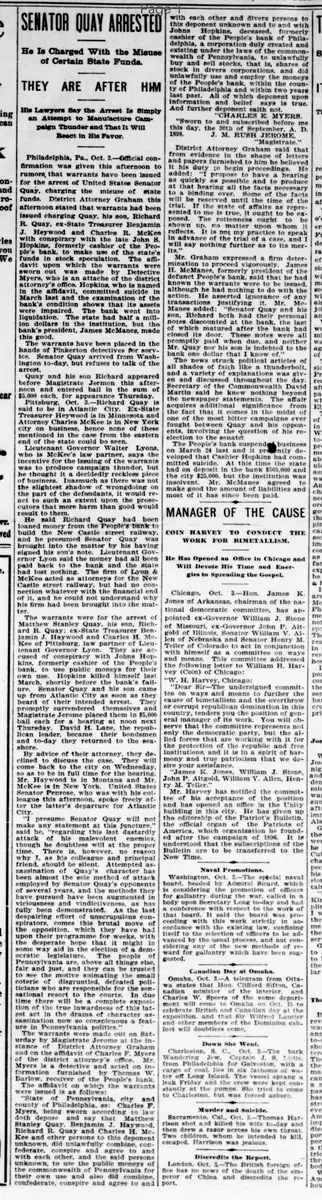
THEY ARE AFTER HIM
His Lawyers Say the Arrest Is Simply an Attempt to Manufacture Campaign Thunder and That It Will React in His Favor.
Philadelphia, Pa., Oct. 3.-Official confirmation was given this afternoon to rumors that warrants have been issued for the arrest of United States Senator Quay, charging the misuse of state funds. District Attorney Graham this afternoon stated that warrants had been issued charging Quay, his son, Richard R. Quay, ex-State Treasurer Benjamin J. Heywood and Charles R. McKee with conspiracy with the late John S. Hopkins, formerly cashier of the People's bank, to make use of the state's funds in stock speculation. The affidavit upon which the warrants were sworn out was made by Detective Myers, who is an attache of the district attorney's office. Hopkins, who is named in the affidavit, committed suicide in March last and the examination of the bank's condition shows that its assets were impaired. The bank went into liquidation. The state had half a million dollars in the institution, but the bank's president, James McManes, made this good.
The warrants have been placed in the hands of Pinkerton detectives for service. Senator Quay arrived from Washington to-day, but refuses to talk of the arrest.
Quay and his son Richard appeared before Magistrate Jermon this afternoon and entered bail in the sum of $5,000 each, for appearance Thursday.
Pittsburg, Oct. 3.-Richard Quay is said to be in Atlantic City. Ex-State Treasurer Heywood is in Minnesota and Attorney Charles McKee is in New York city on business, hence none of these mentioned in the case from the eastern end of the state could be seen.
Lieutenant Governor Walter Lyons who is McKee's law partner, says the incentive for the issuing of the warrants was to produce campaign thunder, but he thought it a decidedly reckless piece of business. Inasmuch as there was not the slightest shadow of wrongdoing on the part of the defendants, it would react to such an extent upon the prosecutors that more harm than good would result to them.
He said Richard Quay had been loaned money from the People's bank to build the New Castle street railway, and he presumed Senator Quay was brought into the matter by his having signed his son's note. Lieutenant Governor Lyon said the money had all been paid back to the bank and the state had lost nothing. The firm of Lyon & McKee acted as attorneys for the New Castle street railway, but had no connection whatever with the financial end of it, and he could not understand why his firm had been brought into the matter.
The warrants were for the arrest of Matthew Stanley Quay, his son, Richard R. Quay; ex-State Treasurer Benjamin J. Haywood and Charles H. McKee of Pittsburg, law partner of Lieutenant Governor Lyon. They are accused of conspiracy with Johns Hopkins, formerly cashier of the People's bank, to use public moneys for their own use. Hopkins killed himself last March, shortly before the bank's failure. Senator Quay and his son came up from Atlantic City as soon as they heard of their intended arrest. They promptly surrendered themselves and Magistrate Jerome placed them in $5,000 bail each for a hearing at noon next Thursday. David H. Lane, the republican leader, became their bondsmen and to-day they returned to the seashore.
By advice of their attorney, they declined to discuss the case. They will come back to the city on Wednesday, so as to be in full time for the hearing.
Mr. Haywood is in Montana and Mr. McKee is in New York. United States Senator Penrose, who was with his colleague this afternoon, spoke freely after the latter's departure for Atlantic City.
"I presume Senator Quay will not make any statement at this juncture," said he, "regarding this last dastardly attack of his malevolent enemies, though he doubtless will at the proper time. There is, however, no reason why I, as his colleague and principal friend, should be silent. Attempted assassination of Quay's character has been almost the sole method of attack employed by Senator Quay's opponents of several years, and the methods they have pursued have been augmented in viciousness and vindictiveness, as has fully been demonstrated. As the last despairing effort of unscrupulous conspirators, comes this brutal move of the opposition, which they have had upon their programme for weeks, with the desperate hope that it might in some way aid in the election of a democratic legislature.
The people of Pennsylvania are, above all things else, fair and just, and they can be trusted to see the motive animating the small coterie of disgruntled, defeated politicians who are responsible for the sensational resort to the courts. In due time there will be a complete exposition of the true inwardness of this latest act in the drama of character assassination now so conspicuous a feature in Pennsylvania politics."
The warrants were made out on Saturday by Magistrate Jerome at the instance of District Attorney Graham and on the affidavit of Charles F. Myers of the district attorney's office. Mr. Myers is a detective and acted on information furnished by Thomas W. Barlow, receiver of the People's bank.
The affidavit on which the warrants were issued is as follows:
"State of Pennsylvania, city and county of Philadelphia, ss: Charles F. Myers, being sworn according to law doth depose and say that Matthew Stanley Quay, Benjamin J. Haywood, Richard R. Quay and Charles H. McKee and other persons to this deponent unknown, did unlawfully combine, confederate, conspire and agree to and with each other, and the said persons unknown, to use the public moneys of the commonwealth of Pennsylvania for their own use and also did combine, confederate, conspire and agree to and with each other and divers persons to this deponent unknown and to and with Johns Hopkins, deceased, formerly cashier of the People's bank of Philadelphia, a corporation duly created and existing under the laws of the commonwealth of Pennsylvania, to unlawfully buy and sell stocks, that is, shares of stock in divers corporations, and did unlawfully use and employ the moneys of the People's bank, within the county of Philadelphia and within two years last past. All of which deponent upon information and belief says is true.
And further deponent saith not.
"CHARLES E. MYERS.
"Sworn to and subscribed before me this day, the 30th of September, A. D. 1898.
J. M. RUSH JEROME.
"Magistrate."
District Attorney Graham said that from evidence in the shape of letters and papers furnished to him he believed it his duty to begin proceedings. He added: "I propose to have a hearing as quickly as possible and to produce at that hearing all the facts necessary to a binding over. Some of the facts will be reserved until the time of the trial. If the state of affairs as represented to me is true, it ought to be exposed. The rottenness ought to be shown up, no matter upon whom it reflects. It is not my practice to speak in advance of the trial of a case, and I will say nothing further as to its merits."
Mr. Graham expressed a firm determination to proceed vigorously. James H. McManes, formerly president of the defunct People's bank, said that he had known the warrants were to be issued, although he had nothing to do with the action. He asserted ignorance of any transactions justifying it. Mr. McManes added: "Senator Quay and his son, Richard both had their personal notes discounted at the bank, the last of which matured after the bank had closed its door. These notes were all promptly paid when due, and neither Mr. Quay nor his son is indebted to the bank one dollar that I know of."
The news struck political circles of all shades of faith like a thunderbolt, and a variety of explanations was given and discussed throughout the day. Secretary of the Commonwealth David Martin said he knew nothing beyond the newspaper statements. The affair acquires additional significance from the fact that it comes in the midst of one of the most bitter campaigns ever fought between Quay and his opponents, involving the question of his re-election to the senate!
The People's bank suspended business on March 24 last and it presently developed that Cashier Hopkins had committed suicide. At this time the state had on deposit in the bank $505,000 and the city $25,000, but the institution was insolvent. Mr. McManes agreed to make good the amount of liabilities and most of it has since been paid.
What sub-type of article is it?
What themes does it cover?
What keywords are associated?
What entities or persons were involved?
Where did it happen?
Story Details
Key Persons
Location
Philadelphia, Pa.
Event Date
1898 10 03
Story Details
Warrants issued for arrest of U.S. Senator Matthew Stanley Quay, his son Richard R. Quay, ex-State Treasurer Benjamin J. Heywood, and Charles R. McKee for conspiracy with deceased bank cashier Johns Hopkins to misuse state funds in stock speculation at People's Bank. They post bail; political motivations alleged amid campaign.