Thank you for visiting SNEWPapers!
Sign up free
Gazette Of The United States, & Philadelphia Daily Advertiser
Philadelphia, Philadelphia County, Pennsylvania
What is this article about?
U.S. House of Representatives proceedings on Thursday, June 8: Passed bill preventing arms/ammunition export (79-8); advanced privateer fitting ban; appointed committees for prohibiting U.S. citizens on foreign warships and prize resales; deferred artillerists bill; proposed British debts agent; debated and rejected arming merchant vessels for East Indies/Mediterranean/West Indies (votes: 35-46, 41-40, etc.).
Clipping
OCR Quality
Full Text
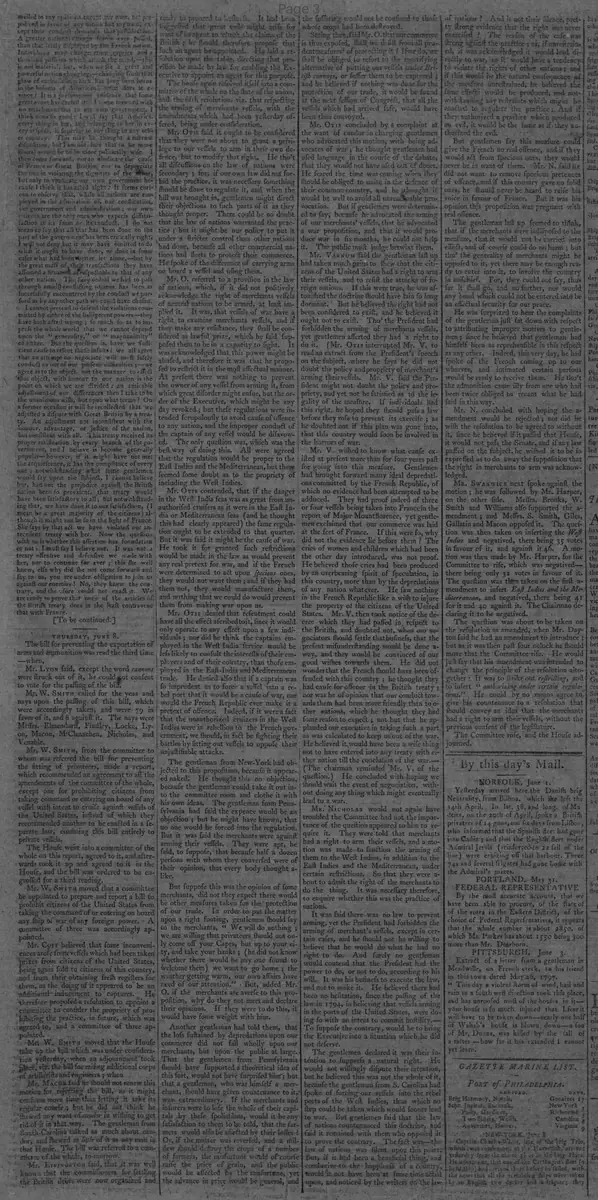
The bill for preventing the exportation of arms and ammunition was read the third time—when,
Mr. Lyon said, except the word cannons were struck out of it, he could not consent to vote for the passing of the bill.
Mr. W. Smith called for the yeas and nays upon the passing of this bill, which were accordingly taken, and were 79 in favor of it, and 8 against it. The nays were Mess. Elmendorff, Findley, Locke, Lyon, Macon, M'Clenachan, Nicholas, and Venable.
Mr. W. Smith, from the committee to whom was referred the bill for preventing the fitting of privateers, made a report, which recommended an agreement to all the amendments of the committee of the whole, except one for prohibiting citizens from taking command or entering on board of any vessel with intent to cruise against vessels of the United States, instead of which they recommended another to be enacted in a separate law, confining this bill entirely to private vessels.
The House went into a committee of the whole on this report, agreed to it, and afterwards took it up and agreed to it in the House, and the bill was ordered to be engrossed for a third reading.
Mr. W. Smith moved that a committee be appointed to prepare and report a bill to prohibit citizens of the United States from taking the command of or entering on board any ship of war of any foreign power. A committee of three was accordingly appointed.
Mr. Claiborne believed that some inconveniences arose from vessels which had been taken prizes from citizens of the United States, being again sold to citizens of this country, and from their obtaining fresh registers for them, as the doing of it appeared to be an additional inducement to captures. He therefore proposed a resolution to appoint a committee to consider the propriety of prohibiting the practice, in future, which was agreed to, and a committee of three appointed.
Mr. W. Smith moved that the House take up the bill which was under consideration yesterday, when an adjournment took place, viz. the bill for raising additional corps of artillerists and engineers ; when
Mr. Macon said he should not renew this motion for rejecting the bill, as it might consume more time than letting it take its regular course.; but he did not think he showed any want of candor in wishing to get rid of it in that way. The gentleman from South-Carolina talked as much about candor, and showed as little of it as any man in that House. The bill was referred to a committee of the whole, to-morrow.
Mr. Livingston said, that it was well known that the commissioners for settling the British debts were now organized and ready to proceed to business. It had been suggested that great evils might arise for want of an agent to check the claims of the British ; he should, therefore propose that such an agent be appointed. He laid a resolution upon the table, directing that provision be made by law for enabling the Executive to appoint an agent for this purpose.
The house again resolved itself into a committee of the whole on the state of the union, and the fifth resolution. viz. that respecting the arming of merchants vessels, with the amendments which had been yesterday offered, being under consideration.
Mr. Otis said it ought to be considered that they were not about to grant. a privilege to our vessels to arm in their own defence, but to modify that right. He tho't all discussions on the law of nations were secondary ; for, if our own law did not forbid the practice, it was necessary something should be done to regulate it, and when the bill was brought in, gentlemen might direct their objections to such parts of it as they thought proper. . There could be no doubt that the law of nations warranted the practice ; but it might. be our policy to put it under a stricter control than other nations had done, because all other commercial nations had fleets to protect their commerce.
He spoke of the difference of carrying arms on board a vessel and using them.
Mr. O. referred to a provision in the law of nations, which, if it did not positively acknowledge the right of merchants vessels of neutral nations to be armed, at least implied it. It was, that vessels of war have a right to examine merchants vessels, and if they make any resistance, they shall be considered as lawful prize, which he said 'upposed them to be in a capacity to fight. It was acknowledged that this power might be abused, and therefore it was that he proposed to restrict it in the most effectual manner.
At present there was nothing to prevent the owner of any vessel from arming it, from which great disorder might ensue, but the order of the Executive, which might be any day revoked ; but these regulations were intended scrupulously to avoid cause of offence to any nation, and the improper conduct of the captain of any vessel would be disavowed. The only question was, which was the best way of doing this. All were agreed that the regulation would be proper to the East Indies and the Mediterranean, but there seemed some doubt as to the propriety of including the West Indies.
Mr. Otis contended, that if the danger in the West India seas was as great from unauthorized cruisers as it were in the East India or Mediterranean seas (and he thought this had clearly appeared) the same regulation ought to be extended to that quarter.
But it was said it might be the cause of war. He took it for granted such restrictions would be made in the law as would prevent any real pretext for war, and if the French were determined to act upon fictitious ones, they would not want them ; and if they had them not, they would manufacture them, and nothing that we could do would prevent them from making war upon us.
Mr. Otis denied that resentment could have all the effect ascribed to it, since it would only operate to any effect upon a few individuals; nor did he think the captains employed in the West India service would be less likely to consult the interests of their employers and of their country, than those employed in the East-India and Mediterranean trade. He denied also that if a captain was so imprudent as to force a vessel into a rebel port that it would be a cause of war, nor would the French Republic ever make it a pretext of offence. Indeed, if it were a fact that the unauthorized cruizers in the West Indies were in rebellion to the French government, we should, in fact be fighting their battles by setting out vessels to oppose their unjustifiable attacks.
The gentleman from New-York had objected to this proposition, because it appeared naked. He thought this no objection, because the gentleman could take it out into the committee room and clothe it with his own ideas. The gentleman from Pennsylvania had said the expence would be an objection ; but he might have known, that no one would be forced into the regulation.
But it was said the merchants were against arming their vessels. They were apt, he said, to suppose, ' that because half a dozen persons with whom they conversed were of their opinion, that every body thought alike. But suppose this was the opinion of some merchants, did not they expect there would be other measures taken for the protection of our trade. In order to put the matter upon a right footing, gentlemen should say to the merchants, "We will do nothing; we are willing that privateers should not only come off your Capes, but up to your city, and take your banks; (he did not know whether there would be any one found to welcome them) we want to go home ; the weather getting warm, our own affairs have need of our attention." . But, added Mr. O. if the merchants are averse to this proposition, why do they not meet and declare their opinions. If they were to do this, it would have one weight with him.
Another gentleman had told them, that the loss sustained by depredations upon our commerce did not fall wholly upon our merchants, but upon the public at large. That the gentlemen from Pennsylvania should have supported a theoretical idea of this sort, would not have surprised him; but that a gentleman, who was himself a merchant, should have given countenance to it, was extraordinary. If the merchants and insurers were to lose the whole of their capitals by these spoliations, would it be any satisfaction to them to be told, that the farmers would also be affected by their losses ? Or, if the matter was reversed, and a mildew should destroy the crops of a number of farmers, the misfortune would of course raise the price of grain, and the public would be affected by the misfortune, yet the advance in price would be general, and the suffering would not be confined to those whose crops had been destroyed.
Seeing then, said Mr. O. that our commerce is thus exposed, shall we desist from all prudent measures of protecting it ? If we do, we shall be obliged to resort to the mortifying alternative of putting our vessels under British convoys, or suffer them to be captured ; and he believed if nothing was done for the protection of our trade, it would be found at the next session of Congress, that all the vessels which had arrived safe, would have been thus convoyed.
Mr. Otis concluded by a complaint at the want of candor in charging gentlemen who advocated this motion, with being advocates of war ; he thought gentlemen had used language in the course of the debate, that they would not have used out of doors. He feared the time was coming when they should be obliged to unite in the defence of their common country, and he thought it would be well to avoid all unreasonable provocation. But if gentlemen were determined to say, because he advocated the arming of our merchants' vessels, that he advocated a war proposition, and that it would produce war in six months, he could not help it. The public must judge betwixt them.
Mr. Varnum said the gentleman last up had taken much pains to show that the citizens of the United States had a right to arm their vessels, and to resist the attacks of foreign nations. If this were true, he was astonished the doctrine should have lain so long dormant. ' But he believed the right had not been considered to exist, and he believed it ought not to exist. Tho' the President had forbidden the arming of merchants vessels, yet gentlemen asserted they had a right to do it. (Mr. Otis interrupted Mr. V. to read an extract from the President's speech on the subject, where he says he did not doubt the policy and propriety of merchant's arming their vessels. Mr. V. said the President might not doubt the policy and propriety, and yet not be satisfied as to the legality of the measure. If individuals had this right, he hoped they should pass a law before they rose to prevent its exercise ; as he doubted not if this plan was gone into, that this country would soon be involved in the horrors of war.
Mr. V. wished to know what cause existed at present more than for four years past for going into this measure. Gentlemen had brought forward many ideal depredations committed by the French Republic, of which no evidence had been attempted to be adduced. They had proof indeed of three or four vessels being taken into France in the report of Major Mountflorence, yet gentlemen exclaimed that our commerce was laid at the feet of France. If this were so, why did not the evidence lie before them ? The cries of women and children which had been the other day introduced, was not proof. He believed those cries had been produced by an overbearing spirit of speculation, in this country, more than by the depredations of any nation whatever. He saw nothing in the French Republic like a wish to injure the property of the citizens of the United States. Mr. V. then took notice of the decree which they had passed in respect to the British, and doubted not, when our negotiators should settle that business, that the present misunderstanding would be done away, and they would be convinced of our good wishes towards them. He did not wonder that the French should have been offended with this country ; he thought they had cause for offense in the British treaty; nor was he of opinion that our conduct towards them had been more friendly than to other nations, which he thought they had some reason to expect ; not but that he applauded our executive in taking such a part as was calculated to keep us out of the war. He believed it would have been a wise thing not to have entered into any treaty with either nation till the conclusion of the war.— (The chairman reminded Mr. V. of the question.) He concluded with hoping we should wait the event of negotiation, without doing any thing which might eventually lead to a war..
Mr. Nicholas would not again have troubled the Committee had not the importance of the question appeared to him to require it. They were told that merchants had a right—to arm their vessels, and a motion was made to sanction the arming of them to the West Indies, in addition to the East Indies and the Mediterranean, under certain restrictions. So that they were about to admit the right of the merchants to do the thing. It was necessary therefore, to enquire whether this was the practice of nations.
It was said there was no law to prevent arming, yet the President had forbidden the arming of merchant's vessels, except in certain cases, and he should not be willing to believe that he would do what he had no right to do. And surely no gentleman would contend that the President had the power to do, or not to do, according to his will. It was his business to execute the law, and not to make it. He believed there had been no hesitation, since the passing of the law in 1794, in believing that vessels arming in the ports of the United States, were doing so with an intent to commit hostility.- To suppose the contrary, would be to bring the Executive into a situation which he did not deserve.
The gentlemen declared it was their intention to suppress a natural right. , He would not willingly dispute their intention, but he believed this was not the whole of it, because the gentleman from S. Carolina had spoke of forcing our vessels into the rebel ports of the West Indies, than which no step could be taken which would sooner lead to war. But gentlemen said that the law of nations countenanced this doctrine, and said it remained with them who opposed it to prove the contrary. The fact was—the law of nations was silent upon this point.
But, if it had been a beneficial thing, and conducive to the happiness of a country, would it not have been at some time acted upon, and noticed by the writers on the law of nations ? And is not their silence, pretty strong evidence that the right was never exercised ? The reason of the case was strong against the practice ; as, if unrestrained it was acknowledged it would lead directly to war, as it would have a tendency to violate the rights of other nations; and if this would be the natural consequence of the measure unrestrained, he believed the same effects would be produced, and notwithstanding any restraints which might be enacted to regulate the practice: And if they authorized a practice which produced an evil, it would be the same as if they authorized the evil.
But gentlemen say this measure could give the French no real offence, and if they would act from fictitious ones, they would never be in want of them. Mr. N. said he did not want to remove fictitious pretences of offence, and if this country gave no solid ones, he should never be heard to raise his voice in favour of France. But it was his opinion this proposition was pregnant with real offence.
The gentleman last up seemed to think, that if the merchants were indisposed to the measure, that it would not be carried into effect, and of course could do no harm ; but tho' the generality of merchants might be opposed to it, yet there may be enough ready to enter into it, to involve the country in mischief. For, they could not say, thus far it shall go, and no farther, nor would any bond which could not be entered into be an effectual security for our peace.
He was surprised to hear the complaints of the gentleman just sat down with respect to attributing improper motives to gentlemen; since he believed that gentleman had himself been as reprehensible in this respect as any other. Indeed, this very day, he had spoke of the French coming up to our wharves, and intimated certain persons would be ready to receive them. He tho't the admonition came ill from one who had been twice obliged to recant what he had said in this way.
Mr. N. concluded with hoping the amendment would be rejected; nor did he wish the resolution to be agreed to without it, since he believed if it passed that House, it would not pass the Senate, and if any law passed on the subject, he wished it to be so expressed as to do away the supposition that the right in merchants to arm was acknowledged.
Mr. Swanwick next spoke against the motion ; he was followed by Mr. Harper, on the other side. Mess. Brooks, W. Smith and Williams also supported the amendment ; and Mess. S. Smith, Giles, Gallatin and Macon opposed it. The question was then taken on inserting the West Indies and negatived, there being 35 votes in favour of it, and against it 46. A motion was then made by Mr. Harper, for the Committee to rise, which was negatived— there being only 32 votes in favour of it.
The question was then taken on the first amendment to insert East Indies and the Mediterranean, and negatived, there being 41 for it and 40 against it. The Chairman declaring it to be negatived.
The question was about to be taken on the resolution as amended, when Mr. Dayton said he had an amendment to introduce ; but as it was then past four oclock he should move that the Committee rise. He would just say that his amendment was intended to change the principle of the resolution altogether : It was to strike out restricting, and to insert " authorizing under certain regulations." He could by no means agree to give his countenance to a resolution that should convey an idea that the merchants had a right to arm their vessels, without the previous consent of the legislature.
The Committee rose, and the House adjourned.
What sub-type of article is it?
What keywords are associated?
What entities or persons were involved?
Where did it happen?
Domestic News Details
Primary Location
United States House Of Representatives
Event Date
Thursday, June 8.
Key Persons
Outcome
arms export bill passed 79-8; privateer bill advanced to third reading; committees appointed for prohibiting u.s. citizens on foreign warships and prize resales; artillerists bill referred to committee; british debts agent resolution tabled; arming merchant vessels resolution amendments for east indies, mediterranean, west indies rejected (35-46, 41-40); committee rose and house adjourned.
Event Details
House debates and votes on bills preventing arms export, privateer fitting, citizen service on foreign warships, prize resales, raising artillerists/engineers, appointing British debts agent, and regulating arming of merchant vessels for defense against French depredations, focusing on law of nations, risks of war, and merchant rights.