Thank you for visiting SNEWPapers!
Sign up free
The Tucson Citizen
Tucson, Pima County, Arizona
What is this article about?
An ancient Latin Bible manuscript from the late 9th century in England's Cottonian Library was used in royal coronations since around 1000 AD, predating Edward I's transfer of the Stone of Destiny. Owned by King Athelstan (925-940), it survived the 1731 Ashburnham House fire with damage.
Clipping
OCR Quality
Full Text
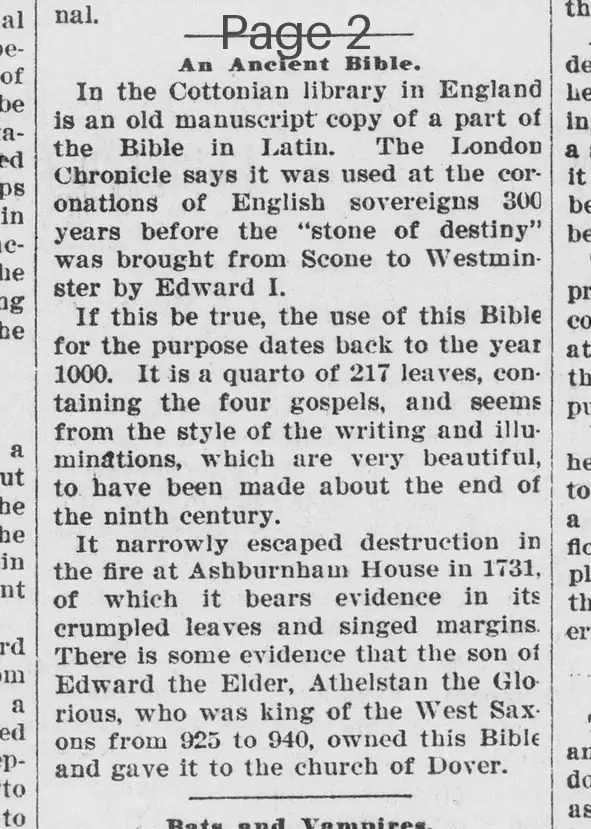
In the Cottonian library in England is an old manuscript copy of a part of the Bible in Latin. The London Chronicle says it was used at the coronations of English sovereigns 300 years before the "stone of destiny" was brought from Scone to Westminster by Edward I.
If this be true, the use of this Bible for the purpose dates back to the year 1000. It is a quarto of 217 leaves, containing the four gospels, and seems from the style of the writing and illuminations, which are very beautiful, to have been made about the end of the ninth century.
It narrowly escaped destruction in the fire at Ashburnham House in 1731, of which it bears evidence in its crumpled leaves and singed margins.
There is some evidence that the son of Edward the Elder, Athelstan the Glorious, who was king of the West Saxons from 925 to 940, owned this Bible and gave it to the church of Dover.
What sub-type of article is it?
What keywords are associated?
What entities or persons were involved?
Where did it happen?
Filler Details
Topic
Ancient Manuscript Bible Used In English Coronations
Location
Cottonian Library, England
Key Persons
Event Details
An old manuscript copy of part of the Bible in Latin in the Cottonian library was used at English sovereign coronations 300 years before Edward I brought the stone of destiny from Scone to Westminster, dating back to year 1000. It is a quarto of 217 leaves with the four gospels, made about the end of the ninth century, with beautiful illuminations. It escaped destruction in the 1731 Ashburnham House fire, showing crumpled leaves and singed margins. Athelstan, son of Edward the Elder and king of West Saxons from 925 to 940, owned it and gave it to the church of Dover.