Thank you for visiting SNEWPapers!
Sign up free
The Kennewick Courier Reporter
Kennewick, Benton County, Washington
What is this article about?
In this chapter of the serial 'The Wedding March Murder,' novelist Peter Cardigan and Sergeant Kilday interrogate bridesmaid Callis Shipley, who confesses initial lies due to fear for Rylie Carmody's involvement in groom Jim Franklin's murder. They discuss suspects like Webster Spears before interviewing politician Daniel Bullis, who admits confronting Franklin and seeing a blonde woman in blue arguing with him.
Merged-components note: Continuation of the serialized story 'The Wedding March Murder' across pages 6 and 9
Clippings
1 of 2
OCR Quality
Full Text
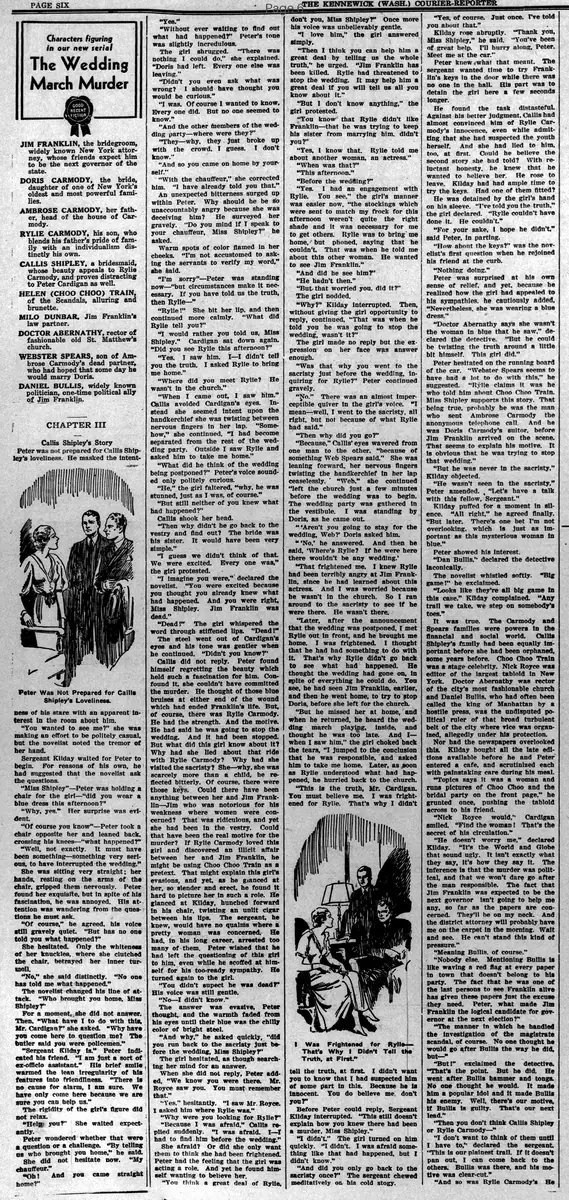
The Wedding March Murder
JIM FRANKLIN, the bridegroom, widely known New York attorney, whose friends expect him to be the next governor of the state.
DORIS CARMODY, the bride, daughter of one of New York's oldest and most powerful families.
AMBROSE CARMODY, her father, head of the house of Carmody.
RYLIE CARMODY, his son, who blends his father's pride of family with an individualism distinctly his own.
CALLIS SHIPLEY, a bridesmaid, whose beauty appeals to Rylie Carmody, and proves distracting to Peter Cardigan as well.
HELEN (CHOO CHOO) TRAIN, of the Scandals, alluring and brunette.
MILO DUNBAR, Jim Franklin's law partner.
DOCTOR ABERNATHY, rector of fashionable old St. Matthew's church.
WEBSTER SPEARS, son of Ambrose Carmody's dead partner, who had hoped that some day he would marry Doris.
DANIEL BULLIS, widely known politician, one-time political ally of Jim Franklin.
CHAPTER III
Callis Shipley's Story
Peter was not prepared for Callis Shipley's loveliness. He masked the intentness of his stare with an apparent interest in the room about him.
"You wanted to see me?" she was making an effort to be politely casual, but the novelist noted the tremor of her hand.
Sergeant Kilday waited for Peter to begin. For reasons of his own, he had suggested that the novelist ask the questions.
"Miss Shipley"—Peter was holding a chair for the girl—"did you wear a blue dress this afternoon?"
"Why, yes." Her surprise was evident.
"Of course you know"—Peter took a chair opposite her and leaned back, crossing his knees—"what happened?"
"Well, not exactly. It must have been something—something very serious, to have interrupted the wedding."
She was sitting very straight; her hands, resting on the arms of the chair, gripped them—nervously. Peter found her exquisite, but in spite of his fascination, he was annoyed. His attention was wandering from the questions he must ask.
"Of course," he agreed, his voice still gravely quiet. "But has no one told you what happened?"
She hesitated. Only the whiteness of her knuckles, where she clutched the chair, betrayed her inner turmoil.
"No," she said distinctly. "No one has told me what happened."
The novelist changed his line of attack. "Who brought you home, Miss Shipley?"
For a moment, she did not answer. Then, "What have I to do with this, Mr. Cardigan?" she asked. "Why have you come here to question me? The butler said you were policemen."
"Sergeant Kilday is." Peter indicated his friend. "I am just a sort of ex-officio assistant." His brief smile warmed the lean irregularity of his features into friendliness. "There is no cause for alarm, I am sure. We have only come here because we are sure you can help us."
The rigidity of the girl's figure did not relax.
"Help you?"
She waited expectantly.
Peter wondered whether that were a question or a challenge. "By telling us who brought you home," he said.
She did not hesitate now. "My chauffeur."
"Oh! And you came straight home?"
"without ever waiting to find out what had happened?" Peter's tone was slightly incredulous.
The girl shrugged.
"There was nothing I could do," she explained. "Doris had left. Every one else was leaving."
"Didn't you even ask what was wrong? I should have thought you would be curious."
"I was. Of course I wanted to know. Every one did. But no one seemed to know."
"And the other members of the wedding party—where were they?"
"They—why, they just broke up with the crowd, I guess. I don't know."
"And so you came on home by yourself."
With the chauffeur," she corrected him. "I have already told you that."
An unexpected bitterness surged up within Peter. Why should he be so unaccountably angry because she was deceiving him? He surveyed her gravely. "Do you mind if I speak to your chauffeur, Miss Shipley?" he asked.
Warm spots of color flamed in her cheeks. "I'm not accustomed to asking the servants to verify my word," she said.
"I'm sorry"—Peter was standing now—"but circumstances make it necessary. If you have told us the truth, then Rylie—"
"Rylie!" She bit her lip, and then continued more calmly. "What did Rylie tell you?"
"I would rather you told us, Miss Shipley." Cardigan sat down again. "Did you see Rylie this afternoon?"
"Yes. I saw him. I didn't tell you the truth. I asked Rylie to bring me home."
"Where did you meet Rylie? He wasn't in the church."
"When I came out. I saw him." Callis avoided Cardigan's eyes. Instead she seemed intent upon the handkerchief she was twisting between nervous fingers in her lap. "Somehow," she continued, "I had become separated from the rest of the wedding party. Outside I saw Rylie and asked him to take me home."
"What did he think of the wedding being postponed?" Peter's voice sounded only politely curious.
"He," the girl faltered, "why, he was stunned, just as I was, of course."
"But still neither of you knew what had happened?"
Callis shook her head.
"Then why didn't he go back to the vestry and find out? The bride was his sister. It would have been very simple."
"I guess we didn't think of that. We were excited. Every one was," the girl protested.
"I imagine you were," declared the novelist. "You were excited because you thought you already knew what had happened. And you were right, Miss Shipley.
Jim Franklin was dead."
"Dead!" The girl whispered the word through stiffened lips. "Dead!"
The steel went out of Cardigan's eyes and his tone was gentler when he continued. "Didn't you know?"
Callis did not reply. Peter found himself regretting the beauty which held such a fascination for him. Confound it, she couldn't have committed the murder. He thought of those blue bruises at either end of the wound which had ended Franklin's life. But of course, there was Rylie Carmody. He had the strength. And the motive. He had said he was going to stop the wedding. And it had been stopped.
But what did this girl know about it? Why had she lied about that ride with Rylie Carmody? Why had she visited the sacristy? She—why, she was scarcely more than a child, he reflected bitterly. Of course, there were those keys. Could there have been anything between her and Jim Franklin—Jim who was notorious for his weakness where women were concerned? That was ridiculous, and yet she had been in the vestry. Could that have been the real motive for the murder? If Rylie Carmody loved this girl and discovered an illicit affair between her and Jim Franklin, he might be using Choo Choo Train as a pretext. That might explain this girl's evasions, and yet, as he glanced at her, so slender and erect, he found it hard to picture her in such a role. He glanced at Kilday, hunched forward in his chair, twisting an unlit cigar between his lips. The sergeant, he knew, would have no qualms where a pretty woman was concerned. He had, in his long career, arrested too many of them. Peter wished that he had left the questioning of this girl to him, even while he scoffed at himself for his too-ready sympathy. He turned again to the girl.
"You didn't suspect he was dead?"
His voice was still gentle.
"No, I didn't know."
The answer was evasive, Peter thought, and the warmth faded from his eyes until their blue was the chilly color of bright steel.
"And why," he asked quickly, "did you run back to the sacristy just before the wedding, Miss Shipley?"
The girl hesitated, as though searching her mind for an answer.
When she did not reply, Peter added, "We know you were there. Mr. Royce saw you. You must remember that."
"Yes," hesitantly. "I saw Mr. Royce. I asked him where Rylie was."
"Why were you looking for Rylie?"
"Because I was afraid," Callis replied suddenly. "I was afraid. I—I had to find him before the wedding."
She afraid? Or did she only want them to think she had been frightened. Peter had the feeling that the girl was acting a role. And yet he found himself wanting to believe her.
"You think a great deal of Rylie, don't you, Miss Shipley?" Once more his voice was unbelievably gentle.
"I love him," the girl answered simply.
"Then I think you can help him a great deal by telling us the whole truth," he urged. "Jim Franklin has been killed. Rylie had threatened to stop the wedding. It may help him a great deal if you will tell us all you know about it."
"But I don't know anything," the girl protested.
"You know that Rylie didn't like Franklin—that he was trying to keep his sister from marrying him, didn't you?"
"Yes, I know that. Rylie told me about another woman, an actress."
"When was that?"
"This afternoon."
"Before the wedding?"
"Yes. I had an engagement with Rylie. You see," the girl's manner was easier now, "the stockings which were sent to match my frock for this afternoon weren't quite the right shade and it was necessary for me to get others. Rylie was to bring me home, but phoned, saying that he couldn't. That was when he told me about this other woman. He wanted to see Jim Franklin."
"And did he see him?"
"He hadn't then."
"But that worried you, did it?"
The girl nodded.
"Why?" Kilday interrupted. Then, without giving the girl opportunity to reply, continued, "That was when he told you he was going to stop the wedding, wasn't it?"
The girl made no reply but the expression on her face was answer enough.
"Was that why you went to the sacristy just before the wedding, inquiring for Rylie?" Peter continued gravely.
"No." There was an almost imperceptible quiver in the girl's voice. "I mean—well, I went to the sacristy, all right, but not because of what Rylie had said."
"Then why did you go?"
"Because," Callis' eyes wavered from one man to the other, "because of something Web Spears said." She was leaning forward, her nervous fingers twisting the handkerchief in her lap ceaselessly. "Web," she continued, "left the church just a few minutes before the wedding was to begin. The wedding party was gathered in the vestibule. I was standing by Doris, as he came out.
"'Aren't you going to stay for the wedding, Web?' Doris asked him.
"'No,' he answered. And then he said, 'Where's Rylie? If he were here there wouldn't be any wedding.'"
"That frightened me. I knew Rylie had been terribly angry at Jim Franklin, since he had learned about this actress. And I was worried because he wasn't in the church. So I ran around to the sacristy to see if he were there. He wasn't there.
Later, after the announcement that the wedding was postponed, I met Rylie out in front, and he brought me home. I was frightened. I thought that he had had something to do with it. That's why Rylie didn't go back to see what had happened. He thought the wedding had gone on, in spite of everything he could do. You see, he had seen Jim Franklin, earlier, and then he went home, to try to stop Doris, before she left for the church.
"But he missed her at home, and when he returned, he heard the wedding march playing, inside, and thought he was too late. And I—when I saw him," the girl choked back the tears, "I jumped to the conclusion that he was responsible, and asked him to take me home. Later, as soon as Rylie understood what had happened, he hurried back to the church.
"This is the truth, Mr. Cardigan. You must believe me. I was frightened for Rylie. That's why I didn't tell the truth, at first. I didn't want you to know that I had suspected him of some part in this. Because he is innocent. You do believe me, don't you?"
Before Peter could reply, Sergeant Kilday interrupted. "This still doesn't explain how you knew there had been a murder, Miss Shipley."
"I didn't." The girl turned on him quickly. "I didn't. I was afraid something like that had happened, but I didn't know."
"And did you only go back to the sacristy once?" The sergeant chewed meditatively on his cold stogie.
"Yes, of course. Just once. I've told you about that."
Kilday rose abruptly. "Thank you, Miss Shipley," he said. "You've been of great help. I'll hurry along, Peter. Meet me at the car."
Peter knew what that meant. The sergeant wanted time to try Franklin's keys in the door while there was no one in the hall. His part was to detain the girl here a few seconds longer.
He found the task distasteful. Against his better judgment, Callis had almost convinced him of Rylie Carmody's innocence, even while admitting that she had suspected the youth herself. And she had lied to him, too, at first. Could he believe the second story she had told? With reluctant honesty, he knew that he wanted to believe her. He rose to leave. Kilday had had ample time to try the keys. Had one of them fitted?
He was detained by the girl's hand on his sleeve. "I've told you the truth," the girl declared. "Rylie couldn't have done it. He couldn't."
"For your sake, I hope he didn't," said Peter, in parting.
"How about the keys?" was the novelist's first question when he rejoined his friend at the curb.
"Nothing doing."
Peter was surprised at his own sense of relief, and yet, because he realized how the girl had appealed to his sympathies, he cautiously added, "Nevertheless, she was wearing a blue dress."
"Doctor Abernathy says she wasn't the woman in blue that he saw," declared the detective. "But he could be twisting the truth around a little bit himself. This girl did."
Peter hesitated on the running board of the car. "Webster Spears seems to have had a lot to do with this," he suggested. "Rylie claims it was he who told him about Choo Choo Train. Miss Shipley supports this story. That being true, probably he was the man who sent Ambrose Carmody the anonymous telephone call. And he was Doris Carmody's suitor, before Jim Franklin arrived on the scene. That seems to explain his motive. It is obvious that he was trying to stop that wedding."
"But he was never in the sacristy."
Kilday objected.
"He wasn't seen in the sacristy." Peter amended. "Let's have a talk with this fellow, Sergeant."
Kilday puffed for a moment in silence.
"All right," he agreed finally. "But later. There's one bet I'm not overlooking, which is just as important as this mysterious woman in blue."
Peter showed his interest.
"Dan Bullis," declared the detective laconically.
The novelist whistled softly.
"Big game!"
he exclaimed.
"Looks like they're all big game in this case," Kilday complained. "Any trail we take, we step on somebody's toes."
It was true. The Carmody and Spears families were powers in the financial and social world. Callis Shipley's family had been equally important before she had been orphaned, some years before. Choo Choo Train was a stage celebrity. Nick Royce was editor of the largest tabloid in New York. Doctor Abernathy was rector of the city's most fashionable church and Daniel Bullis, who had often been called the king of Manhattan by a hostile press, was the undisputed political ruler of that broad turbulent belt of the city where vice was organized, allegedly under his protection.
Nor had the newspapers overlooked this, Kilday bought all the late editions available before he and Peter entered a cafe, and scrutinized each with painstaking care during his meal.
"Topics says it was a woman and runs pictures of Choo Choo and the bridal party on the front page," he grunted once, pushing the tabloid across to his friend.
"Nick Royce would," Cardigan smiled. "Find the woman! That's the secret of his circulation."
"He doesn't worry me." declared Kilday. "It's the World and Globe that sound ugly. It isn't exactly what they say, it's how they say it. The inference is that the murder was political, and that we won't dare go after the man responsible. The fact that Jim Franklin was expected to be the next governor isn't going to help me any, so far as the papers are concerned. They'll be on my neck. And the district attorney will probably have me on the carpet in the morning. Wait and see. He can't stand this kind of pressure."
Meaning Bullis, of course.
"Nobody else. Mentioning Bullis is like waving a red flag at every paper in town that doesn't belong to his party. The fact that he was one of the last persons to see Franklin alive has given these papers just the excuse they need. Peter, what made Jim Franklin the logical candidate for governor at the next election?"
"The manner in which he handled the investigation of the magistrate scandal, of course. No one thought he would go after Bullis the way he did, but—"
"But he did. He went after Bullis hammer and tongs. No one thought he would. It made him a popular idol and it made Bullis his enemy. Well, there's our motive, if Bullis is guilty. That's our next lead."
"Then you don't think Callis Shipley or Rylie Carmody—"
"I don't want to think of them until I have to," declared the sergeant. "This is our plainest trail. If it doesn't pan out, I can come back to the others. Bullis was there, and his motive was clear-cut."
"And so was Rylie Carmody's. He—"
was determined to stop the wedding,' Peter reminded him earnestly, 'So was Choo Choo Train's. She was Franklin's mistress. She had a mo- tive for stopping the wedding. And the woman in blue whoever she may have been—had a motive for stopping it. If she loved Franklin. That's the queer thing about this case. Eight or nine people. that we know of. had an opportunity to commit the crime, and it doesn't require much imagination to find a motive for any of them.'
Kilday rose. 'I'l take 'em one at a time.' he said. 'And I'm going to start with Bullis. Coming?'
'Let's go,' said Peter.
Daniel Bullis was unexpectedly easy to find. A telephone call from the restaurant located him at his down- town club, where he usually dined. He was still at table when interrupted by Kilday's call.
'Come on over, Sergeant,' he in- vited. 'I'll be glad to tell you what I know.'
But that seemed very little 'Sure I went to see him,' the poli tician said, after seating each of his guests. 'How about a drink? What will you have. boys?'
They both declined. It was a mat ter of principle with Kilday. It was his boast that no one had anything 'on' him, Cardigan thought there was a shade too much breezy friendli- ness in the invitation. It didn't quite ring true.
'Well, you don't mind If I do,' said Bullis. ringing for an attendant. 'Every one to his own tastes, as the widow said, when she kissed the pig.' The quantity of his booming laugh more than atonedfor its lack of mirth. He entertained his visitors with an anecdote. obviously intended to reveal his own importance, as he waited for his drink 'And I told the senator.' he con- cluded, ''George, you're all wet.''
Peter was not interested in what Bullis had told the senator. but he was interested in the man himself and welcomed the opportunity to study him.
Daniel Bullis was a huge man, from the hairy hands that had engulfed Peter's during their introduction, to the crown of his head, which seemed almost too ponderous, even for his massive frame. The wideleather chair in which he slouched was almost concealed by his bulk. One long leg was thrown carelessly across the chair-arm, swinging slowly, and blunt fingers drummed incessantly against his knee as he talked.
But it was that ponderous head which dwarfed the wide shoulders. that fascinated Peter most. In spite of its size, or because of it. Cardigan was not sure which, there was some- thing almost infantile about the man's expression. The short, whitish blond hair, straight as a string. grew low on his forehead, and was unparted. It was not as though it had been combed. long ago, and forgotten, so much as though it had never known a comb. Eyebrows. there were almost none, and this heightened the wide inno- cence of the man's blue stare. except when he laughed. Then telltale folds of flesh curled up beneath his eyes, re- vealing an uncertain maturity. The mouth and chin were a direct negation of Bullis' other features, for there was strength written in the lean lips and wide sweep of jaw.
The drink arrived, and the politician drained half the cool contents of the long glass before turning again to Kilday.
'Yeah.' he repeated, 'Iwent to see Franklin.' He nodded toward a dis- orderly pile of newspapers by his chair. 'I've been reading about it. So I·wasn't surprised when you phoned that you wanted to see me. Well?'
He twisted In his chair. in order to face the deterctive. 'Iet's go. What do you want to know?'
'First I want to know what you were so anxious to see Franklin about, Mr. Bullis?'
'Anxious?' The politician weighed the word. 'Well, I guess you'd call it that. I had to see him. I wanted to tell him what I thought of him. Why. I helped make Jim Franklin, and he knew it. He'd still be unknown, if It hadn't been for me. That's why he was afraid to see me, after he turned on me.'
'Afraid to see you?' Peter inter rupted.
'What else would you say?' Bullis demanded contemptuously. 'rd been trying to get hold of him for three days, At his office, his home, his club, everywhere. Why. I've even been pag- Ing him over at Choo Choo Train's. But he was dodging me.
'Well, I knew there was one place he couldn't dodge me—the church. So I went there. and I saw him.'
'what was it you were so anxious to see him about?' Kilday repeated his question.
Builis compressed his lips into a thin hard line. 'Huh.' he grunted, 'and you call yourself a detective Well, I'll tell you. Jim Franklin thought he was going to climb into the governor's chair by sacrificing a few old friends who put him where he was. I went there to tell him he'd never get near Albany, until he was willing to listen to me. And I told him.'
'What did Franklin have to say to that?'
'He was in a tough spot, He had to listen to me. And he agreed with me, too.'
'You mean to say,' Peter leaned forwardintently, 'that you and Frank lin came to an agreement, there in the church study? Did you part friends?'
'Sure.' Bullis grinned with his mouth, but his eyes remained palely expressionless. 'Jim saw his mistake, and we parted the best of friends.'
'Just how did that come aboutr
the novelist inquired curiously. You weren't in a very friendly frame of mind, when you went there.'
The politician leaned back in his chair. 'I have ways of making people agree with me.'
'So I see. I'm trying to find out just what you had to say to Franklin, and what he said to you, that caused such a sudden change offeeling be- tween you.'
'You'll neverknow that,'replied Bullis shortly.
Again he picked up his highball glass, his attention appar ently riveted solely on the drink,
'Then perhaps you'll tell us about the woman you saw there,' suggested Cardigan. 'There was a woman there, wasn't there?'
'Sure.' said Bullis. Apeach.Jim always was a better handwith women than he was with politics.'
'Didyou know the woman. Had you ever seen her before?'
The politician shook his head. 'rd never seen her before,' he said. 'I'm sure of that. She wasn't the kind you'd forget.'
'Perhaps you could describe her,' Kilday suggested
'Well,' Bullis hesitated. 'Idon't know whether Icould or not. She was a good-looker, andblond.'
'Did she have on a blue dress?' In quired the sergeant.
'I believe so. I'm not sure.'
Peter picked up the Topics, crum- pled beside the politician's chair, and held up the page of pictures. Choo Choo Train was pictured there. So was Callis Shipley. among the other bridesmaids. 'Could you pick her out of thatgroup, Mr. Bullis?'
Bullishesitated over the pictures. 'I don't think she's there,' he replied finally. 'If she is, I don't recognize her.'
The novelist had hardly hoped It would be as easy to identlfy the wom- an in blue as that, yet he was disap- pointed. He continued the question- ing.
'Was Franklin quarreling with this woman when you enteredthe room?'
'Yes.'
'Do you know what they were quar reling about?'
'In a-way I do. It seems that the woman was in love with Jim, and she didn't like this wedding business.'
'What did she say?'
'I don'tremember everything that was said. I only remember that she was hysterical. and Jim was trying to quiet her. The only words I re- memher are that she kept saying. 'You can't do this, Jim. You can't do it.. I'll ruin both of us, before I'lllet you.'
'Jim was gladto see even me, right then, He quietedthe woman, and I told him Iwanted to see him alone. She didn't want to leave, and finally Jim said, 'Go aheadand talk. She's all right.'
'Later. when Iwas ready to leave Jim turned to the womanagain. 'Can't you see how much trouble I'm in, honey?' he asked her. I'll keep my word to you, this time, sure. Just as soon as I get back.' The woman started to cry. If I could believe you, Jim,' she said, 'everything would be all right.'
' It's going to be all right, boney.' he told her. and he motioned me to help him.
' 'Listen,' I says to her, 'give him a break. He's going to be marriedin five minutes.'
'Idon't remember all we said, but she finally agreed to go, and she left with me. We went out the back door. My car's here,'I told her. I'll take you home.'
'But she wouldn't let me. She bad her own car, a green sedan. I know because I watched her get in.'
'What make was the car?' demand- ed Kilday.
'It was a Cadillac, I think.'
The sergeant groaned. It wouldbe. There are only ten thousand green Cadillaes in this town.'
Peter lighted a cigarette and studied Bullis thoughtfully, through its blue haze.
'You couldidentify that woman, If you saw her again, couldn't you, Mr. Bullis?'
I don't know. Maybe.' The politi- clan returnedhis stare coolly.
'She made quite an impression on you, didn't she?' This time it was Kilday who asked.
The politician turned the battery of his expressionless eyes upon him. 'I said she was easy to look at,' he re- plied.
But still you couldn't identify her picture in the paper?' The detective grunted his disbelief.
Bullis once more examinedthe pic
What sub-type of article is it?
What themes does it cover?
What keywords are associated?
Literary Details
Title
Chapter Iii Callis Shipley's Story
Subject
Investigation Into The Murder Of Jim Franklin During His Wedding
Key Lines