Thank you for visiting SNEWPapers!
Sign up free
Norfolk Gazette And Publick Ledger
Norfolk, Virginia
What is this article about?
On May 3, King Louis XVIII entered Paris in a grand procession from St. Cloud, accompanied by royal family, marshals, and officials. Received with immense acclamations, the king was presented the city keys, attended ceremonies at Notre Dame, and proceeded to the Tuileries amid celebrations marking the Bourbon restoration.
Clipping
OCR Quality
Full Text
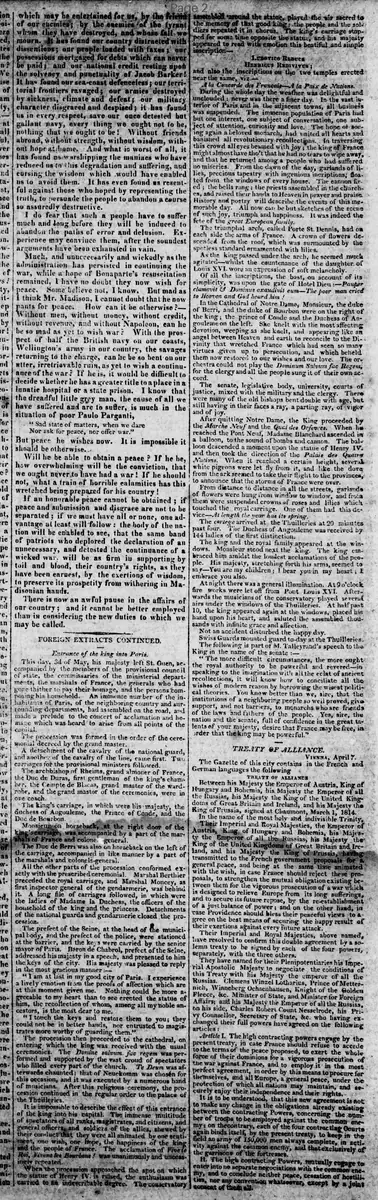
Entrance of the king into Paris.
This day, 3d of May, his majesty left St. Cloud, accompanied by the members of the provisional council of state, the commissaries of the ministerial departments, the marshals of France, the generals who had gone thither to pay their homage, and the persons composing his household. An immense number of the inhabitants of Paris, of the neighboring country and surrounding departments, had assembled on the road, and made a prelude to the concert of acclamation and homage which was heard to arise from all points of the capital.
The procession was formed in the order of the ceremonial decreed by the grand master. A detachment of the cavalry of the national guard, and another of the cavalry of the line, came first. Two carriages for the provisional ministers followed.
The archbishop of Rheims, grand almoner of France, the Duc de Duras, first gentleman of the king's chamber, the Comte de Blacas, grand master of the wardrobe, and the grand master of the ceremonies, were in one coach.
The king's carriage, in which were his majesty, the duchess of Angouleme, the Prince of Conde, and the Duc de Bourbon.
Monsieur on horseback, at the right door of the king's carriage, was accompanied by a part of the marshals of France and colonel general.
The Duc de Berri was also on horseback on the left of the carriage, accompanied in like manner by a part of the marshals and colonels-general.
All the other parts of the procession conformed exactly with the prescribed ceremonial. Marshal Berthier preceded the royal carriage, and Marshal Moncey, as first inspector general of the gendarmerie, was behind it. A long file of carriages followed, in which were the ladies of Madame the Duchess, the officers of the household of the king and the princess. Detachments of the national guards and gendarmerie closed the procession.
The prefect of the Seine, at the head of the municipal body, and the prefect of the police, were stationed at the barrier, and the keys were carried by the senior mayor of Paris. Baron de Chabrol, prefect of the Seine, addressed his majesty in a speech, and presented to him the keys of the city. His majesty was pleased to reply in the most gracious manner:--
'I am at last in my good city of Paris. I experience a lively emotion from the proofs of affection which are at this moment given me. Nothing could be more agreeable to my heart than to see erected the statue of him, the recollection of whom, among all my noble ancestors, is the most dear to me.
I touch the keys and restore them to you; they could not be in better hands, nor entrusted to magistrates more worthy of guarding them.'
The procession then proceeded to the cathedral, on entering which the king was received with the usual ceremonies. The Domine salvum fac regem was performed and supported by the vast crowd of spectators who filled every part of the church. Te Deum was afterwards chaunted; that of Neuckomm was chosen for this occasion, and it was executed by a numerous band of musicians. After this religious ceremony, the procession continued in the regular order to the palace of the Thuilleries.
It is impossible to describe the effect of this entrance of the king into his capital. The immense multitude of spectators of all ranks, magistrates, and citizens, and general officers and soldiers of the allies, shewed by their conduct that they were all animated by one sentiment, one wish, one hope, the happiness of the king and the people of France. The acclamation of Vive le Roi, Vivent les Bourbons! was unanimously and unceasingly repeated.
When the procession approached the spot on which the statue of Henry IV. is raised, the enthusiasm was carried to an indescribable degree. The conservatory assembled around the statue played their sacred to the memory of that good king the people and the soldiers repeated it in chorus. The king's carriage stopped for some time opposite the statue, and his majesty appeared to read with emotion this beautiful and simple inscription
RE IPUBLICO REDUC
HENRICUS REDIVIVUS;
and also the inscriptions on the two temples erected near the same, viz.
'A la Concorde des Francais A la Paix des Nations.'
During the whole day the weather was delightful and unclouded; never was there a finer day. In the vast interior of Paris and in the adjacent towns, all business was suspended. The immense population of Paris had but one interest, one subject of conversation, one subject of attention, curiosity and love. The hope of seeing again a beloved monarch, had united all hearts and banished all revolutionary recollections. In traversing this crowd all eyes beamed with joy; the king of France might almost have thought that he had no tears to wipe away, and that he returned among a people who had suffered no miseries. From the dawn of the day, garlands of lilies, precious tapestry with ingenious inscriptions; soared from the windows of every house. The cannon fired; the bells rang; the priests assembled in the churches, and raised their hands to Heaven in prayer and praise. History and poetry will describe the events of this memorable day. All now can be but sketches of the scene of such joy, triumph and happiness. It was indeed the fete of the great European family.
The triumphal arch, called Porte St. Denis, had on each side the arms of France. A crown of flowers descended from the roof, which was surmounted by the spotless standard ornamented with lilies.
As the king passed under the arch, he seemed much agitated--whilst the countenance of the daughter of Louis XVI. wore an expression of soft melancholy.
Of all the inscriptions, the best, on account of its simplicity, was upon the gate of Hotel Dieu:--Pauper clamavit & Dominus exaudivit eum--The poor man cried to Heaven and God heard him!
In the Cathedral of Notre Dame, Monsieur, the duke of Berri, and the duke of Bourbon were on the right of the king: the prince of Conde and the Duchess of Angouleme on the left. She knelt with the most affecting devotion, weeping as she knelt, and appearing like an angel between Heaven and earth to reconcile to the Divinity that wretched France which had seen so many virtues given up to persecution, and which beheld them now restored to our wishes and our love. The orchestra could not play the Dominum Salvum fac Regem, for the clergy and all the people sung it of their own accord.
The senate, legislative body, university, courts of justice, mixed with the military and the clergy. There were many of the old bishops bent double with age, but still having in their faces a ray, a parting ray, of vigor and of joy.
After quitting Notre Dame, the King proceeded by the Marche Neuf and the Quai des Orfevres. When he reached the Pont Neuf, Madame Blanchard ascended in a balloon, to the sound of bombs and cannon. The balloon descended a moment upon the statue of Henry IV. and then took the direction of the Palais des Quatre Nations. When it reached a certain height, several white pigeons were let fly from it, and like the dove from the ark seemed to take their flight to the provinces, to announce that the storms of France were over.
From distance to distance in all the streets, garlands of flowers were hung from window to window, and from them were suspended crowns of roses and lilies which touched the royal carriage. One of them had this device--At length the year has its spring.
The cortege arrived at the Thuilleries at 20 minutes past four. The Duchess of Angouleme was received by 144 ladies of the first distinction.
The king and the royal family appeared at the windows. Monsieur stood next the king. The king embraced him amidst the loudest acclamations of the people. His majesty, stretching forth his arms, seemed to say--You are my children; I bear you in my heart; I embrace you also.
At night there was a general illumination. At 9 o'clock fire works were let off from Pont Louis XVI. Afterwards the musicians of the conservatory played several airs under the windows of the Thuilleries. At half past 10, the king appeared again at the windows, placed his hand upon his heart, and saluted the assembled thousands with infinite grace and affection.
Not an accident disturbed the happy day.
Swiss Guards mounted guard to-day at the Thuilleries:
The following is part of M. Talleyrand's speech to the King in the name of the senate:--
'The more difficult circumstances, the more ought the royal authority to be powerful and revered--in speaking to the imagination with all the eclat of ancient recollections, it will know how to conciliate all the wishes of modern reason by borrowing the wisest political theories. You know better than we, sire, that the institutions of a neighboring people so well proved, give support, and not barriers, to monarchs who are friends of the laws and fathers of the people. Yes, sire, the nation and the senate, full of confidence in the great talents of your majesty, desire that France may be free, in order that the king may be powerful.'
What sub-type of article is it?
What keywords are associated?
What entities or persons were involved?
Where did it happen?
Foreign News Details
Primary Location
Paris
Event Date
3d Of May
Key Persons
Outcome
no accidents; joyful reception with acclamations, illuminations, and celebrations marking the king's return and the restoration of the bourbons.
Event Details
King left St. Cloud in a grand procession with royal family, officials, and military escort, entering Paris amid immense crowds and acclamations. Presented with city keys at the barrier, replied graciously. Processed to Notre Dame for religious ceremonies including Domine salvum fac regem and Te Deum. Continued to Tuileries with stops at Henry IV statue and triumphal arches. Evening illuminations and fireworks. Talleyrand's speech emphasized strong royal authority with modern institutions.