Thank you for visiting SNEWPapers!
Sign up free
Editorial
October 5, 1954
The Farmville Herald And Farmer Leader
Farmville, Prince Edward County, Virginia
What is this article about?
Roger Babson argues that the U.S. can achieve both peace and prosperity by adhering to the Law of Supply and Demand, drawing lessons from the 1953 recession, 1929-1940 depression, and World War II. He emphasizes consumer research, advertising, lower prices, and free market adjustments over government subsidies.
Clipping
OCR Quality
98%
Excellent
Full Text
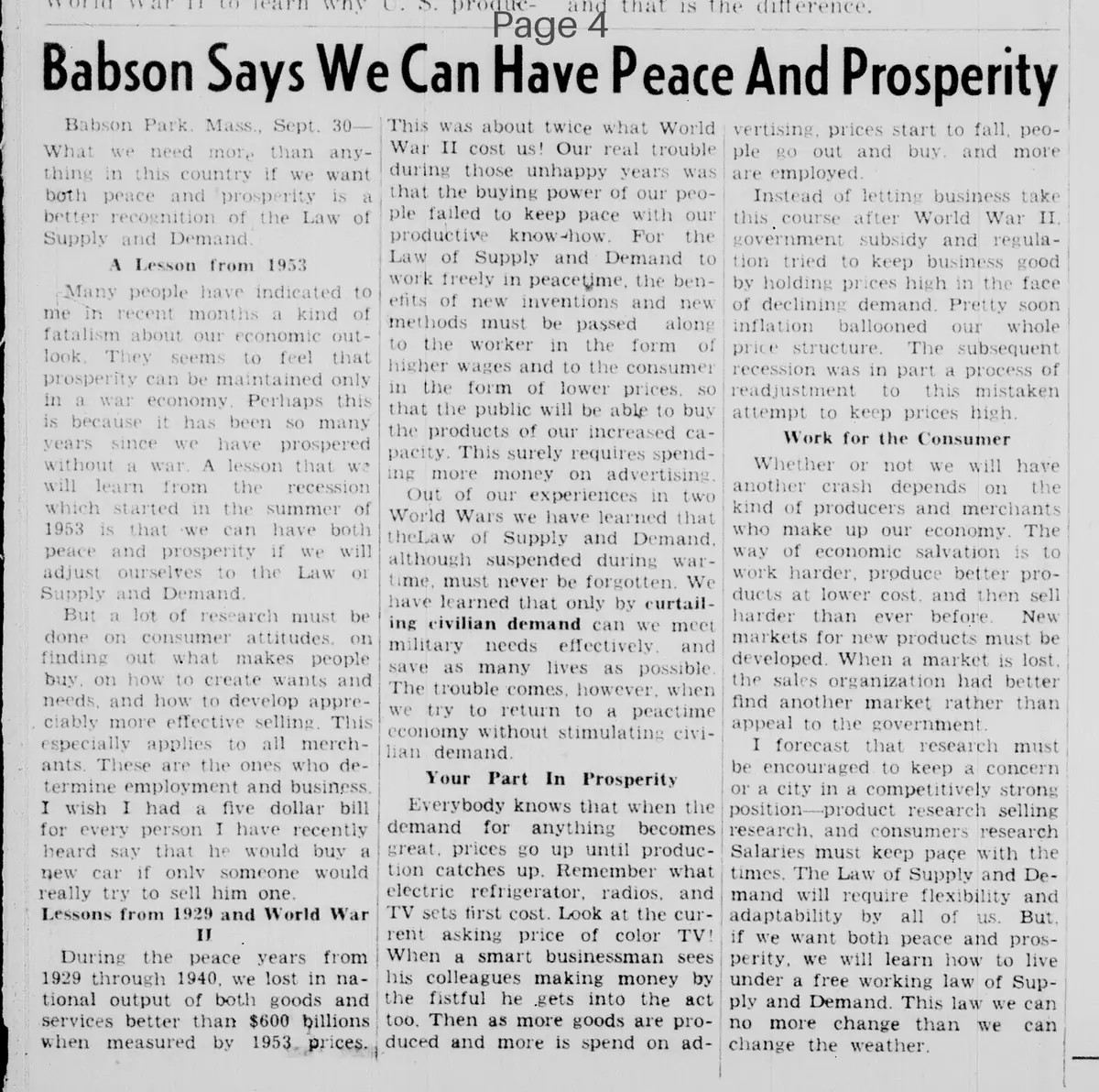
Babson Says We Can Have Peace And Prosperity
Babson Park, Mass. Sept. 30-- What we need more than anything in this country if we want both peace and prosperity is a better recognition of the Law of Supply and Demand.
A Lesson from 1953
Many people have indicated to me in recent months a kind of fatalism about our economic outlook. They seem to feel that prosperity can be maintained only in a war economy. Perhaps this is because it has been so many years since we have prospered without a war. A lesson that we will learn from the recession which started in the summer of 1953 is that we can have both peace and prosperity if we will adjust ourselves to the Law of Supply and Demand.
But a lot of research must be done on consumer attitudes, on finding out what makes people buy, on how to create wants and needs, and how to develop appreciably more effective selling. This especially applies to all merchants. These are the ones who determine employment and business.
I wish I had a five dollar bill for every person I have recently heard say that he would buy a new car if only someone would really try to sell him one.
Lessons from 1929 and World War II
During the peace years from 1929 through 1940, we lost in national output of both goods and services better than $600 billions when measured by 1953 prices. This was about twice what World War II cost us! Our real trouble during those unhappy years was that the buying power of our people failed to keep pace with our productive know-how. For the Law of Supply and Demand to work freely in peacetime, the benefits of new inventions and new methods must be passed along to the worker in the form of higher wages and to the consumer in the form of lower prices, so that the public will be able to buy the products of our increased capacity. This surely requires spending more money on advertising.
Out of our experiences in two World Wars we have learned that the Law of Supply and Demand, although suspended during wartime, must never be forgotten. We have learned that only by curtailing civilian demand can we meet military needs effectively, and save as many lives as possible. The trouble comes, however, when we try to return to a peacetime economy without stimulating civilian demand.
Your Part In Prosperity
Everybody knows that when the demand for anything becomes great, prices go up until production catches up. Remember what electric refrigerators, radios, and TV sets first cost. Look at the current asking price of color TV! When a smart businessman sees his colleagues making money by the fistful he gets into the act too. Then as more goods are produced and more is spent on advertising, prices start to fall, people go out and buy and more are employed.
Instead of letting business take this course after World War II government subsidy and regulation tried to keep business good by holding prices high in the face of declining demand. Pretty soon inflation ballooned our whole price structure. The subsequent recession was in part a process of readjustment to this mistaken attempt to keep prices high.
Work for the Consumer
Whether or not we will have another crash depends on the kind of producers and merchants who make up our economy. The way of economic salvation is to work harder, produce better products at lower cost, and then sell harder than ever before. New markets for new products must be developed. When a market is lost, the sales organization had better find another market rather than appeal to the government.
I forecast that research must be encouraged to keep a concern or a city in a competitively strong position-product research, selling research, and consumers research. Salaries must keep pace with the times. The Law of Supply and Demand will require flexibility and adaptability by all of us. But, if we want both peace and prosperity, we will learn how to live under a free working law of Supply and Demand. This law we can no more change than we can change the weather.
Babson Park, Mass. Sept. 30-- What we need more than anything in this country if we want both peace and prosperity is a better recognition of the Law of Supply and Demand.
A Lesson from 1953
Many people have indicated to me in recent months a kind of fatalism about our economic outlook. They seem to feel that prosperity can be maintained only in a war economy. Perhaps this is because it has been so many years since we have prospered without a war. A lesson that we will learn from the recession which started in the summer of 1953 is that we can have both peace and prosperity if we will adjust ourselves to the Law of Supply and Demand.
But a lot of research must be done on consumer attitudes, on finding out what makes people buy, on how to create wants and needs, and how to develop appreciably more effective selling. This especially applies to all merchants. These are the ones who determine employment and business.
I wish I had a five dollar bill for every person I have recently heard say that he would buy a new car if only someone would really try to sell him one.
Lessons from 1929 and World War II
During the peace years from 1929 through 1940, we lost in national output of both goods and services better than $600 billions when measured by 1953 prices. This was about twice what World War II cost us! Our real trouble during those unhappy years was that the buying power of our people failed to keep pace with our productive know-how. For the Law of Supply and Demand to work freely in peacetime, the benefits of new inventions and new methods must be passed along to the worker in the form of higher wages and to the consumer in the form of lower prices, so that the public will be able to buy the products of our increased capacity. This surely requires spending more money on advertising.
Out of our experiences in two World Wars we have learned that the Law of Supply and Demand, although suspended during wartime, must never be forgotten. We have learned that only by curtailing civilian demand can we meet military needs effectively, and save as many lives as possible. The trouble comes, however, when we try to return to a peacetime economy without stimulating civilian demand.
Your Part In Prosperity
Everybody knows that when the demand for anything becomes great, prices go up until production catches up. Remember what electric refrigerators, radios, and TV sets first cost. Look at the current asking price of color TV! When a smart businessman sees his colleagues making money by the fistful he gets into the act too. Then as more goods are produced and more is spent on advertising, prices start to fall, people go out and buy and more are employed.
Instead of letting business take this course after World War II government subsidy and regulation tried to keep business good by holding prices high in the face of declining demand. Pretty soon inflation ballooned our whole price structure. The subsequent recession was in part a process of readjustment to this mistaken attempt to keep prices high.
Work for the Consumer
Whether or not we will have another crash depends on the kind of producers and merchants who make up our economy. The way of economic salvation is to work harder, produce better products at lower cost, and then sell harder than ever before. New markets for new products must be developed. When a market is lost, the sales organization had better find another market rather than appeal to the government.
I forecast that research must be encouraged to keep a concern or a city in a competitively strong position-product research, selling research, and consumers research. Salaries must keep pace with the times. The Law of Supply and Demand will require flexibility and adaptability by all of us. But, if we want both peace and prosperity, we will learn how to live under a free working law of Supply and Demand. This law we can no more change than we can change the weather.
What sub-type of article is it?
Economic Policy
Trade Or Commerce
What keywords are associated?
Supply And Demand
Peace Prosperity
Economic Recession
War Economy
Advertising
Consumer Research
Post War Adjustment
What entities or persons were involved?
Roger Babson
U.S. Government
Merchants
Consumers
Editorial Details
Primary Topic
Achieving Peace And Prosperity Via The Law Of Supply And Demand
Stance / Tone
Advocacy For Free Market Principles And Criticism Of Government Intervention
Key Figures
Roger Babson
U.S. Government
Merchants
Consumers
Key Arguments
Prosperity Possible In Peacetime By Adjusting To Supply And Demand
Research Needed On Consumer Attitudes And Effective Selling
Lessons From 1953 Recession Show War Economy Not Necessary
1929 1940 Losses Due To Buying Power Not Keeping Pace With Production
Benefits Of Inventions Must Lower Prices And Raise Wages
More Advertising Required For Peacetime Demand
Post Wwii Government Subsidies Caused Inflation And Recession
Producers And Merchants Must Innovate And Sell Harder Without Government Aid