Thank you for visiting SNEWPapers!
Sign up free
Editorial
December 30, 1826
Literary Cadet, And Saturday Evening Bulletin
Providence, Providence County, Rhode Island
What is this article about?
New Year's editorial reflects on personal losses, town improvements through industry, and urges charity to local distressed families to prevent crime, illustrated by an anecdote of a proud widow tempted to steal but aided by benevolence. Ends with a prayer for virtue.
Clipping
OCR Quality
98%
Excellent
Full Text
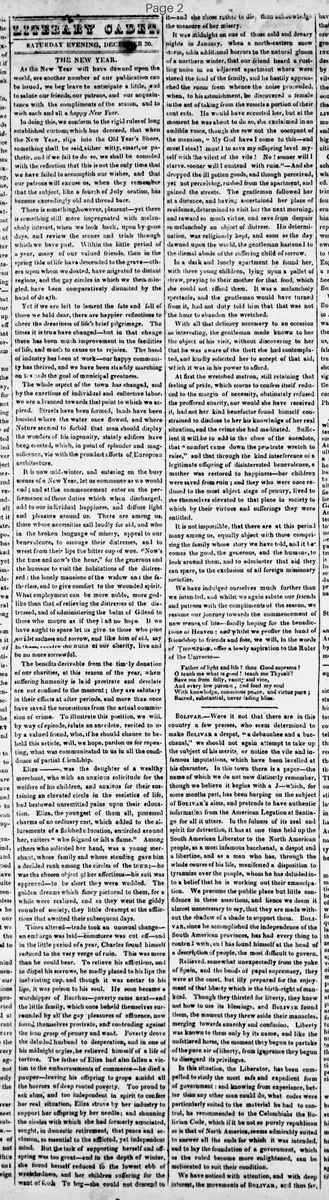
SATURDAY EVENING, DECEMBER 30.
THE NEW YEAR.
As the New Year will have dawned upon the world, ere another number of our publication can be issued, we beg leave to anticipate a little, and to salute our friends, our patrons, and our acquaintance with the compliments of the season, and to wish each and all a happy New Year.
In doing this, we conform to the rigid rules of long established custom; which has decreed, that when the New Year, slips into the Old Year's Shoes something shall be said either witty, smart, or pathetic, and if we fail to do so, we shall be consoled with the reflection that this is not the only time that we have failed to accomplish our wishes, and that our patrons will excuse us, when they remember that the subject, like a fourth of July oration, has become exceedingly old and thread bare.
There is something, however, pleasant—yet there is something still more impregnated with melancholy interest, when we look back, upon by-gone days, and review the scenes and trials through which we have past. Within the little period of a year, many of our valued friends, then in the spring tide of life have descended to the grave—others upon whom we doted, have migrated to distant regions, and the gay circles in which we then mingled, have been comparatively disunited by the hand of death.
Yet if we are left to lament the fate and fall of those we held dear, there are happier reflections to cheer the dreariness of life's brief pilgrimage. The times it is true have changed—but in that change there has been much improvement in the facilities of life, and much to cause us to rejoice. The hand of industry has been at work—our happy community has thrived, and we have been steadily marching on towards the goal of municipal greatness.
The whole aspect of the town has changed, and by the exertions of individual and collective labor, we are advanced towards that point to which we aspired. Streets have been formed, lands have been located where the water once flowed, and where Nature seemed to forbid that man should display the wonders of his ingenuity, stately edifices have been erected, which, in point of splendor and magnificence, vie with the proudest efforts of European architecture.
It is now mid-winter, and entering on the busy scenes of a New Year, let us commence as we would end; and at the commencement enter on the performance of those duties which when discharged, add to our individual happiness, and diffuse light and pleasure around us. There are among us, those whose necessities call loudly for aid, and who in the broken language of misery, appeal to our benevolence, to assuage their distresses, and to wrest from their lips the bitter cup of woe. "Now's the time and now's the hour," for the generous and the humane to visit the habitations of the distressed: the lonely mansions of the widow and the fatherless, and to give comfort to the wounded spirit.
What employment can be more noble, more godlike than that of relieving the distresses of the distressed, and of administering the balm of Gilead to those who mourn as if they had no hope. If we have aught to spare let us give to those who pine amidst sadness and sorrow, and like him of old, say to them, receive the alms of our charity, live and be no more sorrowful.
The benefits derivable from the timely donation of our charities, at this season of the year, when suffering humanity is laid prostrate and desolate are not confined to the moment; they are salutary in their effects at after periods, and more than once have saved the necessitous from the actual commission of crime. To illustrate this position, we will, by way of episode, relate an anecdote, recited to us by a valued friend, who, if he should chance to behold this article, will, we hope, pardon us for repeating, what was communicated to us in all the confidence of partial friendship.
Eliza Ann, was the daughter of a wealthy merchant, who with an anxious solicitude for the welfare of his children, and anxious for their sustaining an elevated circle in the societies of life, had bestowed unremitted pains upon their education. Eliza, the youngest of them all, possessed charms of no ordinary cast, which added to the allurements of a finished education, encircled around her, suitors "who feigned or felt a flame." Among others who solicited her hand, was a young merchant, whose family and whose standing gave him a decided rank among the circles of the town;—he was the chosen object of her affections—his suit was approved—to be short they were wedded. The golden dreams which fancy pictured to them, for a while were realized, and as they went the giddy rounds of society, they little dreamt of the afflictions that awaited their subsequent days.
Times altered—trade took an unusual change—an embargo was laid—commerce was cut off—and in the little period of a year, Charles found himself reduced to the very verge of ruin. This was more than he could bear. To relieve his afflictions, and to dispel his sorrows, he sadly placed to his lips the inebriating cup, and though it was nectar to his lips, it was poison to his soul. He soon became a worshipper of Bacchus—poverty came next—and the little family, which once beheld themselves surrounded by all the gay pleasures of affluence, now found themselves prostrate, and contending against the iron grasp of penury and want. Poverty drove the deluded husband to desperation, and in one of his midnight orgies, he relieved himself of a life of torture. The father of Eliza had also fallen a victim to the embarrassments of commerce—he died a pauper—leaving his offspring to grope amidst all the horrors of deep rooted poverty. Too proud to ask alms, and too independent in spirit to confess her real situation, Eliza strove by her industry to support her offspring by her needle; and shunning the circles with which she had formerly associated, sought, in domestic retirement, that peace and seclusion, so essential to the afflicted, yet independent mind. But the task of supporting herself and offspring was too great—and in the depth of winter, she found herself reduced to the lowest ebb of wretchedness, and her children suffering for the want of food. To beg—she could not descend to it—and she chose rather to die, than acknowledge the measure of her misery.
It was midnight on one of those cold and dreary nights in January, when a north-eastern snow storm, adds additional horrors to the natural gloom of a northern winter, that our friend heard a rustling noise in an adjacent apartment where were stored the food of the family, and he hastily approached the room from whence the noise proceeded, when, to his astonishment, he discovered a female in the act of taking from the vessels a portion of their contents. He would have accosted her, but at the moment he was about to do so, she exclaimed in an audible voice, though she saw not the occupant of the mansion, "My God have I come to this—and must I steal! must I to save my offspring level myself with the vilest of the vile! No! sooner will I starve, sooner will I contend with ruin."—And she dropped the ill gotten goods, and though perceived, yet not perceiving, rushed from the apartment, and gained the streets. The gentleman followed her at a distance, and having ascertained her place of residence, determined to visit her the next morning, and reward so much virtue, and save from despair so melancholy an object of distress. His determination, was religiously kept, and soon as the day dawned upon the world, the gentleman hastened to the dismal abode of the suffering child of sorrow.
In a dark and lonely apartment he found her, with three young children, lying upon a pallet of straw, praying to their mother for that food, which she could not afford them. It was a melancholy spectacle, and the gentleman would have turned from it, had not duty told him that that was not the hour to abandon the wretched.
With all that delicacy necessary to an occasion so interesting, the gentleman made known to her the object of his visit, without discovering to her that he was aware of the theft she had contemplated, and kindly solicited her to accept of that aid, which it was in his power to afford.
At first the wretched matron, still retaining that feeling of pride, which scorns to confess itself reduced to the margin of necessity, obstinately refused the proffered charity, nor would she have received it, had not her kind benefactor found himself constrained to disclose to her his knowledge of her real situation, and the crime she had meditated. Sufficient it will be to add in the close of the anecdote, that "comfort came down the prostrate wretch to raise," and that through the kind interference of a legitimate offspring of disinterested benevolence, a mother was restored to happiness—her children were saved from ruin; and they who were once reduced to the most abject stage of penury, lived to see themselves elevated to that place in society to which by their virtues and sufferings they were entitled.
It is not impossible, that there are at this period many among us, equally abject with those comprising the family whose story we have told, and it becomes the good, the generous, and the humane, to look around them, and to administer that aid they can spare, to the exclusion of all foreign missionary societies.
We have indulged ourselves much further than we intended, and whilst we again salute our friends and patrons with the compliments of the season, we resume our journey towards the commencement of new scenes of life—fondly hoping for the benedictions of Heaven; and whilst we proffer the hand of friendship to friends and foes, we will, in the words of Thompson, offer a lowly aspiration to the Ruler of the Universe—
Father of light and life! thou Good supreme!
O teach me what is good! teach me Thyself!
Save me from folly, vanity, and vice,
And every low pursuit, and feed my soul
With knowledge, conscious peace, and virtue pure;
Sacred, substantial, never fading bliss.
THE NEW YEAR.
As the New Year will have dawned upon the world, ere another number of our publication can be issued, we beg leave to anticipate a little, and to salute our friends, our patrons, and our acquaintance with the compliments of the season, and to wish each and all a happy New Year.
In doing this, we conform to the rigid rules of long established custom; which has decreed, that when the New Year, slips into the Old Year's Shoes something shall be said either witty, smart, or pathetic, and if we fail to do so, we shall be consoled with the reflection that this is not the only time that we have failed to accomplish our wishes, and that our patrons will excuse us, when they remember that the subject, like a fourth of July oration, has become exceedingly old and thread bare.
There is something, however, pleasant—yet there is something still more impregnated with melancholy interest, when we look back, upon by-gone days, and review the scenes and trials through which we have past. Within the little period of a year, many of our valued friends, then in the spring tide of life have descended to the grave—others upon whom we doted, have migrated to distant regions, and the gay circles in which we then mingled, have been comparatively disunited by the hand of death.
Yet if we are left to lament the fate and fall of those we held dear, there are happier reflections to cheer the dreariness of life's brief pilgrimage. The times it is true have changed—but in that change there has been much improvement in the facilities of life, and much to cause us to rejoice. The hand of industry has been at work—our happy community has thrived, and we have been steadily marching on towards the goal of municipal greatness.
The whole aspect of the town has changed, and by the exertions of individual and collective labor, we are advanced towards that point to which we aspired. Streets have been formed, lands have been located where the water once flowed, and where Nature seemed to forbid that man should display the wonders of his ingenuity, stately edifices have been erected, which, in point of splendor and magnificence, vie with the proudest efforts of European architecture.
It is now mid-winter, and entering on the busy scenes of a New Year, let us commence as we would end; and at the commencement enter on the performance of those duties which when discharged, add to our individual happiness, and diffuse light and pleasure around us. There are among us, those whose necessities call loudly for aid, and who in the broken language of misery, appeal to our benevolence, to assuage their distresses, and to wrest from their lips the bitter cup of woe. "Now's the time and now's the hour," for the generous and the humane to visit the habitations of the distressed: the lonely mansions of the widow and the fatherless, and to give comfort to the wounded spirit.
What employment can be more noble, more godlike than that of relieving the distresses of the distressed, and of administering the balm of Gilead to those who mourn as if they had no hope. If we have aught to spare let us give to those who pine amidst sadness and sorrow, and like him of old, say to them, receive the alms of our charity, live and be no more sorrowful.
The benefits derivable from the timely donation of our charities, at this season of the year, when suffering humanity is laid prostrate and desolate are not confined to the moment; they are salutary in their effects at after periods, and more than once have saved the necessitous from the actual commission of crime. To illustrate this position, we will, by way of episode, relate an anecdote, recited to us by a valued friend, who, if he should chance to behold this article, will, we hope, pardon us for repeating, what was communicated to us in all the confidence of partial friendship.
Eliza Ann, was the daughter of a wealthy merchant, who with an anxious solicitude for the welfare of his children, and anxious for their sustaining an elevated circle in the societies of life, had bestowed unremitted pains upon their education. Eliza, the youngest of them all, possessed charms of no ordinary cast, which added to the allurements of a finished education, encircled around her, suitors "who feigned or felt a flame." Among others who solicited her hand, was a young merchant, whose family and whose standing gave him a decided rank among the circles of the town;—he was the chosen object of her affections—his suit was approved—to be short they were wedded. The golden dreams which fancy pictured to them, for a while were realized, and as they went the giddy rounds of society, they little dreamt of the afflictions that awaited their subsequent days.
Times altered—trade took an unusual change—an embargo was laid—commerce was cut off—and in the little period of a year, Charles found himself reduced to the very verge of ruin. This was more than he could bear. To relieve his afflictions, and to dispel his sorrows, he sadly placed to his lips the inebriating cup, and though it was nectar to his lips, it was poison to his soul. He soon became a worshipper of Bacchus—poverty came next—and the little family, which once beheld themselves surrounded by all the gay pleasures of affluence, now found themselves prostrate, and contending against the iron grasp of penury and want. Poverty drove the deluded husband to desperation, and in one of his midnight orgies, he relieved himself of a life of torture. The father of Eliza had also fallen a victim to the embarrassments of commerce—he died a pauper—leaving his offspring to grope amidst all the horrors of deep rooted poverty. Too proud to ask alms, and too independent in spirit to confess her real situation, Eliza strove by her industry to support her offspring by her needle; and shunning the circles with which she had formerly associated, sought, in domestic retirement, that peace and seclusion, so essential to the afflicted, yet independent mind. But the task of supporting herself and offspring was too great—and in the depth of winter, she found herself reduced to the lowest ebb of wretchedness, and her children suffering for the want of food. To beg—she could not descend to it—and she chose rather to die, than acknowledge the measure of her misery.
It was midnight on one of those cold and dreary nights in January, when a north-eastern snow storm, adds additional horrors to the natural gloom of a northern winter, that our friend heard a rustling noise in an adjacent apartment where were stored the food of the family, and he hastily approached the room from whence the noise proceeded, when, to his astonishment, he discovered a female in the act of taking from the vessels a portion of their contents. He would have accosted her, but at the moment he was about to do so, she exclaimed in an audible voice, though she saw not the occupant of the mansion, "My God have I come to this—and must I steal! must I to save my offspring level myself with the vilest of the vile! No! sooner will I starve, sooner will I contend with ruin."—And she dropped the ill gotten goods, and though perceived, yet not perceiving, rushed from the apartment, and gained the streets. The gentleman followed her at a distance, and having ascertained her place of residence, determined to visit her the next morning, and reward so much virtue, and save from despair so melancholy an object of distress. His determination, was religiously kept, and soon as the day dawned upon the world, the gentleman hastened to the dismal abode of the suffering child of sorrow.
In a dark and lonely apartment he found her, with three young children, lying upon a pallet of straw, praying to their mother for that food, which she could not afford them. It was a melancholy spectacle, and the gentleman would have turned from it, had not duty told him that that was not the hour to abandon the wretched.
With all that delicacy necessary to an occasion so interesting, the gentleman made known to her the object of his visit, without discovering to her that he was aware of the theft she had contemplated, and kindly solicited her to accept of that aid, which it was in his power to afford.
At first the wretched matron, still retaining that feeling of pride, which scorns to confess itself reduced to the margin of necessity, obstinately refused the proffered charity, nor would she have received it, had not her kind benefactor found himself constrained to disclose to her his knowledge of her real situation, and the crime she had meditated. Sufficient it will be to add in the close of the anecdote, that "comfort came down the prostrate wretch to raise," and that through the kind interference of a legitimate offspring of disinterested benevolence, a mother was restored to happiness—her children were saved from ruin; and they who were once reduced to the most abject stage of penury, lived to see themselves elevated to that place in society to which by their virtues and sufferings they were entitled.
It is not impossible, that there are at this period many among us, equally abject with those comprising the family whose story we have told, and it becomes the good, the generous, and the humane, to look around them, and to administer that aid they can spare, to the exclusion of all foreign missionary societies.
We have indulged ourselves much further than we intended, and whilst we again salute our friends and patrons with the compliments of the season, we resume our journey towards the commencement of new scenes of life—fondly hoping for the benedictions of Heaven; and whilst we proffer the hand of friendship to friends and foes, we will, in the words of Thompson, offer a lowly aspiration to the Ruler of the Universe—
Father of light and life! thou Good supreme!
O teach me what is good! teach me Thyself!
Save me from folly, vanity, and vice,
And every low pursuit, and feed my soul
With knowledge, conscious peace, and virtue pure;
Sacred, substantial, never fading bliss.
What sub-type of article is it?
Social Reform
Moral Or Religious
What keywords are associated?
New Year
Charity
Benevolence
Poverty
Moral Reflection
Town Improvement
Winter Aid
What entities or persons were involved?
Widows And Orphans
Suffering Families
Benevolent Individuals
Editorial Details
Primary Topic
New Year's Reflections And Exhortation To Local Charity
Stance / Tone
Benevolent And Moralistic Exhortation
Key Figures
Widows And Orphans
Suffering Families
Benevolent Individuals
Key Arguments
Reflect On Past Year's Losses And Town Progress
Aid The Local Poor During Winter To Prevent Crime
Charity Provides Lasting Benefits Beyond Immediate Relief
Prioritize Local Aid Over Foreign Missionary Societies
Relieving Distress Is A Noble, Godlike Duty