Thank you for visiting SNEWPapers!
Sign up free
Story
September 17, 1865
The Daily Phoenix
Columbia, Richland County, South Carolina
What is this article about?
Satirical essay from post-Civil War Columbia, SC, portraying thieving as an elegant fine art superior to past crude forms. Laments the recent murder of master thief David Theophilus Hines, South Carolina's greatest in the 'art,' and calls for a proper biography of his varied career.
Clipping
OCR Quality
95%
Excellent
Full Text
COLUMBIA:
Sunday Morning, September 17, 1865
Thieving as One of the Fine Arts.
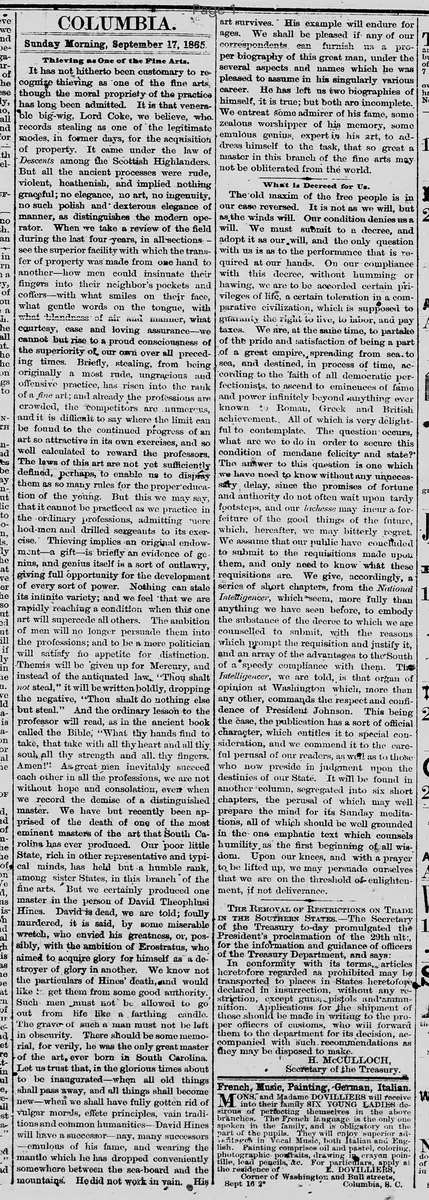
It has not hitherto been customary to recognize thieving as one of the fine arts though the moral propriety of the practice has long been admitted. It is that venerable big-wig, Lord Coke, we believe, who records stealing as one of the legitimate modes, in former days, for the acquisition of property. It came under the law of Descents among the Scottish Highlanders. But all the ancient processes were rude, violent, heathenish, and implied nothing graceful; no elegance, no art, no ingenuity, no such polish and dexterous elegance of manner, as distinguishes the modern operator. When we take a review of the field during the last four years, in all sections—see the superior facility with which the transfer of property was made from one hand to another—how men could insinuate their fingers into their neighbor's pockets and coffers—with what smiles on their face, what gentle words on the tongue, with what blandness of air and manner, what courtesy, ease and loving assurance—we cannot but rise to a proud consciousness of the superiority of our own over all preceding times. Briefly, stealing, from being originally a most rude, ungracious and offensive practice, has risen into the rank of a fine art; and already the professions are crowded, the competitors are numerous, and it is difficult to say where the limit can be found to the continued progress of an art so attractive in its own exercises, and so well calculated to reward the professors.
The laws of this art are not yet sufficiently defined, perhaps, to enable us to display them as so many rules for the proper education of the young. But this we may say, that it cannot be practiced as we practice in the ordinary professions, admitting mere hod-men and drilled sergeants to its exercise. Thieving implies an original endowment—a gift—is briefly an evidence of genius, and genius itself is a sort of outlawry, giving full opportunity for the development of every sort of power. Nothing can stale its infinite variety; and we feel that we are rapidly reaching a condition when this one art will supersede all others. The ambition of men will no longer persuade them into the professions; and to be a mere politician will satisfy no appetite for distinction. Themis will be given up for Mercury, and instead of the antiquated law, "Thou shalt not steal," it will be written boldly, dropping the negative, "Thou shalt do nothing else but steal." And the ordinary lesson to the professor will read, as in the ancient book called the Bible, "What thy hands find to take, that take with all thy heart and all thy soul, all thy strength and all thy fingers. Amen!" As great men inevitably succeed each other in all the professions, we are not without hope and consolation, even when we record the demise of a distinguished master. We have but recently been apprised of the death of one of the most eminent masters of the art that South Carolina has ever produced. Our poor little State, rich in other representative and typical minds, has held but a humble rank, among sister States, in this branch of the fine arts. But we certainly produced one master in the person of David Theophilus Hines. David is dead, we are told; foully murdered, it is said, by some miserable wretch, who envied his greatness, or, possibly, with the ambition of Erostratus, who aimed to acquire glory for himself as a destroyer of glory in another: We know not the particulars of Hines' death, and would like to get them from some good authority. Such men must not be allowed to go out from life like a farthing candle. The grave of such a man must not be left in obscurity. There should be some memorial, for verily, he was the only great master of the art, ever born in South Carolina. Let us trust that, in the glorious times about to be inaugurated—when all old things shall pass away, and all things shall become new—when we shall have fully gotten rid of vulgar morals, effete principles, vain traditions and common humanities—David Hines will have a successor—nay, many successors emulous of his fame, and wearing the mantle which he has dropped conveniently somewhere between the sea-board and the mountains. He did not work in vain. His art survives. His example will endure for ages. We shall be pleased if any of our correspondents can furnish us a proper biography of this great man, under the several aspects and names which he was pleased to assume in his singularly various career. He has left us two biographies of himself, it is true; but both are incomplete. We entreat some admirer of his fame, some zealous worshipper of his memory, some emulous genius, expert in his art, to address himself to the task, that so great a master in this branch of the fine arts may not be obliterated from the world.
Sunday Morning, September 17, 1865
Thieving as One of the Fine Arts.
It has not hitherto been customary to recognize thieving as one of the fine arts though the moral propriety of the practice has long been admitted. It is that venerable big-wig, Lord Coke, we believe, who records stealing as one of the legitimate modes, in former days, for the acquisition of property. It came under the law of Descents among the Scottish Highlanders. But all the ancient processes were rude, violent, heathenish, and implied nothing graceful; no elegance, no art, no ingenuity, no such polish and dexterous elegance of manner, as distinguishes the modern operator. When we take a review of the field during the last four years, in all sections—see the superior facility with which the transfer of property was made from one hand to another—how men could insinuate their fingers into their neighbor's pockets and coffers—with what smiles on their face, what gentle words on the tongue, with what blandness of air and manner, what courtesy, ease and loving assurance—we cannot but rise to a proud consciousness of the superiority of our own over all preceding times. Briefly, stealing, from being originally a most rude, ungracious and offensive practice, has risen into the rank of a fine art; and already the professions are crowded, the competitors are numerous, and it is difficult to say where the limit can be found to the continued progress of an art so attractive in its own exercises, and so well calculated to reward the professors.
The laws of this art are not yet sufficiently defined, perhaps, to enable us to display them as so many rules for the proper education of the young. But this we may say, that it cannot be practiced as we practice in the ordinary professions, admitting mere hod-men and drilled sergeants to its exercise. Thieving implies an original endowment—a gift—is briefly an evidence of genius, and genius itself is a sort of outlawry, giving full opportunity for the development of every sort of power. Nothing can stale its infinite variety; and we feel that we are rapidly reaching a condition when this one art will supersede all others. The ambition of men will no longer persuade them into the professions; and to be a mere politician will satisfy no appetite for distinction. Themis will be given up for Mercury, and instead of the antiquated law, "Thou shalt not steal," it will be written boldly, dropping the negative, "Thou shalt do nothing else but steal." And the ordinary lesson to the professor will read, as in the ancient book called the Bible, "What thy hands find to take, that take with all thy heart and all thy soul, all thy strength and all thy fingers. Amen!" As great men inevitably succeed each other in all the professions, we are not without hope and consolation, even when we record the demise of a distinguished master. We have but recently been apprised of the death of one of the most eminent masters of the art that South Carolina has ever produced. Our poor little State, rich in other representative and typical minds, has held but a humble rank, among sister States, in this branch of the fine arts. But we certainly produced one master in the person of David Theophilus Hines. David is dead, we are told; foully murdered, it is said, by some miserable wretch, who envied his greatness, or, possibly, with the ambition of Erostratus, who aimed to acquire glory for himself as a destroyer of glory in another: We know not the particulars of Hines' death, and would like to get them from some good authority. Such men must not be allowed to go out from life like a farthing candle. The grave of such a man must not be left in obscurity. There should be some memorial, for verily, he was the only great master of the art, ever born in South Carolina. Let us trust that, in the glorious times about to be inaugurated—when all old things shall pass away, and all things shall become new—when we shall have fully gotten rid of vulgar morals, effete principles, vain traditions and common humanities—David Hines will have a successor—nay, many successors emulous of his fame, and wearing the mantle which he has dropped conveniently somewhere between the sea-board and the mountains. He did not work in vain. His art survives. His example will endure for ages. We shall be pleased if any of our correspondents can furnish us a proper biography of this great man, under the several aspects and names which he was pleased to assume in his singularly various career. He has left us two biographies of himself, it is true; but both are incomplete. We entreat some admirer of his fame, some zealous worshipper of his memory, some emulous genius, expert in his art, to address himself to the task, that so great a master in this branch of the fine arts may not be obliterated from the world.
What sub-type of article is it?
Deception Fraud
Crime Story
Biography
What themes does it cover?
Deception
Crime Punishment
Moral Virtue
What keywords are associated?
Thieving As Art
David Theophilus Hines
South Carolina Thief
Post Civil War Satire
Master Thief Death
Biography Request
What entities or persons were involved?
David Theophilus Hines
Lord Coke
Where did it happen?
South Carolina
Story Details
Key Persons
David Theophilus Hines
Lord Coke
Location
South Carolina
Event Date
September 17, 1865
Story Details
Satirical praise of thieving as a refined art form evolved during the last four years, contrasting ancient crude methods with modern elegant deception. Announces the recent murder of South Carolina's master thief David Theophilus Hines and solicits a full biography of his career under various names.