Thank you for visiting SNEWPapers!
Sign up free
Literary
October 19, 1830
Constitutional Whig
Richmond, Virginia
What is this article about?
In 14th-century Italy near Bologna, widow Madonna Lucrezia, former beggar now innkeeper, agrees to hold a bag of gold for three travelers. One, a Venetian, steals it after she signs a bond requiring delivery to all three. Facing lawsuit, her daughter's lover, young lawyer Lorenzo Martelli, wins the case by demanding all three claimants, securing her future and his fame.
Clipping
OCR Quality
95%
Excellent
Full Text
THE BAG OF GOLD:
A Tale by an old Cardinal.
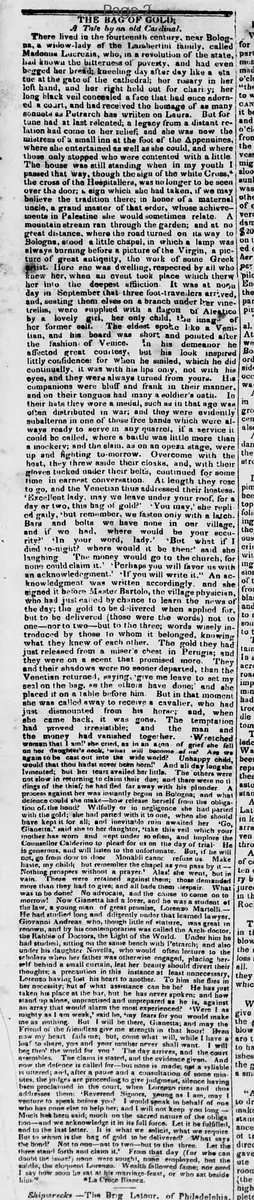
There lived in the fourteenth century, near Bologna, a widow-lady of the Lorubertini family, called Madonna Lucrezia, who, in a revolution of the state, had known the bitterness of poverty, and had even begged her bread; kneeling day after day like a statue at the gate of the cathedral; her rosary in her left hand, and her right held out for charity: her long black veil concealed a face that had once adorned a court, and had received the homage of as many sonnets as Petrarch has written on Laura. But fortune had at last relented; a legacy from a distant relation had come to her relief; and she was now the mistress of a small inn at the foot of the Apennines, where she entertained as well as she could, and where those only stopped who were contented with a little.
The house was still standing when in my youth I passed that way, though the sign of the white Cross, the cross of the Hospitaliers, was no longer to be seen over the door; a sign which she had taken, if we may believe the tradition there, in honor of a maternal uncle, a grandmaster of that order, whose achievements in Palestine she would sometimes relate. A mountain stream ran through the garden; and at no great distance, where the road turned on its way to Bologna, stood a little chapel, in which a lamp was always burning before a picture of the Virgin, a picture of great antiquity, the work of some Greek artist. Here she was dwelling, respected by all who knew her, when an event took place which threw her into the deepest affliction. It was at noonday in September that three foot-travellers arrived, and, seating themselves on a bench under her vine trellis, were supplied with a flagon of Aleatico by a lovely girl, her only child, the image of her former self. The eldest spoke like a Venetian, and his beard was short and pointed after the fashion of Venice. In his demeanor he affected great courtesy, but his look inspired little confidence: for when he smiled, which he did continually, it was with his lips only, not with his eyes, and they were always turned from yours. His companions were bluff and frank in their manner, and on their tongues had many a soldier's oath. In their hats they wore a medal, such as in that age was often distributed in war; and they were evidently subalterns in one of those free bands which were always ready to serve in any quarrel, if a service it could be called, where a battle was little more than a mockery; and the slain, as on an opera stage, were up and fighting to-morrow. Overcome with the heat, they threw aside their cloaks, and, with their gloves tucked under their belts, continued for some time in earnest conversation. At length they rose to go, and the Venetian thus addressed their hostess.
'Excellent lady, may we leave under your roof, for a day or two, this bag of gold?' 'You may,' she replied gaily, 'but remember, we fasten only with a latch. Bars and bolts we have none in our village, and if security?' 'In your word, lady.' 'But what if I died to-night? where would it be then?' said she laughing. 'The money would go to the church, for none could claim it.' 'Perhaps you will favor us with an acknowledgment.' 'If you will write it.' An acknowledgment was written accordingly, and she signed it before Master Bartolo, the village physician, who had just called by chance to learn the news of the day; the gold to be delivered when applied for, but to be delivered (those were the words) not to one--nor to two--but to the three; words wisely introduced by those to whom it belonged, knowing what they knew of each other. The gold they had just released from miser chest they were on a scent that promised more. They and their shadows were no sooner departed, than the Venetian returned, saying, 'give me leave to set my seal on the bag, as the others have done;' and she placed it on a table before him. But in that moment she was just dismounted from his horse; and, when she came back, it was gone. The temptation had proved irresistible; and the man and the money had vanished together.
Wretched woman that I am!' she cried, as in an agony of grief she fell on her daughter's neck. 'What will become of us? Again to be cast out into the wide world? Unhappy child, would that thou hadst never been born!' She bewailed; but her tears availed her little. The others were not slow in returning to claim their due; and there were no tidings of the thief; he had fled far away with his plunder. A process against her was instantly begun in Bologna; and what defence could she make--how release herself from the obligation of the bond? Wilfully or in negligence she had parted with the gold; she had parted with it to one, whom she should have kept it for all; and inevitable ruin awaited her. 'Go, Gianetta,' said she to her daughter, 'take this veil which your mother has worn and wept under so often, and implore the Counsellor Calderino to plead for us on the day of trial. He is generous, and will listen to the unfortunate. But, if he will not, go from door to door. Monaldi cannot refuse us. Make haste, my child; but remember the chapel as you pass by it.--Nothing prospers without a prayer.' Alas! she went, but in vain. These were retained against them; those demanded more than they had to give; and all bade them despair. What was done on the morrow! Now Gianetta had a lover, and he was a student of the law, a young man of great promise, Lorenzo Martelli. He had studied long and diligently under that learned lawyer, Giovanni Andreas, who, though little of stature, was great in renown, and by his contemporaries was called the Arch-doctor, the Rabbi of Doctors, the Light of the World. Under him he had studied, sitting on the same bench with Petrarch; and also under his daughter Novella, who would often lecture to the scholars when her father was otherwise engaged, placing herself behind a small curtain, lest her beauty should divert their thoughts: a precaution in this instance at least unnecessary, Lorenzo having lost his heart to another. To him she flies in her necessity; but of what assistance can he be? He has just taken his place at the bar, but he has never spoken: and how stand up alone, unpractised and unprepared as he is, against an array that would alarm the most experienced? 'Were I as mighty as I am weak,' said he, 'my fears for you would make me as nothing. But I will be there, Gianetta; and may the Friend of the friendless give me strength in that hour! Even now my heart fails me; but, come what will, while I have a loaf to share, you and your mother never shall want. I will beg through the world for you.'
The day arrives, and the court assembles. The claim is stated, and the evidence given. And now the defence is called for--but none is made; not a syllable is uttered; and, after a pause and a consultation of some minutes, the judges are proceeding to give judgment, silence having been proclaimed in the court, when Lorenzo rises and thus addresses them: 'Reverend Signors, young as I am, may I venture to speak before you? I would speak in behalf of one who has none else to help her; and I will not keep you long--Much had been said; much on the sacred nature of the obligation--and we acknowledge it in its full force. Let it be fulfilled, and to the last letter. It is what we solicit, what we require. But to whom is the bag of gold to be delivered? What says the bond? Not to one--not to two--but to the three. Let the three stand forth and claim it.' From that day (for who can doubt the issue?) none were sought, none employed, but the subtle, the eloquent Lorenzo. Wealth followed fame; nor need I say how soon he sat at his marriage-feast, or who sat beside him.'
La Croce Bianca.
A Tale by an old Cardinal.
There lived in the fourteenth century, near Bologna, a widow-lady of the Lorubertini family, called Madonna Lucrezia, who, in a revolution of the state, had known the bitterness of poverty, and had even begged her bread; kneeling day after day like a statue at the gate of the cathedral; her rosary in her left hand, and her right held out for charity: her long black veil concealed a face that had once adorned a court, and had received the homage of as many sonnets as Petrarch has written on Laura. But fortune had at last relented; a legacy from a distant relation had come to her relief; and she was now the mistress of a small inn at the foot of the Apennines, where she entertained as well as she could, and where those only stopped who were contented with a little.
The house was still standing when in my youth I passed that way, though the sign of the white Cross, the cross of the Hospitaliers, was no longer to be seen over the door; a sign which she had taken, if we may believe the tradition there, in honor of a maternal uncle, a grandmaster of that order, whose achievements in Palestine she would sometimes relate. A mountain stream ran through the garden; and at no great distance, where the road turned on its way to Bologna, stood a little chapel, in which a lamp was always burning before a picture of the Virgin, a picture of great antiquity, the work of some Greek artist. Here she was dwelling, respected by all who knew her, when an event took place which threw her into the deepest affliction. It was at noonday in September that three foot-travellers arrived, and, seating themselves on a bench under her vine trellis, were supplied with a flagon of Aleatico by a lovely girl, her only child, the image of her former self. The eldest spoke like a Venetian, and his beard was short and pointed after the fashion of Venice. In his demeanor he affected great courtesy, but his look inspired little confidence: for when he smiled, which he did continually, it was with his lips only, not with his eyes, and they were always turned from yours. His companions were bluff and frank in their manner, and on their tongues had many a soldier's oath. In their hats they wore a medal, such as in that age was often distributed in war; and they were evidently subalterns in one of those free bands which were always ready to serve in any quarrel, if a service it could be called, where a battle was little more than a mockery; and the slain, as on an opera stage, were up and fighting to-morrow. Overcome with the heat, they threw aside their cloaks, and, with their gloves tucked under their belts, continued for some time in earnest conversation. At length they rose to go, and the Venetian thus addressed their hostess.
'Excellent lady, may we leave under your roof, for a day or two, this bag of gold?' 'You may,' she replied gaily, 'but remember, we fasten only with a latch. Bars and bolts we have none in our village, and if security?' 'In your word, lady.' 'But what if I died to-night? where would it be then?' said she laughing. 'The money would go to the church, for none could claim it.' 'Perhaps you will favor us with an acknowledgment.' 'If you will write it.' An acknowledgment was written accordingly, and she signed it before Master Bartolo, the village physician, who had just called by chance to learn the news of the day; the gold to be delivered when applied for, but to be delivered (those were the words) not to one--nor to two--but to the three; words wisely introduced by those to whom it belonged, knowing what they knew of each other. The gold they had just released from miser chest they were on a scent that promised more. They and their shadows were no sooner departed, than the Venetian returned, saying, 'give me leave to set my seal on the bag, as the others have done;' and she placed it on a table before him. But in that moment she was just dismounted from his horse; and, when she came back, it was gone. The temptation had proved irresistible; and the man and the money had vanished together.
Wretched woman that I am!' she cried, as in an agony of grief she fell on her daughter's neck. 'What will become of us? Again to be cast out into the wide world? Unhappy child, would that thou hadst never been born!' She bewailed; but her tears availed her little. The others were not slow in returning to claim their due; and there were no tidings of the thief; he had fled far away with his plunder. A process against her was instantly begun in Bologna; and what defence could she make--how release herself from the obligation of the bond? Wilfully or in negligence she had parted with the gold; she had parted with it to one, whom she should have kept it for all; and inevitable ruin awaited her. 'Go, Gianetta,' said she to her daughter, 'take this veil which your mother has worn and wept under so often, and implore the Counsellor Calderino to plead for us on the day of trial. He is generous, and will listen to the unfortunate. But, if he will not, go from door to door. Monaldi cannot refuse us. Make haste, my child; but remember the chapel as you pass by it.--Nothing prospers without a prayer.' Alas! she went, but in vain. These were retained against them; those demanded more than they had to give; and all bade them despair. What was done on the morrow! Now Gianetta had a lover, and he was a student of the law, a young man of great promise, Lorenzo Martelli. He had studied long and diligently under that learned lawyer, Giovanni Andreas, who, though little of stature, was great in renown, and by his contemporaries was called the Arch-doctor, the Rabbi of Doctors, the Light of the World. Under him he had studied, sitting on the same bench with Petrarch; and also under his daughter Novella, who would often lecture to the scholars when her father was otherwise engaged, placing herself behind a small curtain, lest her beauty should divert their thoughts: a precaution in this instance at least unnecessary, Lorenzo having lost his heart to another. To him she flies in her necessity; but of what assistance can he be? He has just taken his place at the bar, but he has never spoken: and how stand up alone, unpractised and unprepared as he is, against an array that would alarm the most experienced? 'Were I as mighty as I am weak,' said he, 'my fears for you would make me as nothing. But I will be there, Gianetta; and may the Friend of the friendless give me strength in that hour! Even now my heart fails me; but, come what will, while I have a loaf to share, you and your mother never shall want. I will beg through the world for you.'
The day arrives, and the court assembles. The claim is stated, and the evidence given. And now the defence is called for--but none is made; not a syllable is uttered; and, after a pause and a consultation of some minutes, the judges are proceeding to give judgment, silence having been proclaimed in the court, when Lorenzo rises and thus addresses them: 'Reverend Signors, young as I am, may I venture to speak before you? I would speak in behalf of one who has none else to help her; and I will not keep you long--Much had been said; much on the sacred nature of the obligation--and we acknowledge it in its full force. Let it be fulfilled, and to the last letter. It is what we solicit, what we require. But to whom is the bag of gold to be delivered? What says the bond? Not to one--not to two--but to the three. Let the three stand forth and claim it.' From that day (for who can doubt the issue?) none were sought, none employed, but the subtle, the eloquent Lorenzo. Wealth followed fame; nor need I say how soon he sat at his marriage-feast, or who sat beside him.'
La Croce Bianca.
What sub-type of article is it?
Prose Fiction
What themes does it cover?
Moral Virtue
Friendship
What keywords are associated?
Bag Of Gold
Madonna Lucrezia
Venetian Thief
Lorenzo Martelli
Legal Bond
Court Defense
Moral Tale
Fourteenth Century Italy
What entities or persons were involved?
A Tale By An Old Cardinal.
Literary Details
Title
The Bag Of Gold
Author
A Tale By An Old Cardinal.
Key Lines
'The Gold To Be Delivered When Applied For, But To Be Delivered (Those Were The Words) Not To One Nor To Two But To The Three'
'Let The Three Stand Forth And Claim It.'
'Wretched Woman That I Am!' She Cried, As In An Agony Of Grief She Fell On Her Daughter's Neck.