Thank you for visiting SNEWPapers!
Sign up free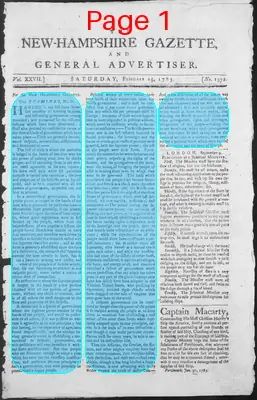
Editorial
February 15, 1783
The New Hampshire Gazette And General Advertiser
Portsmouth, Exeter, Rockingham County, New Hampshire
What is this article about?
The Examiner No. II discusses forms of government: despotic, monarchical, aristocratic, and democratic. It analyzes their strengths and weaknesses, praises the British mixed constitution as near-perfect but flawed, and suggests the Thirteen United States have improved upon it by avoiding past errors.
Clipping
OCR Quality
98%
Excellent
Full Text
For the New-Hampshire Gazette.
THE EXAMINER, NO. II.
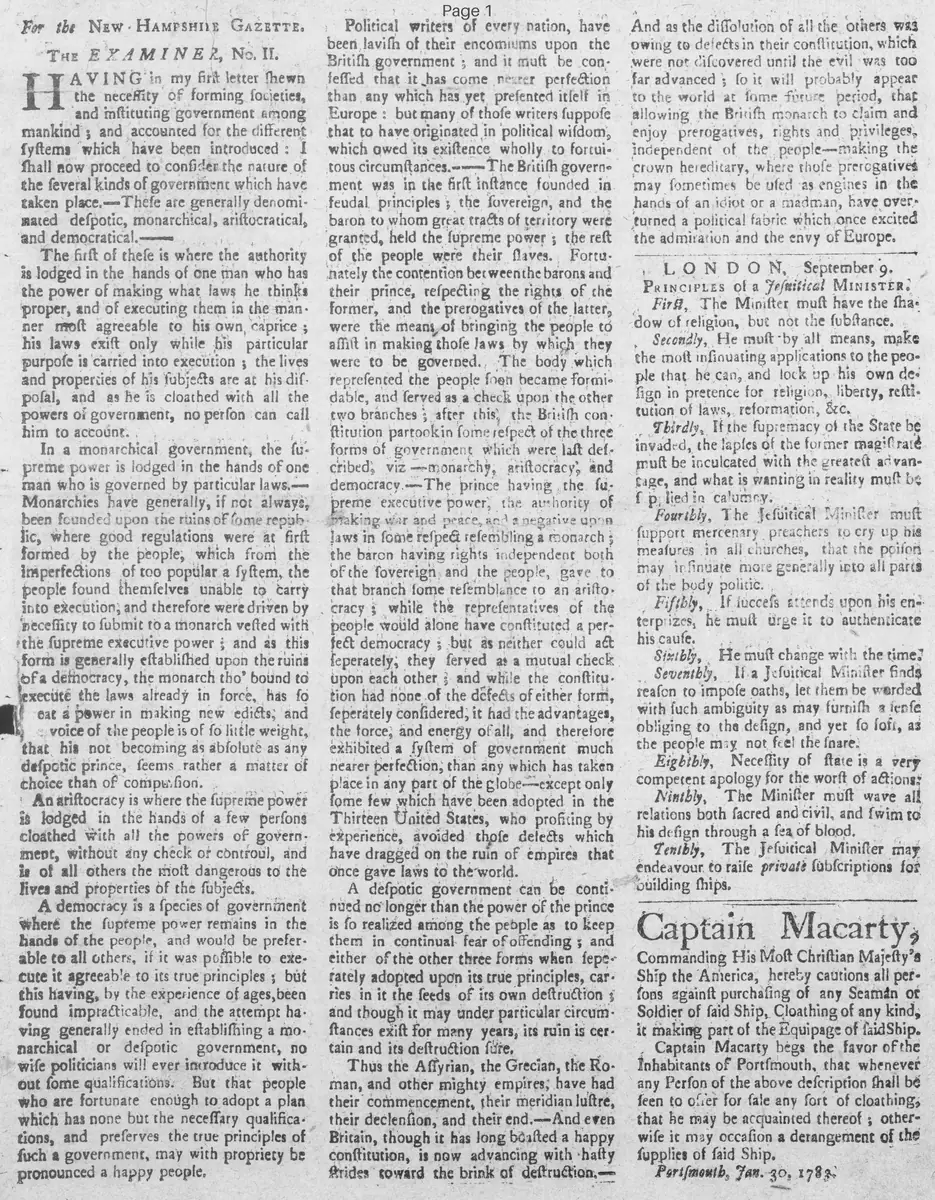
Having in my first letter shown the necessity of forming societies, and instituting government among mankind: and accounted for the different systems which have been introduced: I shall now proceed to consider the nature of the several kinds of government which have taken place.--These are generally denominated despotic, monarchical, aristocratical, and democratical.
The first of these is where the authority is lodged in the hands of one man who has the power of making what laws he thinks proper, and of executing them in the manner most agreeable to his own caprice; his laws exist only while his particular purpose is carried into execution; the lives and properties of his subjects are at his disposal, and as he is clothed with all the powers of government, no person can call him to account.
In a monarchical government, the supreme power is lodged in the hands of one man who is governed by particular laws. Monarchies have generally, if not always, been founded upon the ruins of some republic, where good regulations were at first formed by the people, which from the imperfections of too popular a system, the people found themselves unable to carry into execution, and therefore were driven by necessity to submit to a monarch vested with the supreme executive power; and as this form is generally established upon the ruins of a democracy, the monarch though bound to execute the laws already in force, has so great a power in making new edicts, and the voice of the people is of so little weight, that his not becoming as absolute as any despotic prince, seems rather a matter of choice than of compulsion.
An aristocracy is where the supreme power is lodged in the hands of a few persons clothed with all the powers of government, without any check or controul, and is of all others the most dangerous to the lives and properties of the subjects.
A democracy is a species of government where the supreme power remains in the hands of the people, and would be preferable to all others, if it was possible to execute it agreeable to its true principles; but this having, by the experience of ages, been found impracticable, and the attempt having generally ended in establishing a monarchical or despotic government, no wise politicians will ever introduce it without some qualifications. But that people who are fortunate enough to adopt a plan which has none but the necessary qualifications, and preserves the true principles of such a government, may with propriety be pronounced a happy people.
Political writers of every nation, have been lavish of their encomiums upon the British government: and it must be confessed that it has come nearer perfection than any which has yet presented itself in Europe: but many of those writers suppose that to have originated in political wisdom, which owed its existence wholly to fortuitous circumstances. The British government was in the first instance founded in feudal principles; the sovereign, and the baron to whom great tracts of territory were granted, held the supreme power; the rest of the people were their slaves. Fortunately the contention between the barons and their prince, respecting the rights of the former, and the prerogatives of the latter, were the means of bringing the people to act in making those laws by which they were to be governed. The body which represented the people soon became formidable, and served as a check upon the other two branches: after this, the British constitution partook in some respect of the three forms of government which were last described, viz.--monarchy, aristocracy: and democracy. The prince having the supreme executive power, the authority of making war and peace, and a negative upon laws in some respect resembling a monarch: the baron having rights independent both of the sovereign and the people, gave to that branch some resemblance to an aristocracy while the representatives of the people would alone have constituted a perfect democracy: but as neither could act separately: they served as a mutual check upon each other; and while the constitution had none of the defects of either form, separately considered, it had the advantages, the force, and energy of all, and therefore exhibited a system of government much nearer perfection, than any which has taken place in any part of the globe--except only some few which have been adopted in the Thirteen United States, who profiting by experience, avoided those defects which have dragged on the ruin of empires that once gave laws to the world.
A despotic government can be continued no longer than the power of the prince is so realized among the people as to keep them in continual fear of offending; and either of the other three forms when separately adopted upon its true principles, carries in it the seeds of its own destruction; and though it may under particular circumstances exist for many years, its ruin is certain and its destruction sure.
Thus the Asian, the Grecian, the Roman, and other mighty empires, have had their commencement, their meridian lustre, their declension, and their end.--And even Britain, though it has long boasted a happy constitution, is now advancing with hasty strides toward the brink of destruction.
And as the dissolution of all the others was owing to defects in their constitution, which were not discovered until the evil was too far advanced; so it will probably appear to the world at some future period, that allowing the British monarch to claim and enjoy prerogatives, rights and privileges, independent of the people--making the crown hereditary, where those prerogatives may sometimes be used as engines in the hands of an idiot or a madman, have overturned a political fabric which once excited the admiration and the envy of Europe.
THE EXAMINER, NO. II.
Having in my first letter shown the necessity of forming societies, and instituting government among mankind: and accounted for the different systems which have been introduced: I shall now proceed to consider the nature of the several kinds of government which have taken place.--These are generally denominated despotic, monarchical, aristocratical, and democratical.
The first of these is where the authority is lodged in the hands of one man who has the power of making what laws he thinks proper, and of executing them in the manner most agreeable to his own caprice; his laws exist only while his particular purpose is carried into execution; the lives and properties of his subjects are at his disposal, and as he is clothed with all the powers of government, no person can call him to account.
In a monarchical government, the supreme power is lodged in the hands of one man who is governed by particular laws. Monarchies have generally, if not always, been founded upon the ruins of some republic, where good regulations were at first formed by the people, which from the imperfections of too popular a system, the people found themselves unable to carry into execution, and therefore were driven by necessity to submit to a monarch vested with the supreme executive power; and as this form is generally established upon the ruins of a democracy, the monarch though bound to execute the laws already in force, has so great a power in making new edicts, and the voice of the people is of so little weight, that his not becoming as absolute as any despotic prince, seems rather a matter of choice than of compulsion.
An aristocracy is where the supreme power is lodged in the hands of a few persons clothed with all the powers of government, without any check or controul, and is of all others the most dangerous to the lives and properties of the subjects.
A democracy is a species of government where the supreme power remains in the hands of the people, and would be preferable to all others, if it was possible to execute it agreeable to its true principles; but this having, by the experience of ages, been found impracticable, and the attempt having generally ended in establishing a monarchical or despotic government, no wise politicians will ever introduce it without some qualifications. But that people who are fortunate enough to adopt a plan which has none but the necessary qualifications, and preserves the true principles of such a government, may with propriety be pronounced a happy people.
Political writers of every nation, have been lavish of their encomiums upon the British government: and it must be confessed that it has come nearer perfection than any which has yet presented itself in Europe: but many of those writers suppose that to have originated in political wisdom, which owed its existence wholly to fortuitous circumstances. The British government was in the first instance founded in feudal principles; the sovereign, and the baron to whom great tracts of territory were granted, held the supreme power; the rest of the people were their slaves. Fortunately the contention between the barons and their prince, respecting the rights of the former, and the prerogatives of the latter, were the means of bringing the people to act in making those laws by which they were to be governed. The body which represented the people soon became formidable, and served as a check upon the other two branches: after this, the British constitution partook in some respect of the three forms of government which were last described, viz.--monarchy, aristocracy: and democracy. The prince having the supreme executive power, the authority of making war and peace, and a negative upon laws in some respect resembling a monarch: the baron having rights independent both of the sovereign and the people, gave to that branch some resemblance to an aristocracy while the representatives of the people would alone have constituted a perfect democracy: but as neither could act separately: they served as a mutual check upon each other; and while the constitution had none of the defects of either form, separately considered, it had the advantages, the force, and energy of all, and therefore exhibited a system of government much nearer perfection, than any which has taken place in any part of the globe--except only some few which have been adopted in the Thirteen United States, who profiting by experience, avoided those defects which have dragged on the ruin of empires that once gave laws to the world.
A despotic government can be continued no longer than the power of the prince is so realized among the people as to keep them in continual fear of offending; and either of the other three forms when separately adopted upon its true principles, carries in it the seeds of its own destruction; and though it may under particular circumstances exist for many years, its ruin is certain and its destruction sure.
Thus the Asian, the Grecian, the Roman, and other mighty empires, have had their commencement, their meridian lustre, their declension, and their end.--And even Britain, though it has long boasted a happy constitution, is now advancing with hasty strides toward the brink of destruction.
And as the dissolution of all the others was owing to defects in their constitution, which were not discovered until the evil was too far advanced; so it will probably appear to the world at some future period, that allowing the British monarch to claim and enjoy prerogatives, rights and privileges, independent of the people--making the crown hereditary, where those prerogatives may sometimes be used as engines in the hands of an idiot or a madman, have overturned a political fabric which once excited the admiration and the envy of Europe.
What sub-type of article is it?
Constitutional
What keywords are associated?
Government Forms
Despotism
Monarchy
Aristocracy
Democracy
British Constitution
Mixed Government
American States
What entities or persons were involved?
British Government
Thirteen United States
Monarch
Barons
People
Editorial Details
Primary Topic
Analysis Of Government Forms And Mixed Constitutions
Stance / Tone
Analytical Praise For Balanced Government With Critique Of British Flaws
Key Figures
British Government
Thirteen United States
Monarch
Barons
People
Key Arguments
Despotic Government Relies On Fear And Absolute Power In One Man.
Monarchies Arise From Failed Democracies And Risk Becoming Despotic.
Aristocracy Is Dangerous Without Checks.
Pure Democracy Is Ideal But Impracticable Without Qualifications.
British Constitution Mixes Monarchy, Aristocracy, And Democracy For Balance.
American Systems Improve On Historical Models By Avoiding Defects.
All Pure Governments Contain Seeds Of Destruction.
British Hereditary Monarchy Risks Ruin Through Flawed Prerogatives.