Thank you for visiting SNEWPapers!
Sign up free
Editorial
April 1, 1780
The Virginia Gazette
Richmond, Williamsburg, Richmond County, Virginia
What is this article about?
Editorial argues that Britain's financial war against America fails due to US currency depreciation, which has effectively discharged 196.5 million of 200 million dollars in debt. Proposes no new taxes to improve currency, as it would unjustly burden the public; the real debt is only 3.5 million hard dollars.
Clipping
OCR Quality
95%
Excellent
Full Text
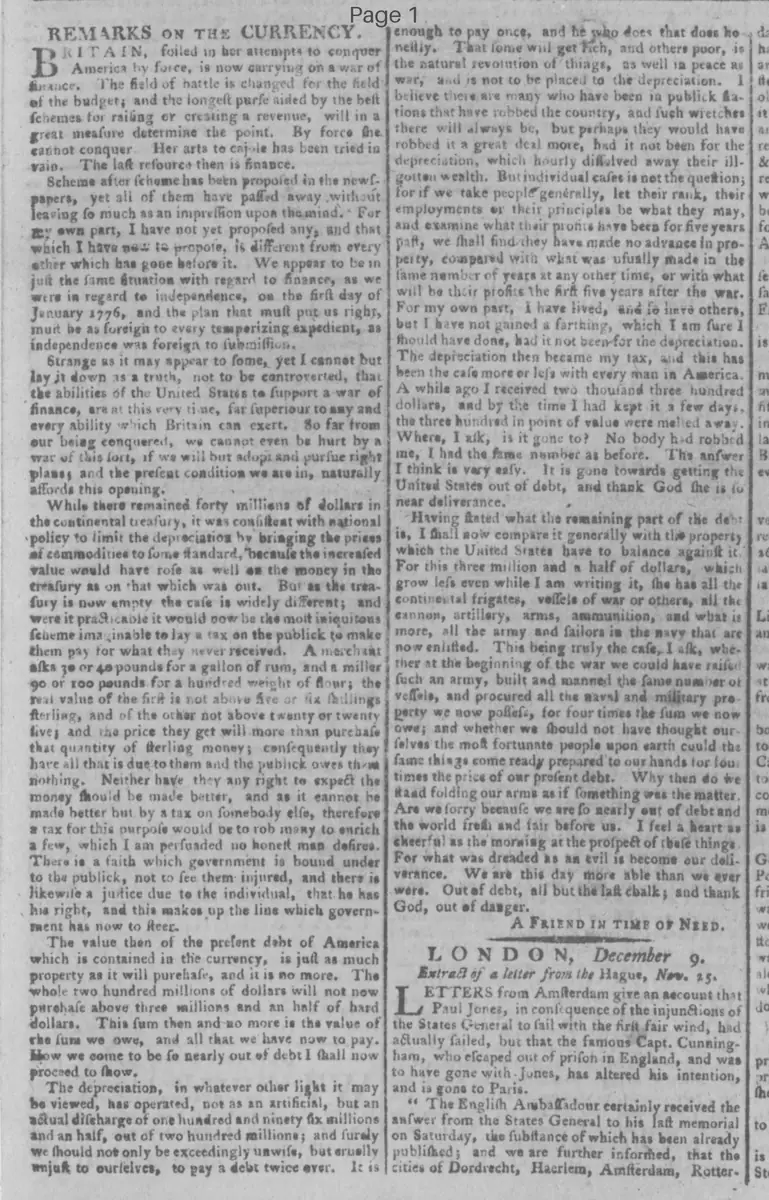
REMARKS ON THE CURRENCY.
BRITAIN, foiled in her attempts to conquer America by force, is now carrying on a war of finance.
The field of battle is changed for the field of the budget; and the longest purse aided by the best schemes for raising or creating a revenue, will in a great measure determine the point.
By force she cannot conquer. Her arts to cajole have been tried in vain. The last resource then is finance.
Scheme after scheme has been proposed in the newspapers, yet all of them have passed away without leaving so much as an impression upon the mind. For my own part, I have not yet proposed any, and that which I have now to propose, is different from every other which has gone before it.
We appear to be in just the same situation with regard to finance, as we were in regard to independence, on the first day of January 1776, and the plan that must put us right, must be as foreign to every temporizing expedient, as independence was foreign to submission.
Strange as it may appear to some, yet I cannot but lay it down as a truth, not to be controverted, that the abilities of the United States to support a war of finance, are at this very time, far superior to any and every ability which Britain can exert.
So far from our being conquered, we cannot even be hurt by a war of this sort, if we will but adopt and pursue right plans; and the present condition we are in, naturally affords this opening.
While there remained forty millions of dollars in the continental treasury, it was consistent with national policy to limit the depreciation by bringing the prices of commodities to some standard, because the increased value would have rose as well the money in the treasury as that which was out.
But as the treasury is now empty the case is widely different; and were it practicable it would now be the most iniquitous scheme imaginable to lay a tax on the public to make them pay for what they never received.
Merchant asks 30 or 40 pounds for a gallon of rum, and a miller 50 or 100 pounds for a hundred weight of flour; the real value of the first is not above five or six shillings sterling, and of the other not above twenty or twenty five and the price they get will more than purchase that quantity of sterling money; consequently they have all that is due to them and the public owes them nothing.
Neither have they any right to expect the money should be made better, and as it cannot be made better but by a tax on somebody else, therefore a tax for this purpose would be to rob many to enrich a few, which I am persuaded no honest man desires.
There is a faith which government is bound under to the public, not to see them injured, and there is likewise a justice due to the individual, that he has his right, and this makes up the line which government has now to steer.
The value then of the present debt of America which is contained in this currency, is just as much property as it will purchase, and it is no more.
The whole two hundred millions of dollars will not now purchase above three millions and a half of hard dollars. This sum then and no more is the value of the sum we owe, and all that we have now to pay.
How we come to be so nearly out of debt I shall now proceed to show.
The depreciation, in whatever other light it may be viewed, has operated, not as an artificial, but an actual discharge of one hundred and ninety six millions and a half, out of two hundred millions; and surely we should not only be exceedingly unwise, but cruelly unjust to ourselves, to pay a debt twice over.
It is enough to pay once, and he who does that does honestly.
BRITAIN, foiled in her attempts to conquer America by force, is now carrying on a war of finance.
The field of battle is changed for the field of the budget; and the longest purse aided by the best schemes for raising or creating a revenue, will in a great measure determine the point.
By force she cannot conquer. Her arts to cajole have been tried in vain. The last resource then is finance.
Scheme after scheme has been proposed in the newspapers, yet all of them have passed away without leaving so much as an impression upon the mind. For my own part, I have not yet proposed any, and that which I have now to propose, is different from every other which has gone before it.
We appear to be in just the same situation with regard to finance, as we were in regard to independence, on the first day of January 1776, and the plan that must put us right, must be as foreign to every temporizing expedient, as independence was foreign to submission.
Strange as it may appear to some, yet I cannot but lay it down as a truth, not to be controverted, that the abilities of the United States to support a war of finance, are at this very time, far superior to any and every ability which Britain can exert.
So far from our being conquered, we cannot even be hurt by a war of this sort, if we will but adopt and pursue right plans; and the present condition we are in, naturally affords this opening.
While there remained forty millions of dollars in the continental treasury, it was consistent with national policy to limit the depreciation by bringing the prices of commodities to some standard, because the increased value would have rose as well the money in the treasury as that which was out.
But as the treasury is now empty the case is widely different; and were it practicable it would now be the most iniquitous scheme imaginable to lay a tax on the public to make them pay for what they never received.
Merchant asks 30 or 40 pounds for a gallon of rum, and a miller 50 or 100 pounds for a hundred weight of flour; the real value of the first is not above five or six shillings sterling, and of the other not above twenty or twenty five and the price they get will more than purchase that quantity of sterling money; consequently they have all that is due to them and the public owes them nothing.
Neither have they any right to expect the money should be made better, and as it cannot be made better but by a tax on somebody else, therefore a tax for this purpose would be to rob many to enrich a few, which I am persuaded no honest man desires.
There is a faith which government is bound under to the public, not to see them injured, and there is likewise a justice due to the individual, that he has his right, and this makes up the line which government has now to steer.
The value then of the present debt of America which is contained in this currency, is just as much property as it will purchase, and it is no more.
The whole two hundred millions of dollars will not now purchase above three millions and a half of hard dollars. This sum then and no more is the value of the sum we owe, and all that we have now to pay.
How we come to be so nearly out of debt I shall now proceed to show.
The depreciation, in whatever other light it may be viewed, has operated, not as an artificial, but an actual discharge of one hundred and ninety six millions and a half, out of two hundred millions; and surely we should not only be exceedingly unwise, but cruelly unjust to ourselves, to pay a debt twice over.
It is enough to pay once, and he who does that does honestly.
What sub-type of article is it?
Economic Policy
War Or Peace
What keywords are associated?
Currency Depreciation
National Debt
War Finance
Taxation Injustice
Continental Currency
Revolutionary War
What entities or persons were involved?
Britain
United States
Continental Treasury
Editorial Details
Primary Topic
Currency Depreciation As Debt Discharge In Revolutionary War Finance
Stance / Tone
Advocacy For Accepting Depreciation To Avoid Unjust Taxation
Key Figures
Britain
United States
Continental Treasury
Key Arguments
Britain's Financial War Cannot Conquer America Due To Superior Us Abilities
Currency Depreciation Has Discharged 196.5 Million Of 200 Million Dollars In Debt
Taxing To Improve Currency Value Would Be Iniquitous And Rob Many To Enrich Few
Real Debt Value Is Only 3.5 Million Hard Dollars Based On Purchasing Power
Government Must Balance Public Faith And Individual Justice Without Double Paying Debt