Thank you for visiting SNEWPapers!
Sign up free
Editorial
July 24, 1837
Vermont Watchman And State Journal
Montpelier, Washington County, Vermont
What is this article about?
Windham County Convention address on July 4, 1837, by Whig committee, draws parallels between Jackson-Van Buren administration's actions (vetoes, removals, bank 'experiment') and King George III's tyrannies in the Declaration of Independence, urging Whigs to resist and vote against the 'despots'.
Clipping
OCR Quality
98%
Excellent
Full Text
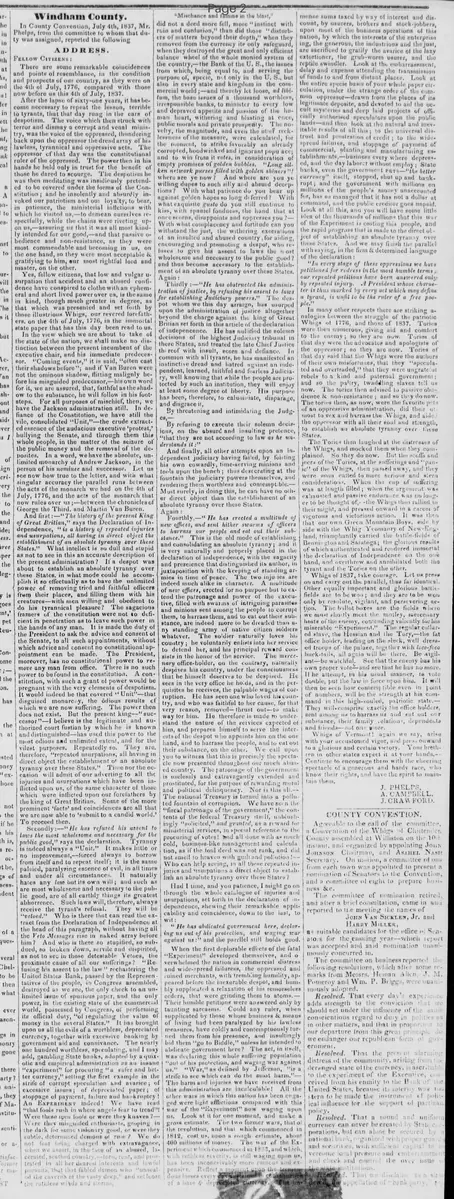
WINDHAM COUNTY.
In County Convention, July 4th, 1837, Mr. Phelps, from the committee to whom that duty was assigned, reported the following
ADDRESS.
Fellow Citizens:
There are some remarkable coincidences and points of resemblance, in the condition and prospects of our country, as they were on the 4th of July, 1776, compared with those now before us this 4th of July, 1837.
After the lapse of sixty-one years, it has become necessary to repeat the lesson, terrible to tyrants, that that day rung in the ears of despotism. The voice which then struck with terror and dismay a corrupt and venal ministry, was the voice of the oppressed, thundering back upon the oppressor the dread array of his lawless, tyrannical and oppressive acts. The oppressor of that day was the constitutional ruler of the oppressed. The power then in his hands he held only in trust for the benefit of those he dared to scourge. The despotism he was then meditating was insidiously pretended to be covered under the forms of the Constitution; and he insolently and absurdly invoked our patriotism and our loyalty, to bear, in patience, the ministerial inflictions with which he visited us,—to demean ourselves respectfully, while the chains were riveting upon us,—assuring us that it was all most kindly intended for our good,—and that passive obedience and non-resistance, as they were most commendable and becoming in us, on the one hand, so they were most acceptable & gratifying to him, our most rightful lord and master, on the other.
Yes, fellow citizens, that low and vulgar usurpation that accident and an abused confidence have conspired to clothe with an ephemeral and short lived power over us, is the same in kind, though much greater in degree, as that which was presented and set forth by those illustrious Whigs, our revered forefathers, on the 4th of July, 1776, in the immortal state paper that has this day been read to us.
In the view which we are about to take of the state of the nation, we shall make no distinction between the present incumbent of the executive chair, and his immediate predecessor. "Coming events," it is said, "often cast their shadows before"; and if Van Buren were not the ominous shadow, flitting malignly before his misguided predecessor,—his own word for it, we are assured, that, faithful as the shadow to the substance, he will follow in his footsteps. For all purposes of mischief, then, we have the Jackson administration still. In defiance of the Constitution, we have still the vile, consolidated "Unit,"—the crude extracted essence of the audacious executive "protest," bullying the Senate, and through them this whole people, in the matter of the seizure of the public money and the removal of the deposites. In a word, we have the absolute, unlimited monarchy of Andrew Jackson, in the person of his nominee and successor. Let us see now how true to the letter, and with what singular accuracy the parallel runs between the acts of the monarch we had on the 4th of July, 1776, and the acts of the monarch that now rules over us;—between the chronicles of George the Third, and Martin Van Buren.
And first:—"The history of the present King of Great Britain," says the Declaration of Independence, "is a history of repeated injuries and usurpations, all having in direct object the establishment of an absolute tyranny over these States." What intellect is so dull and stupid as not to see in this an accurate description of the present administration? If a despot was about to establish an absolute tyranny over these States, in what mode could he accomplish it so effectually as to have the unlimited power of removing tried and faithful officers from their places, and filling them with his creatures—with men willing and obedient to do his tyrannical pleasure? The sagacious framers of the constitution were not so deficient in penetration as to leave such power in the hands of any man. It is made the duty of the President to ask the advice and consent of the Senate, to all such appointments, without which advice and consent no constitutional appointment can be made. The President, moreover, has no constitutional power to remove any man from office. There is no such power to be found in the constitution. A constitution, with such a grant of power would be pregnant with the very elements of despotism. It would indeed be that covered "Unit"—that disguised monarchy, the odious results of which we are now suffering. The power then does not exist. But the present king—"successor"—I believe is the legitimate and authorized court jargon by which he is known and distinguished—has used this power to the most odious and unlimited extent, and for the vilest purposes. Repeatedly so. They are, therefore, "repeated usurpations, all having in direct object the establishment of an absolute tyranny over these States." Time nor the occasion will admit of our adverting to all the injuries and usurpations which have been inflicted upon us, of the same character of those which were inflicted upon our forefathers by the king of Great Britain. Some of the more prominent "facts" and coincidences are all that we are now able to "submit to a candid world."
To proceed then.
Secondly:—"He has refused his assent to laws the most wholesome and necessary for the public good," says the declaration. Tyranny is indeed always a "Unit." It makes little or no improvement,—forced always to borrow from itself and to repeat itself: it is the same palsied, paralysing essence of evil, in all times and under all circumstances. It naturally hates any law but its own will; and such as are most wholesome and necessary to the public good, are of all earthly things its greatest abhorrence. Such laws will, therefore, always receive the tyrant's refusal. They will be "vetoed." Who is there that can read the extract from the Declaration of Independence at the head of this paragraph, without having all the Veto Messages rise in naked array before him? And who is there so stupified, so subdued, so broken down, servile and dispirited, as not to see in those detestable Vetoes, the proximate cause of all our sufferings? "Refusing his assent to the law" rechartering the United States Bank, passed by the Representatives of the people, in Congress assembled, destroyed as we see, the only check to an unlimited issue of spurious paper, and the only power, in the existing state of the commercial world, possessed by Congress, of performing its official duty, "of regulating the value of money in the several States." It has brought upon us all the evils of a worthless, depreciated currency, together with excessive banking by government aid and connivance. The nearly one hundred worthless, speculating, and I may add, gambling State banks, adopted by a quixotic and empirical administration as an insane "experiment" for procuring "a safer and better currency," setting the first example in the strife of corrupt speculation and avarice; of excessive issues; of depreciated paper; of stoppage of payment, failure and bankruptcy! An Experiment indeed! We have read "that fools rush in where angels fear to tread"! Were these men fools or were they knaves?—Were they misguided enthusiasts, groping in the dark for some visionary good, or were they subtle, determined demons of ruin? We do not fear being charged with extravagance, when we assert, in the face of an abused, lacerated, scathed country,—torn, rent, and prostrated in all her dearest interests and lawful pursuits, that that fabled demon who "unscaled the caverns of the vasty deep," and set loose the ruthless winds and storms,
"Mischance and famine in the blast, did not a deed more fell, more "instinct with ruin and confusion," than did those "disturbers of matters beyond their depth," when they removed from the currency its only safeguard, when they destroyed the great and only efficient balance wheel of the whole monied system of the country,—the Bank of the U. S., the issues from which, being equal to, and serving the purpose of, specie, not only in the U. S., but also in every state and kingdom in the commercial world:—and thereby let loose, ad libitum, the base issues of a thousand worthless, irresponsible banks, to minister to every low and depraved appetite and passion of the human heart, withering and blasting at once, public morals and private prosperity. The novelty, the magnitude, and even the utter recklessness of the measure, were calculated, for the moment, to strike favorably an already corrupted, hoodwinked and ignorant populace; and to win from it votes, in consideration of empty promises of golden bubbles. "Long silken needle-work purses filled with golden shiners"! where are ye now? And where are you ye willing dupes to such silly and absurd deceptions? With what patience do you bear up against golden hopes so long deferred? With what exquisite gusto do you still continue to kiss, with spaniel fondness, the hand that at once scorns, disappoints and oppresses you?—With what complacency and fortitude can you withstand the just, the withering execrations of an insulted and abused country, for aiding, encouraging and promoting a despot, who refuses to give his assent to laws the most wholesome and necessary to the public good? and thus become accessory to the establishment of an absolute tyranny over these States.
Again:
Thirdly:—"He has obstructed the administration of justice, by refusing his assent to laws for establishing Judiciary powers." The despot whom we this day arraign, has usurped upon the administration of justice altogether beyond the charge against the king of Great Britain set forth in this article of the declaration of independence. He has nullified the solemn decisions of the highest Judiciary tribunal in these States, and treated the late Chief Justice thereof with insult, scorn and defiance. In common with all tyrants, he has manifested an instinctive dread and hatred against an independent, learned, faithful and fearless Judiciary, well knowing that while the people are protected by such an institution, they will enjoy at least some degree of liberty. His purpose has been, therefore, to calumniate, disparage, and disgrace it,
By threatening and intimidating the Judges,
By refusing to execute their solemn decisions, on the absurd and insulting pretence, "that they are not according to law as he understands it;"
And finally, all other attempts upon an independent judiciary having failed, by foisting his own cowardly, time-serving minions and tools upon the bench; thus desecrating at the fountain the judiciary powers themselves, and rendering them worthless and contemptible.—Most surely, in doing this, he can have no other direct object than the establishment of an absolute tyranny over these States.
Again:
Fourthly,—"He has erected a multitude of new offices, and sent hither swarms of officers to harrass our people and eat out their substance." This is the old mode of establishing and consolidating an absolute tyranny; and it is very naturally and properly placed in the declaration of independence, with the sagacity and prescience that distinguished its author, in juxtaposition with the keeping of standing armies in time of peace. The two injuries are indeed much alike in character. A multitude of new offices, erected for no purpose but to extend the patronage and power of the executive, filled with swarms of intriguing parasites and minions sent among the people to corrupt them, to harrass them, and to eat out their substance, are indeed more to be dreaded than any standing army of native citizen soldiers whatever. The soldier naturally loves his country; he voluntarily enlists into her service to defend her, and his principal reward consists in the honor of the service. The mercenary office-holder, on the contrary, naturally despises his country, under the consciousness that he himself deserves to be despised. He sees in the very office he holds, and in the perquisites he receives, the palpable wages of corruption. He has seen one who loved his country, and who was faithful to her cause, for that very reason, removed—thrust out—to make way for him. He therefore is made to understand the nature of the services expected of him, and prepares himself to serve the interests of the despot who appoints him on the one hand, and to harrass the people, and to eat out their substance, on the other. We call upon you to witness that this is precisely the spectacle now presented throughout our much abused country. The patronage of the government is uselessly and extravagantly extended and prostituted, for the purpose of rewarding moral and political delinquency. Nor is this all.—The national Treasury is turned into a polluted fountain of corruption. We have seen the "fiscal patronage of the government," the contents of the federal Treasury itself, unblushingly "solicited," and granted, as a reward for ministerial services, in special reference to the procuring of votes! and all done with as much cold, business-like management and calculation, as if the foul deed was not rank, and did not smell to heaven with guilt and pollution!—Who can help seeing, in all these repeated injuries and usurpations a direct object to establish an absolute tyranny over these States?
Had I time, and you patience, I might go on through the whole catalogue of injuries and usurpations, set forth in the declaration of independence, shewing their remarkable applicability and coincidence, down to the last, to wit:
"He has abdicated government here, declaring us out of his protection, and waging war against us:" and the parallel still holds good. When the first deplorable effects of the fatal "Experiment" developed themselves, and overwhelmed the nation in commercial distress and wide-spread failures, the oppressed and ruined merchants, with trembling humility, appeared before the inexorable despot, and humbly supplicated a relaxation of his remorseless orders, that were grinding them to atoms.—Their humble petitions were answered only by taunting sarcasms. Could any ruler, when supplicated by those whose business & means of living had been paralyzed by his lawless measures, have coldly and contemptuously turned them from his presence, and insultingly bid them "go to Biddle," unless he intended to abdicate government here? The act, in itself, was declaring this whole suffering population "out of his protection, and waging war against us." "War," as defined by Jefferson, "is a strife to see which can do the most harm."—The harm and injuries we have received from this administration are incalculable! All the other wars in which this nation has been engaged were light afflictions compared with this war of the "Experiment"
now waging upon us. Look at it for one moment, and make a gross estimate. The two former wars, that of the revolution, and that which commenced in 1812, cost us, upon a rough estimate, about 400 millions of money. The war of the Experiment which commenced in 1833, and which, with ruthless severity, is still waging upon us, has been inconceivably more ruinous and expensive. Add to the direct expenditures for the prosecution of the war, the immense sums taxed by way of interest and discount, by usurers, brokers and stock-jobbers, upon most of the business operations of this nation, by which the interests of the enterprising, the generous, the industrious and the just, are sacrificed to gratify the avarice of the lazy extortioner, the grub-worm usurer, and the reptile swindler. Look at the embarrassment, delay and expense attending the transmission of funds to and from distant places. Look at the entire specie basis of your whole paper circulation, under the strange order of this common oppressor—drawn from the places of its legitimate deposite, and devoted to aid the occult mysteries and deep laid projects of officially authorised speculators upon the public lands—and then look at the natural and inevitable results of all this; to the universal distrust and prostration of credit; to the wide-spread failures, and stoppage of payment of commercial, planting and manufacturing establishments,—business every where depressed, and the day laborer without employ; State banks, even the government pets—"the better currency" itself, stopped, shut up and bankrupt; and the government with millions on millions of the people's money unaccounted for, has so managed that it has not a dollar at command, and the public creditor goes unpaid. Look at all this, and you will have some little idea of the thousands of millions that this war of the Experiment is costing this people, and the rapid progress that is made to the direct object of establishing an absolute tyranny over these States. And we may finish the parallel with saying, in the firm & determined language of the declaration:
"In every stage of these oppressions we have petitioned for redress in the most humble terms, our repeated petitions have been answered only by repeated injury. A President whose character is thus marked by every act which may define a tyrant, is unfit to be the ruler of a free people."
In many other respects there are striking analogies between the struggle of the patriotic Whigs of 1776, and those of 1837. Tories were then numerous, giving aid and comfort to the enemy; so they are now. Tories of that day were the advocates and apologists of the oppressor; so they are now. Tories of that day said that the Whigs were the authors of their own misfortunes, that they "speculated and overtraded," that they were ungrateful rebels to a kind and paternal government; and so the paltry, twaddling slaves tell us now. The tories then advised to passive obedience & non-resistance; and so they do now. The tories then, as now, were the favorite pets of an oppressive administration, did their utmost to vex and harrass the Whigs, and aided the oppressor with all their soul and strength, to establish an absolute tyranny over these States.
The Tories then laughed at the distresses of the Whigs, and mocked them when they complained. "So they do now. But the scoffs and jeers of the Tories, at the sufferings and "panic" of the Whigs, then passed away, and they were soon called to more serious and stern considerations. When the cup of suffering was at length filled; when the argument was exhausted and passive endurance was no longer to be thought of,—the Whigs then rallied in their might, and pressed onward in a career of vigorous and victorious action. It was then that our own Green Mountain Boys, side by side with the Whig Yeomanry of New-England, triumphantly carried the battle-fields of Bennington and Saratoga; the glorious results of which authenticated and rendered immortal the declaration of Independence on the one hand, and overthrew and annihilated both the tyrant and the Tories on the other.
Whigs of 1837, take courage. Let us press on and carry out the parallel, thus far identical. Other equally important and glorious battle-fields are to be won; and they are to be won only by resolute, vigilant, and persevering action. The ballot boxes are the fields where we must shortly meet the motley, mercenary hosts of the enemy, contending valiantly for his miserable "Experiment." The regular collared slave, the Hessian and the Tory,—the fat office holder, leading on the sleek, well dressed troops of the palace, together with loco-foco buck-tails, all again will be there. Be vigilant—be watchful. See that the enemy has his own proper vote and see that he has no more. If he attempt, in his usual manner, to vote double, put the law in force upon him. It will then be seen how contemptible even in point of numbers, will be the strength at his command in this high-souled, patriotic state.—They will—comprise exactly the office holders, sent among us to harrass us and eat out our substance, their family relations, dependents and friends—not one more.
Whigs of Vermont! again we say, arise with your accustomed vigor, and press onward to a glorious and certain victory. Your brethren in other states expect it at your hands.—Continue to encourage them with the cheering spectacle of a generous and hardy race, who know their rights, and have the spirit to maintain them.
J. PHELPS,
A. CAMPBELL
J. CRAWFORD.
In County Convention, July 4th, 1837, Mr. Phelps, from the committee to whom that duty was assigned, reported the following
ADDRESS.
Fellow Citizens:
There are some remarkable coincidences and points of resemblance, in the condition and prospects of our country, as they were on the 4th of July, 1776, compared with those now before us this 4th of July, 1837.
After the lapse of sixty-one years, it has become necessary to repeat the lesson, terrible to tyrants, that that day rung in the ears of despotism. The voice which then struck with terror and dismay a corrupt and venal ministry, was the voice of the oppressed, thundering back upon the oppressor the dread array of his lawless, tyrannical and oppressive acts. The oppressor of that day was the constitutional ruler of the oppressed. The power then in his hands he held only in trust for the benefit of those he dared to scourge. The despotism he was then meditating was insidiously pretended to be covered under the forms of the Constitution; and he insolently and absurdly invoked our patriotism and our loyalty, to bear, in patience, the ministerial inflictions with which he visited us,—to demean ourselves respectfully, while the chains were riveting upon us,—assuring us that it was all most kindly intended for our good,—and that passive obedience and non-resistance, as they were most commendable and becoming in us, on the one hand, so they were most acceptable & gratifying to him, our most rightful lord and master, on the other.
Yes, fellow citizens, that low and vulgar usurpation that accident and an abused confidence have conspired to clothe with an ephemeral and short lived power over us, is the same in kind, though much greater in degree, as that which was presented and set forth by those illustrious Whigs, our revered forefathers, on the 4th of July, 1776, in the immortal state paper that has this day been read to us.
In the view which we are about to take of the state of the nation, we shall make no distinction between the present incumbent of the executive chair, and his immediate predecessor. "Coming events," it is said, "often cast their shadows before"; and if Van Buren were not the ominous shadow, flitting malignly before his misguided predecessor,—his own word for it, we are assured, that, faithful as the shadow to the substance, he will follow in his footsteps. For all purposes of mischief, then, we have the Jackson administration still. In defiance of the Constitution, we have still the vile, consolidated "Unit,"—the crude extracted essence of the audacious executive "protest," bullying the Senate, and through them this whole people, in the matter of the seizure of the public money and the removal of the deposites. In a word, we have the absolute, unlimited monarchy of Andrew Jackson, in the person of his nominee and successor. Let us see now how true to the letter, and with what singular accuracy the parallel runs between the acts of the monarch we had on the 4th of July, 1776, and the acts of the monarch that now rules over us;—between the chronicles of George the Third, and Martin Van Buren.
And first:—"The history of the present King of Great Britain," says the Declaration of Independence, "is a history of repeated injuries and usurpations, all having in direct object the establishment of an absolute tyranny over these States." What intellect is so dull and stupid as not to see in this an accurate description of the present administration? If a despot was about to establish an absolute tyranny over these States, in what mode could he accomplish it so effectually as to have the unlimited power of removing tried and faithful officers from their places, and filling them with his creatures—with men willing and obedient to do his tyrannical pleasure? The sagacious framers of the constitution were not so deficient in penetration as to leave such power in the hands of any man. It is made the duty of the President to ask the advice and consent of the Senate, to all such appointments, without which advice and consent no constitutional appointment can be made. The President, moreover, has no constitutional power to remove any man from office. There is no such power to be found in the constitution. A constitution, with such a grant of power would be pregnant with the very elements of despotism. It would indeed be that covered "Unit"—that disguised monarchy, the odious results of which we are now suffering. The power then does not exist. But the present king—"successor"—I believe is the legitimate and authorized court jargon by which he is known and distinguished—has used this power to the most odious and unlimited extent, and for the vilest purposes. Repeatedly so. They are, therefore, "repeated usurpations, all having in direct object the establishment of an absolute tyranny over these States." Time nor the occasion will admit of our adverting to all the injuries and usurpations which have been inflicted upon us, of the same character of those which were inflicted upon our forefathers by the king of Great Britain. Some of the more prominent "facts" and coincidences are all that we are now able to "submit to a candid world."
To proceed then.
Secondly:—"He has refused his assent to laws the most wholesome and necessary for the public good," says the declaration. Tyranny is indeed always a "Unit." It makes little or no improvement,—forced always to borrow from itself and to repeat itself: it is the same palsied, paralysing essence of evil, in all times and under all circumstances. It naturally hates any law but its own will; and such as are most wholesome and necessary to the public good, are of all earthly things its greatest abhorrence. Such laws will, therefore, always receive the tyrant's refusal. They will be "vetoed." Who is there that can read the extract from the Declaration of Independence at the head of this paragraph, without having all the Veto Messages rise in naked array before him? And who is there so stupified, so subdued, so broken down, servile and dispirited, as not to see in those detestable Vetoes, the proximate cause of all our sufferings? "Refusing his assent to the law" rechartering the United States Bank, passed by the Representatives of the people, in Congress assembled, destroyed as we see, the only check to an unlimited issue of spurious paper, and the only power, in the existing state of the commercial world, possessed by Congress, of performing its official duty, "of regulating the value of money in the several States." It has brought upon us all the evils of a worthless, depreciated currency, together with excessive banking by government aid and connivance. The nearly one hundred worthless, speculating, and I may add, gambling State banks, adopted by a quixotic and empirical administration as an insane "experiment" for procuring "a safer and better currency," setting the first example in the strife of corrupt speculation and avarice; of excessive issues; of depreciated paper; of stoppage of payment, failure and bankruptcy! An Experiment indeed! We have read "that fools rush in where angels fear to tread"! Were these men fools or were they knaves?—Were they misguided enthusiasts, groping in the dark for some visionary good, or were they subtle, determined demons of ruin? We do not fear being charged with extravagance, when we assert, in the face of an abused, lacerated, scathed country,—torn, rent, and prostrated in all her dearest interests and lawful pursuits, that that fabled demon who "unscaled the caverns of the vasty deep," and set loose the ruthless winds and storms,
"Mischance and famine in the blast, did not a deed more fell, more "instinct with ruin and confusion," than did those "disturbers of matters beyond their depth," when they removed from the currency its only safeguard, when they destroyed the great and only efficient balance wheel of the whole monied system of the country,—the Bank of the U. S., the issues from which, being equal to, and serving the purpose of, specie, not only in the U. S., but also in every state and kingdom in the commercial world:—and thereby let loose, ad libitum, the base issues of a thousand worthless, irresponsible banks, to minister to every low and depraved appetite and passion of the human heart, withering and blasting at once, public morals and private prosperity. The novelty, the magnitude, and even the utter recklessness of the measure, were calculated, for the moment, to strike favorably an already corrupted, hoodwinked and ignorant populace; and to win from it votes, in consideration of empty promises of golden bubbles. "Long silken needle-work purses filled with golden shiners"! where are ye now? And where are you ye willing dupes to such silly and absurd deceptions? With what patience do you bear up against golden hopes so long deferred? With what exquisite gusto do you still continue to kiss, with spaniel fondness, the hand that at once scorns, disappoints and oppresses you?—With what complacency and fortitude can you withstand the just, the withering execrations of an insulted and abused country, for aiding, encouraging and promoting a despot, who refuses to give his assent to laws the most wholesome and necessary to the public good? and thus become accessory to the establishment of an absolute tyranny over these States.
Again:
Thirdly:—"He has obstructed the administration of justice, by refusing his assent to laws for establishing Judiciary powers." The despot whom we this day arraign, has usurped upon the administration of justice altogether beyond the charge against the king of Great Britain set forth in this article of the declaration of independence. He has nullified the solemn decisions of the highest Judiciary tribunal in these States, and treated the late Chief Justice thereof with insult, scorn and defiance. In common with all tyrants, he has manifested an instinctive dread and hatred against an independent, learned, faithful and fearless Judiciary, well knowing that while the people are protected by such an institution, they will enjoy at least some degree of liberty. His purpose has been, therefore, to calumniate, disparage, and disgrace it,
By threatening and intimidating the Judges,
By refusing to execute their solemn decisions, on the absurd and insulting pretence, "that they are not according to law as he understands it;"
And finally, all other attempts upon an independent judiciary having failed, by foisting his own cowardly, time-serving minions and tools upon the bench; thus desecrating at the fountain the judiciary powers themselves, and rendering them worthless and contemptible.—Most surely, in doing this, he can have no other direct object than the establishment of an absolute tyranny over these States.
Again:
Fourthly,—"He has erected a multitude of new offices, and sent hither swarms of officers to harrass our people and eat out their substance." This is the old mode of establishing and consolidating an absolute tyranny; and it is very naturally and properly placed in the declaration of independence, with the sagacity and prescience that distinguished its author, in juxtaposition with the keeping of standing armies in time of peace. The two injuries are indeed much alike in character. A multitude of new offices, erected for no purpose but to extend the patronage and power of the executive, filled with swarms of intriguing parasites and minions sent among the people to corrupt them, to harrass them, and to eat out their substance, are indeed more to be dreaded than any standing army of native citizen soldiers whatever. The soldier naturally loves his country; he voluntarily enlists into her service to defend her, and his principal reward consists in the honor of the service. The mercenary office-holder, on the contrary, naturally despises his country, under the consciousness that he himself deserves to be despised. He sees in the very office he holds, and in the perquisites he receives, the palpable wages of corruption. He has seen one who loved his country, and who was faithful to her cause, for that very reason, removed—thrust out—to make way for him. He therefore is made to understand the nature of the services expected of him, and prepares himself to serve the interests of the despot who appoints him on the one hand, and to harrass the people, and to eat out their substance, on the other. We call upon you to witness that this is precisely the spectacle now presented throughout our much abused country. The patronage of the government is uselessly and extravagantly extended and prostituted, for the purpose of rewarding moral and political delinquency. Nor is this all.—The national Treasury is turned into a polluted fountain of corruption. We have seen the "fiscal patronage of the government," the contents of the federal Treasury itself, unblushingly "solicited," and granted, as a reward for ministerial services, in special reference to the procuring of votes! and all done with as much cold, business-like management and calculation, as if the foul deed was not rank, and did not smell to heaven with guilt and pollution!—Who can help seeing, in all these repeated injuries and usurpations a direct object to establish an absolute tyranny over these States?
Had I time, and you patience, I might go on through the whole catalogue of injuries and usurpations, set forth in the declaration of independence, shewing their remarkable applicability and coincidence, down to the last, to wit:
"He has abdicated government here, declaring us out of his protection, and waging war against us:" and the parallel still holds good. When the first deplorable effects of the fatal "Experiment" developed themselves, and overwhelmed the nation in commercial distress and wide-spread failures, the oppressed and ruined merchants, with trembling humility, appeared before the inexorable despot, and humbly supplicated a relaxation of his remorseless orders, that were grinding them to atoms.—Their humble petitions were answered only by taunting sarcasms. Could any ruler, when supplicated by those whose business & means of living had been paralyzed by his lawless measures, have coldly and contemptuously turned them from his presence, and insultingly bid them "go to Biddle," unless he intended to abdicate government here? The act, in itself, was declaring this whole suffering population "out of his protection, and waging war against us." "War," as defined by Jefferson, "is a strife to see which can do the most harm."—The harm and injuries we have received from this administration are incalculable! All the other wars in which this nation has been engaged were light afflictions compared with this war of the "Experiment"
now waging upon us. Look at it for one moment, and make a gross estimate. The two former wars, that of the revolution, and that which commenced in 1812, cost us, upon a rough estimate, about 400 millions of money. The war of the Experiment which commenced in 1833, and which, with ruthless severity, is still waging upon us, has been inconceivably more ruinous and expensive. Add to the direct expenditures for the prosecution of the war, the immense sums taxed by way of interest and discount, by usurers, brokers and stock-jobbers, upon most of the business operations of this nation, by which the interests of the enterprising, the generous, the industrious and the just, are sacrificed to gratify the avarice of the lazy extortioner, the grub-worm usurer, and the reptile swindler. Look at the embarrassment, delay and expense attending the transmission of funds to and from distant places. Look at the entire specie basis of your whole paper circulation, under the strange order of this common oppressor—drawn from the places of its legitimate deposite, and devoted to aid the occult mysteries and deep laid projects of officially authorised speculators upon the public lands—and then look at the natural and inevitable results of all this; to the universal distrust and prostration of credit; to the wide-spread failures, and stoppage of payment of commercial, planting and manufacturing establishments,—business every where depressed, and the day laborer without employ; State banks, even the government pets—"the better currency" itself, stopped, shut up and bankrupt; and the government with millions on millions of the people's money unaccounted for, has so managed that it has not a dollar at command, and the public creditor goes unpaid. Look at all this, and you will have some little idea of the thousands of millions that this war of the Experiment is costing this people, and the rapid progress that is made to the direct object of establishing an absolute tyranny over these States. And we may finish the parallel with saying, in the firm & determined language of the declaration:
"In every stage of these oppressions we have petitioned for redress in the most humble terms, our repeated petitions have been answered only by repeated injury. A President whose character is thus marked by every act which may define a tyrant, is unfit to be the ruler of a free people."
In many other respects there are striking analogies between the struggle of the patriotic Whigs of 1776, and those of 1837. Tories were then numerous, giving aid and comfort to the enemy; so they are now. Tories of that day were the advocates and apologists of the oppressor; so they are now. Tories of that day said that the Whigs were the authors of their own misfortunes, that they "speculated and overtraded," that they were ungrateful rebels to a kind and paternal government; and so the paltry, twaddling slaves tell us now. The tories then advised to passive obedience & non-resistance; and so they do now. The tories then, as now, were the favorite pets of an oppressive administration, did their utmost to vex and harrass the Whigs, and aided the oppressor with all their soul and strength, to establish an absolute tyranny over these States.
The Tories then laughed at the distresses of the Whigs, and mocked them when they complained. "So they do now. But the scoffs and jeers of the Tories, at the sufferings and "panic" of the Whigs, then passed away, and they were soon called to more serious and stern considerations. When the cup of suffering was at length filled; when the argument was exhausted and passive endurance was no longer to be thought of,—the Whigs then rallied in their might, and pressed onward in a career of vigorous and victorious action. It was then that our own Green Mountain Boys, side by side with the Whig Yeomanry of New-England, triumphantly carried the battle-fields of Bennington and Saratoga; the glorious results of which authenticated and rendered immortal the declaration of Independence on the one hand, and overthrew and annihilated both the tyrant and the Tories on the other.
Whigs of 1837, take courage. Let us press on and carry out the parallel, thus far identical. Other equally important and glorious battle-fields are to be won; and they are to be won only by resolute, vigilant, and persevering action. The ballot boxes are the fields where we must shortly meet the motley, mercenary hosts of the enemy, contending valiantly for his miserable "Experiment." The regular collared slave, the Hessian and the Tory,—the fat office holder, leading on the sleek, well dressed troops of the palace, together with loco-foco buck-tails, all again will be there. Be vigilant—be watchful. See that the enemy has his own proper vote and see that he has no more. If he attempt, in his usual manner, to vote double, put the law in force upon him. It will then be seen how contemptible even in point of numbers, will be the strength at his command in this high-souled, patriotic state.—They will—comprise exactly the office holders, sent among us to harrass us and eat out our substance, their family relations, dependents and friends—not one more.
Whigs of Vermont! again we say, arise with your accustomed vigor, and press onward to a glorious and certain victory. Your brethren in other states expect it at your hands.—Continue to encourage them with the cheering spectacle of a generous and hardy race, who know their rights, and have the spirit to maintain them.
J. PHELPS,
A. CAMPBELL
J. CRAWFORD.
What sub-type of article is it?
Partisan Politics
Constitutional
Economic Policy
What keywords are associated?
Jackson Administration
Van Buren
Tyranny
Declaration Of Independence
Bank Veto
Economic Experiment
Whig Exhortation
Vermont Whigs
What entities or persons were involved?
Andrew Jackson
Martin Van Buren
George Iii
Whigs
Tories
J. Phelps
A. Campbell
J. Crawford
Editorial Details
Primary Topic
Parallels Between Jackson Van Buren Administration And George Iii's Tyranny
Stance / Tone
Strongly Anti Administration, Pro Whig Exhortation
Key Figures
Andrew Jackson
Martin Van Buren
George Iii
Whigs
Tories
J. Phelps
A. Campbell
J. Crawford
Key Arguments
Repeated Usurpations Like Removals And Appointments Establish Absolute Tyranny
Veto Of Bank Recharter Caused Economic Ruin And Depreciated Currency
Obstruction Of Justice By Nullifying Court Decisions And Appointing Minions
Creation Of New Offices And Officers To Harass And Corrupt The People
Administration's 'Experiment' Wages Economic War, Costing Billions
Petitions For Redress Answered With Injury, Marking The President As A Tyrant
Tories Aid The Oppressor As In 1776; Whigs Must Rally At Ballot Boxes