Thank you for visiting SNEWPapers!
Sign up free
Arkansas Intelligencer
Van Buren, Crawford County, Arkansas
What is this article about?
Col. Doniphan's expedition in Navajo territory involved a treaty with the Navajos who supplied provisions; his command then visited the agricultural city of the Sumai Indians on the Rio Pescado, made a peace treaty with them and the Navajos, and returned to the Rio del Norte. The Sumai city, with 6,000 inhabitants, features unique architecture and isolation from Mexicans.
Clipping
OCR Quality
Full Text
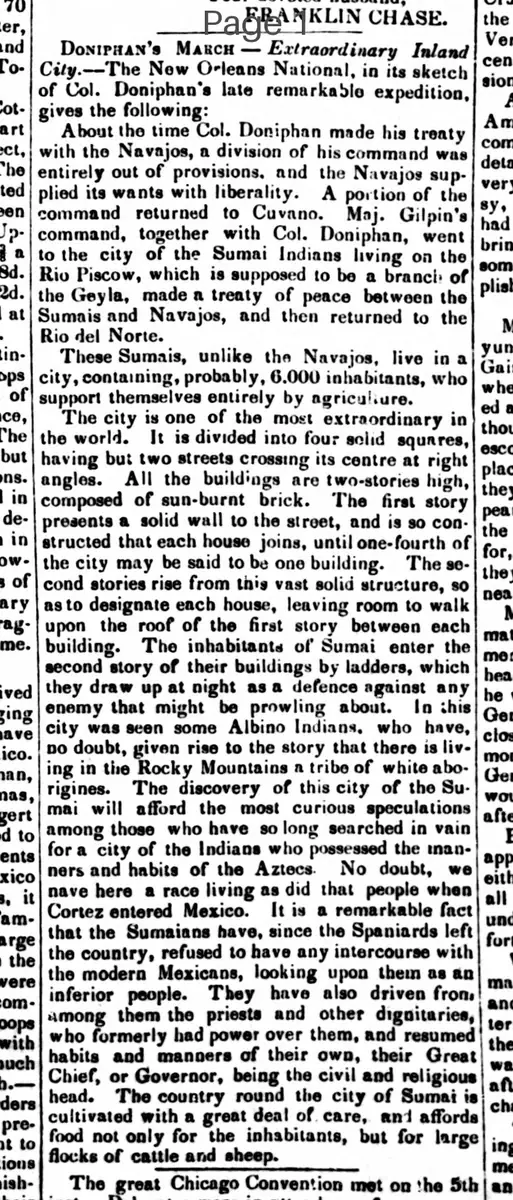
About the time Col. Doniphan made his treaty with the Navajos, a division of his command was entirely out of provisions, and the Navajos supplied its wants with liberality. A portion of the command returned to Cubero. Maj. Gilpin's command, together with Col. Doniphan, went to the city of the Sumai Indians living on the Rio Pescado, which is supposed to be a branch of the Gila, made a treaty of peace between the Sumais and Navajos, and then returned to the Rio del Norte. These Sumais, unlike the Navajos, live in a city, containing, probably, 6,000 inhabitants, who support themselves entirely by agriculture. The city is one of the most extraordinary in the world. It is divided into four solid squares, having but two streets crossing its centre at right angles. All the buildings are two-stories high, composed of sun-burnt brick. The first story presents a solid wall to the street, and is so constructed that each house joins, until one-fourth of the city may be said to be one building. The second stories rise from this vast solid structure, so as to designate each house, leaving room to walk upon the roof of the first story between each building. The inhabitants of Sumai enter the second story of their buildings by ladders, which they draw up at night as a defence against any enemy that might be prowling about. In this city was seen some Albino Indians, who have, no doubt, given rise to the story that there is living in the Rocky Mountains a tribe of white aborigines. The discovery of this city of the Sumai will afford the most curious speculations among those who have so long searched in vain for a city of the Indians who possessed the manners and habits of the Aztecs. No doubt, we have here a race living as did that people when Cortez entered Mexico. It is a remarkable fact that the Sumaians have, since the Spaniards left the country, refused to have any intercourse with the modern Mexicans, looking upon them as an inferior people. They have also driven from among them the priests and other dignitaries, who formerly had power over them, and resumed habits and manners of their own, their Great Chief, or Governor, being the civil and religious head. The country round the city of Sumai is cultivated with a great deal of care, and affords food not only for the inhabitants, but for large flocks of cattle and sheep.
What sub-type of article is it?
What keywords are associated?
What entities or persons were involved?
Where did it happen?
Foreign News Details
Primary Location
City Of The Sumai Indians On The Rio Pescado
Key Persons
Outcome
treaty of peace between the sumais and navajos
Event Details
About the time Col. Doniphan made his treaty with the Navajos, a division of his command was entirely out of provisions, and the Navajos supplied its wants with liberality. A portion of the command returned to Cubero. Maj. Gilpin's command, together with Col. Doniphan, went to the city of the Sumai Indians living on the Rio Pescado, which is supposed to be a branch of the Gila, made a treaty of peace between the Sumais and Navajos, and then returned to the Rio del Norte. These Sumais live in a city containing probably 6,000 inhabitants who support themselves entirely by agriculture. The city is divided into four solid squares with two streets crossing at right angles; buildings are two-stories high of sun-burnt brick, first story solid walls joined together, second stories designate houses with walkable roofs below; entered by ladders drawn up at night for defense. Albino Indians seen there. Sumaians refused intercourse with modern Mexicans since Spaniards left, driven out priests, resumed own habits with Great Chief as civil and religious head. Surrounding country cultivated for inhabitants and livestock.