Thank you for visiting SNEWPapers!
Sign up free
Editorial
February 21, 1771
The Virginia Gazette
Richmond, Williamsburg, Richmond County, Virginia
What is this article about?
An anonymous editorial argues against the British Parliament's right to tax American colonies without representation, citing constitutional principles, historical precedents from Wales, Scotland, Ireland, and Guernsey, and affirming American loyalty to the Crown while warning of liberty's loss if taxation is imposed.
Clipping
OCR Quality
98%
Excellent
Full Text
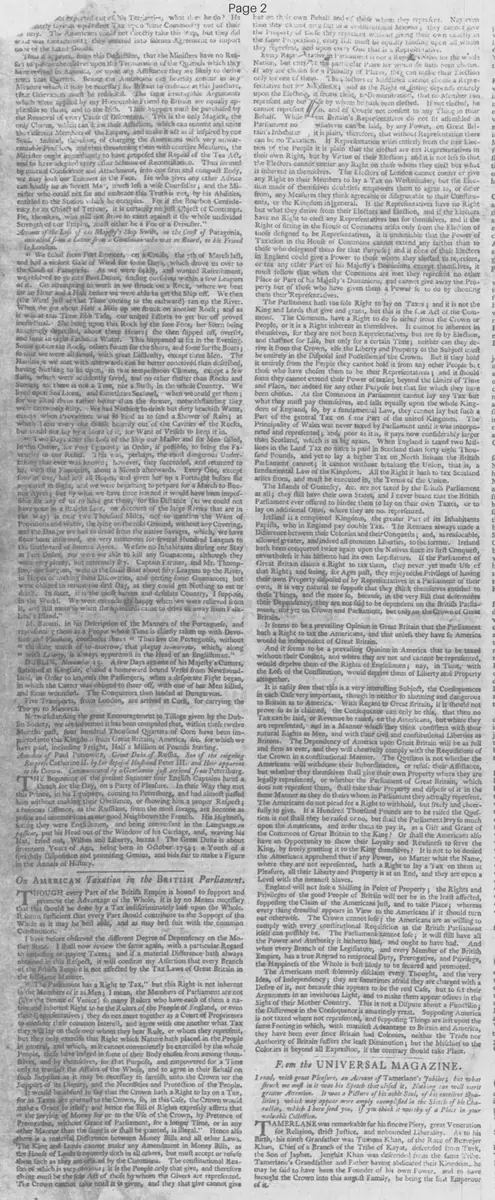
On AMERICAN Taxation in the BRITISH Parliament.
THOUGH every Part of the British Empire is bound to support and promote the Advantage of the Whole, it is by no Means necessary that this should be done by a Tax indiscriminately laid upon the Whole. It seems sufficient that every Part should contribute to the Support of the Whole as it may be best able, and as may best suit with the common Constitution.
I have before observed the different Degree of Dependency on the Mother State. I shall now review the Same again, with a particular Regard to imposing or paying Taxes; and if a material Difference hath always obtained in this Respect, it will confirm my Assertion that every Branch of the British Empire is not affected by the Tax Laws of Great Britain in the Self-same Manner.
The Parliament has a Right to Tax, but this Right is not inherent in the Members of it as Men; I mean, the Members of Parliament are not (like the Senate of Venice) so many Rulers who have each of them a native and inherent Right to be the Rulers of the People of England, or even their Representatives; they do not meet together as a Court of Proprietors to consider their common Interest, and agree with one another what Tax they will lay on those over whom they bear Rule, or whom they represent, but they only exercise that Right which Nature hath placed in the People in general, and which, as it cannot conveniently be exercised by the whole People, these have lodged in some of their Body chosen from among themselves, and by themselves, for that Purpose, and empowered for a Time only to transact the Affairs of the Whole, and to agree in their Behalf on such Supplies as it may be necessary to furnish unto the Crown for the Support of its Dignity, and the Necessities and Protection of the People.
It would be absurd to say that the Crown hath a Right to lay on a Tax, for as Taxes are granted to the Crown, so, in this Case, the Crown would make a Grant to itself; and hence the Bill of Rights expressly asserts that the levying of Money for or to the Use of the Crown, by Pretence of Prerogative, without Grant of Parliament, for a longer Time, or in any other Manner than the Same is or shall be granted, is illegal. Hence also there is a material Difference between Money Bills and all other Laws. The King and Lords cannot make any Amendment in Money Bills, as the House of Lords frequently doth in all others, but must accept or refuse them such as they are offered by the Commons. The constitutional Reason of which is very obvious; it is the People only that give, and therefore everything must be the sole Act of those by whom the Givers are represented. The Crown cannot take until it is given, and they that give cannot give but on their own Behalf and those whom they represent. Nay even then they cannot give but in a constitutional Manner; they cannot give the Property of those they represent without giving their own exactly in the same Proportion; every Bill must be equally binding upon all whom they represent, and upon every One that is a Representative.
Every Representative in Parliament is not a Representative for the whole Nation, but only for the particular Place for which he hath been chosen. If any are chosen for Plurality of Places, they can make their Election only for one of them. The Electors of Middlesex cannot choose a Representative but for Middlesex; and as the Right of sitting depends entirely upon the Election it seems clear, Demonstration, that no Member can represent any but those by whom he hath been elected. If not elected, he cannot represent them, and of Course not consent to anything in their Behalf. While Great Britain's Representatives do not sit assembled in Parliament no Tax whatever can be laid, by any Power, on Great Britain's Inhabitants, it is plain, therefore, that without Representation there can be no Taxation. If Representation arises entirely from the free Election of the People it is plain that the elected are not Representatives in their own Right, but by Virtue of their Election; and it is not less so that the Electors cannot confer any Right on those whom they elect but what is inherent in themselves. The Electors of London cannot confer or give any Right to their Members to lay a Tax on Westminster, but the Election made of themselves doubtless empowers them to agree to, or differ from, any Measures they think agreeable or disagreeable to their Constituents, or the Kingdom in general. If the Representatives have no Right but what they derive from their Electors and Election, and if the Electors have no Right to elect any Representatives but for themselves, and if the Right of sitting in the House of Commons arises only from the Election of those designed to be Representatives, it is undeniable that the Power of Taxation in the House of Commons cannot extend any farther than to those who delegated them for that Purpose; and if none of these Electors in England could give a Power to those whom they elected to represent, or tax any other Part of his Majesty's Dominions except themselves, it must follow that when the Commons are met they represent no other Place or Part of his Majesty's Dominions, and cannot give away the Property but of those who have given them a Power to do so by choosing them their Representatives.
The Parliament hath the sole Right to lay on Taxes; and it is not the King and Lords that give and grant, but this is the sole Act of the Commons. The Commons have a Right to do so either from the Crown or People, or it is a Right inherent in themselves. It cannot be inherent in themselves, for they are not born Representatives, but are so by Election, and that not for Life, but only for a certain Time; neither can they derive it from the Crown, else the Liberty and Property of the Subject must be entirely in the Disposal and Possession of the Crown. But if they hold it entirely from the People they cannot hold it from any other People but those who have chosen them to be their Representatives; and it should seem they cannot extend their Power of taxing beyond the Limits of Time and Place, nor indeed for any other Purpose but that for which they have been chosen. As the Commons in Parliament cannot lay any Tax but what they must pay themselves, and falls equally upon the whole Kingdom of England, so, by a fundamental Law, they cannot lay but such a Part of the general Tax on one Part of the united Kingdom. The Principality of Wales was never taxed by Parliament until it was incorporated and represented; and, poor as it is, it pays now considerably larger than Scotland, which is as big again. When England is taxed two Millions in the Land Tax no more is paid in Scotland than forty eight Thousand Pounds, and yet to lay a higher Tax on North Britain the British Parliament cannot; it cannot without breaking the Union, that is, a fundamental Law of the Kingdom. All the Right it hath to tax Scotland arises from, and must be executed in, the Terms of the Union.
The Islands of Guernsey, &c. are not taxed by the British Parliament at all; they still have their own States, and I never heard that the British Parliament ever offered to hinder them to lay on their own Taxes, or to lay on additional Ones, where they are not represented.
Ireland is a conquered Kingdom, the greater Part of its Inhabitants Papists, who in England pay double Tax. The Romans always made a Difference between their Colonies and their Conquests; and, as reasonable, allowed greater, and indeed all common Liberties, to the former. Ireland hath been conquered twice again upon the Natives since its first Conquest, nevertheless it has hitherto had its own Legislature. If the Parliament of Great Britain claims a Right to tax them, they never yet made Use of that Right; and seeing, for Ages past, they enjoyed the Privilege of having their own Property disposed of by Representatives in a Parliament of their own, it is very natural to suppose that they think themselves entitled to these Things, and the more so, because, in the very Bill that determines their Dependency, they are not said to be dependent on the British Parliament, nor yet on Crown and Parliament, but only on the Crown of Great Britain.
It seems to be a prevailing Opinion in Great Britain that the Parliament hath a Right to tax the Americans, and that unless they have so America would be independent of Great Britain. And it seems to be a prevailing Opinion in America that to be taxed without their Consent, and where they are not and cannot be represented, would deprive them of the Rights of Englishmen; nay, in Time, with the Loss of the Constitution, would deprive them of Liberty and Property altogether.
It is easily seen that this is a very interesting Subject, the Consequences in each Case very important, though in neither so alarming and dangerous to Britain as to America. With Regard to Great Britain, if it should not prove so as is claimed, the Consequence can only be this, that then no Tax can be laid, or Revenue be raised, on the Americans, but where they are represented, and in a Manner which they think consistent with their natural Rights as Men, and with their civil and constitutional Liberties as Britons. The Dependency of America upon Great Britain will be as full and firm as ever, and they will cheerfully comply with the Requisitions of the Crown in a constitutional Manner. The Question is not whether the Americans will withdraw their Subordination, or refuse their Assistance, but whether they themselves shall give their own Property where they are legally represented, or whether the Parliament of Great Britain, which does not represent them, shall take their Property and dispose of it in the same Manner as they do theirs whom in Parliament they actually represent.
The Americans do not plead for a Right to withhold, but freely and cheerfully to give. If a Hundred Thousand Pounds are to be raised the Question is not shall they be raised or no, but shall the Parliament levy so much upon the Americans, and order them to pay it, as a Gift and Grant of the Commons of Great Britain to the King? Or shall the Americans also have an Opportunity to show their Loyalty and Readiness to serve the King, by freely granting it to the King themselves? It is not to be denied the Americans apprehend that if any Power, no Matter what the Name, where they are not represented, hath a Right to lay a Tax on them at Pleasure, all their Liberty and Property is at an End, and they are upon a Level with the meanest Slaves.
England will not lose a Shilling in Point of Property; the Rights and Privileges of the good People of Britain will not be in the least affected, supposing the Claim of the Americans just, and to take Place; whereas every thing dreadful appears in View to the Americans if it should turn out otherwise. The Crown cannot lose; the Americans are as willing to comply with every constitutional Requisition as the British Parliament itself can possibly be. The Parliament cannot lose; it will still have all the Power and Authority it hitherto had, and ought to have had. And when every Branch of the Legislature, and every Member of the British Empire, has a true Regard to reciprocal Duty, Prerogative, and Privilege, the Happiness of the Whole is best likely to be secured and promoted.
The Americans most solemnly disclaim every Thought, and the very Idea, of Independency; they are sometimes afraid they are charged with a Desire of it, not because this appears to be the real Case, but to set their Arguments in an invidious Light, and to make them appear odious in the Sight of their Mother Country. This is not a Dispute about a Punctilio; the Difference in the Consequence is amazingly great. Supposing America is not taxed where not represented, and supposing Things are left upon the same Footing in which, with manifest Advantage to Britain and America, they have been ever since Britain had Colonies, neither the Trade nor Authority of Britain suffers the least Diminution; but the Mischief to the Colonies is beyond all Expression, if the contrary should take Place.
THOUGH every Part of the British Empire is bound to support and promote the Advantage of the Whole, it is by no Means necessary that this should be done by a Tax indiscriminately laid upon the Whole. It seems sufficient that every Part should contribute to the Support of the Whole as it may be best able, and as may best suit with the common Constitution.
I have before observed the different Degree of Dependency on the Mother State. I shall now review the Same again, with a particular Regard to imposing or paying Taxes; and if a material Difference hath always obtained in this Respect, it will confirm my Assertion that every Branch of the British Empire is not affected by the Tax Laws of Great Britain in the Self-same Manner.
The Parliament has a Right to Tax, but this Right is not inherent in the Members of it as Men; I mean, the Members of Parliament are not (like the Senate of Venice) so many Rulers who have each of them a native and inherent Right to be the Rulers of the People of England, or even their Representatives; they do not meet together as a Court of Proprietors to consider their common Interest, and agree with one another what Tax they will lay on those over whom they bear Rule, or whom they represent, but they only exercise that Right which Nature hath placed in the People in general, and which, as it cannot conveniently be exercised by the whole People, these have lodged in some of their Body chosen from among themselves, and by themselves, for that Purpose, and empowered for a Time only to transact the Affairs of the Whole, and to agree in their Behalf on such Supplies as it may be necessary to furnish unto the Crown for the Support of its Dignity, and the Necessities and Protection of the People.
It would be absurd to say that the Crown hath a Right to lay on a Tax, for as Taxes are granted to the Crown, so, in this Case, the Crown would make a Grant to itself; and hence the Bill of Rights expressly asserts that the levying of Money for or to the Use of the Crown, by Pretence of Prerogative, without Grant of Parliament, for a longer Time, or in any other Manner than the Same is or shall be granted, is illegal. Hence also there is a material Difference between Money Bills and all other Laws. The King and Lords cannot make any Amendment in Money Bills, as the House of Lords frequently doth in all others, but must accept or refuse them such as they are offered by the Commons. The constitutional Reason of which is very obvious; it is the People only that give, and therefore everything must be the sole Act of those by whom the Givers are represented. The Crown cannot take until it is given, and they that give cannot give but on their own Behalf and those whom they represent. Nay even then they cannot give but in a constitutional Manner; they cannot give the Property of those they represent without giving their own exactly in the same Proportion; every Bill must be equally binding upon all whom they represent, and upon every One that is a Representative.
Every Representative in Parliament is not a Representative for the whole Nation, but only for the particular Place for which he hath been chosen. If any are chosen for Plurality of Places, they can make their Election only for one of them. The Electors of Middlesex cannot choose a Representative but for Middlesex; and as the Right of sitting depends entirely upon the Election it seems clear, Demonstration, that no Member can represent any but those by whom he hath been elected. If not elected, he cannot represent them, and of Course not consent to anything in their Behalf. While Great Britain's Representatives do not sit assembled in Parliament no Tax whatever can be laid, by any Power, on Great Britain's Inhabitants, it is plain, therefore, that without Representation there can be no Taxation. If Representation arises entirely from the free Election of the People it is plain that the elected are not Representatives in their own Right, but by Virtue of their Election; and it is not less so that the Electors cannot confer any Right on those whom they elect but what is inherent in themselves. The Electors of London cannot confer or give any Right to their Members to lay a Tax on Westminster, but the Election made of themselves doubtless empowers them to agree to, or differ from, any Measures they think agreeable or disagreeable to their Constituents, or the Kingdom in general. If the Representatives have no Right but what they derive from their Electors and Election, and if the Electors have no Right to elect any Representatives but for themselves, and if the Right of sitting in the House of Commons arises only from the Election of those designed to be Representatives, it is undeniable that the Power of Taxation in the House of Commons cannot extend any farther than to those who delegated them for that Purpose; and if none of these Electors in England could give a Power to those whom they elected to represent, or tax any other Part of his Majesty's Dominions except themselves, it must follow that when the Commons are met they represent no other Place or Part of his Majesty's Dominions, and cannot give away the Property but of those who have given them a Power to do so by choosing them their Representatives.
The Parliament hath the sole Right to lay on Taxes; and it is not the King and Lords that give and grant, but this is the sole Act of the Commons. The Commons have a Right to do so either from the Crown or People, or it is a Right inherent in themselves. It cannot be inherent in themselves, for they are not born Representatives, but are so by Election, and that not for Life, but only for a certain Time; neither can they derive it from the Crown, else the Liberty and Property of the Subject must be entirely in the Disposal and Possession of the Crown. But if they hold it entirely from the People they cannot hold it from any other People but those who have chosen them to be their Representatives; and it should seem they cannot extend their Power of taxing beyond the Limits of Time and Place, nor indeed for any other Purpose but that for which they have been chosen. As the Commons in Parliament cannot lay any Tax but what they must pay themselves, and falls equally upon the whole Kingdom of England, so, by a fundamental Law, they cannot lay but such a Part of the general Tax on one Part of the united Kingdom. The Principality of Wales was never taxed by Parliament until it was incorporated and represented; and, poor as it is, it pays now considerably larger than Scotland, which is as big again. When England is taxed two Millions in the Land Tax no more is paid in Scotland than forty eight Thousand Pounds, and yet to lay a higher Tax on North Britain the British Parliament cannot; it cannot without breaking the Union, that is, a fundamental Law of the Kingdom. All the Right it hath to tax Scotland arises from, and must be executed in, the Terms of the Union.
The Islands of Guernsey, &c. are not taxed by the British Parliament at all; they still have their own States, and I never heard that the British Parliament ever offered to hinder them to lay on their own Taxes, or to lay on additional Ones, where they are not represented.
Ireland is a conquered Kingdom, the greater Part of its Inhabitants Papists, who in England pay double Tax. The Romans always made a Difference between their Colonies and their Conquests; and, as reasonable, allowed greater, and indeed all common Liberties, to the former. Ireland hath been conquered twice again upon the Natives since its first Conquest, nevertheless it has hitherto had its own Legislature. If the Parliament of Great Britain claims a Right to tax them, they never yet made Use of that Right; and seeing, for Ages past, they enjoyed the Privilege of having their own Property disposed of by Representatives in a Parliament of their own, it is very natural to suppose that they think themselves entitled to these Things, and the more so, because, in the very Bill that determines their Dependency, they are not said to be dependent on the British Parliament, nor yet on Crown and Parliament, but only on the Crown of Great Britain.
It seems to be a prevailing Opinion in Great Britain that the Parliament hath a Right to tax the Americans, and that unless they have so America would be independent of Great Britain. And it seems to be a prevailing Opinion in America that to be taxed without their Consent, and where they are not and cannot be represented, would deprive them of the Rights of Englishmen; nay, in Time, with the Loss of the Constitution, would deprive them of Liberty and Property altogether.
It is easily seen that this is a very interesting Subject, the Consequences in each Case very important, though in neither so alarming and dangerous to Britain as to America. With Regard to Great Britain, if it should not prove so as is claimed, the Consequence can only be this, that then no Tax can be laid, or Revenue be raised, on the Americans, but where they are represented, and in a Manner which they think consistent with their natural Rights as Men, and with their civil and constitutional Liberties as Britons. The Dependency of America upon Great Britain will be as full and firm as ever, and they will cheerfully comply with the Requisitions of the Crown in a constitutional Manner. The Question is not whether the Americans will withdraw their Subordination, or refuse their Assistance, but whether they themselves shall give their own Property where they are legally represented, or whether the Parliament of Great Britain, which does not represent them, shall take their Property and dispose of it in the same Manner as they do theirs whom in Parliament they actually represent.
The Americans do not plead for a Right to withhold, but freely and cheerfully to give. If a Hundred Thousand Pounds are to be raised the Question is not shall they be raised or no, but shall the Parliament levy so much upon the Americans, and order them to pay it, as a Gift and Grant of the Commons of Great Britain to the King? Or shall the Americans also have an Opportunity to show their Loyalty and Readiness to serve the King, by freely granting it to the King themselves? It is not to be denied the Americans apprehend that if any Power, no Matter what the Name, where they are not represented, hath a Right to lay a Tax on them at Pleasure, all their Liberty and Property is at an End, and they are upon a Level with the meanest Slaves.
England will not lose a Shilling in Point of Property; the Rights and Privileges of the good People of Britain will not be in the least affected, supposing the Claim of the Americans just, and to take Place; whereas every thing dreadful appears in View to the Americans if it should turn out otherwise. The Crown cannot lose; the Americans are as willing to comply with every constitutional Requisition as the British Parliament itself can possibly be. The Parliament cannot lose; it will still have all the Power and Authority it hitherto had, and ought to have had. And when every Branch of the Legislature, and every Member of the British Empire, has a true Regard to reciprocal Duty, Prerogative, and Privilege, the Happiness of the Whole is best likely to be secured and promoted.
The Americans most solemnly disclaim every Thought, and the very Idea, of Independency; they are sometimes afraid they are charged with a Desire of it, not because this appears to be the real Case, but to set their Arguments in an invidious Light, and to make them appear odious in the Sight of their Mother Country. This is not a Dispute about a Punctilio; the Difference in the Consequence is amazingly great. Supposing America is not taxed where not represented, and supposing Things are left upon the same Footing in which, with manifest Advantage to Britain and America, they have been ever since Britain had Colonies, neither the Trade nor Authority of Britain suffers the least Diminution; but the Mischief to the Colonies is beyond all Expression, if the contrary should take Place.
What sub-type of article is it?
Constitutional
Taxation
What keywords are associated?
Taxation Without Representation
Colonial Rights
British Parliament
American Loyalty
Constitutional Liberties
House Of Commons
Crown Requisitions
What entities or persons were involved?
British Parliament
House Of Commons
Crown
American Colonies
Principality Of Wales
Scotland
Ireland
Islands Of Guernsey
Editorial Details
Primary Topic
Opposition To Taxation Of American Colonies Without Representation
Stance / Tone
Strongly Against Parliamentary Taxation Of Unrepresented Americans, Affirming Loyalty To The Crown
Key Figures
British Parliament
House Of Commons
Crown
American Colonies
Principality Of Wales
Scotland
Ireland
Islands Of Guernsey
Key Arguments
Parliament's Taxation Right Derives From Representation By Elected Commons
No Taxation Without Representation Is A Constitutional Principle
Historical Precedents Show Differential Taxation For Non Represented Parts Like Scotland, Wales, Ireland, And Guernsey
Americans Are Willing To Contribute Taxes Constitutionally Through Their Own Assemblies
Imposing Taxes Without Consent Endangers American Liberty And Property
Britain Loses Nothing By Respecting Colonial Rights; Dependency Remains Firm