Thank you for visiting SNEWPapers!
Sign up free
Story
June 11, 1838
Alexandria Gazette
Alexandria, Alexandria County, District Of Columbia
What is this article about?
A correspondent and veteran of the War of 1812 explains high army desertion rates due to misleading enlistment terms that omit non-military labor duties like farming, building, and quartermaster work, leading to dissatisfaction among recruits at western frontier posts.
Clipping
OCR Quality
85%
Good
Full Text
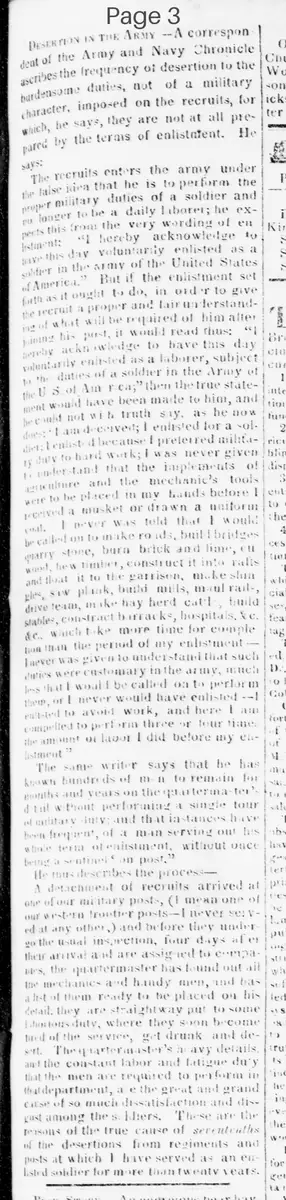
DESERTION IN THE ARMY.—A correspondent of the Army and Navy Chronicle ascribes the frequency of desertion to the burdensome duties, not of a military character, imposed on the recruits, for which, he says, they are not at all prepared by the terms of enlistment. He says: The recruits enter the army under the false idea that he is to perform the proper military duties of a soldier and perceives this from the very wording of enlistment: I hereby acknowledge to have this day voluntarily enlisted as a soldier in the army of the United States of America. But if the enlistment set forth as it ought to do, in order to give the recruit a proper and true understanding of what will be required of him after entering the service, it would read thus: I voluntarily enlisted as a laborer, subject to the duties of a soldier in the army of the United States of America; then the true statement would have been made to him, and he could not with truth say, as he now does, I enlisted because I preferred military duty to hard work; I was never given to understand that the implements of husbandry were to be placed in my hands before I entered the service, and the mechanic's tools continued in my hands. I never was told that I would be called on to make roads, but I bridge quarries, burn brick and lime, cut wood, hew timber, construct it into rafts, shingles, saw plank, build mills, maul rails, and carry them to the garrison, make sheds and stables, construct barracks, hospitals, &c., drive team, make hay, herd cattle, &c. I never was given to understand that such duties were customary in the army, which lessens the idea of military glory, or I never would have enlisted—I enlisted to avoid work, and here I am compelled to perform three or four times the amount of labor I did before my enlistment. The same writer says that he has known hundreds of men to remain for months and years in the quarter master's department without performing a single tour of guard duty, and in this instance have been frequently out of a man serving out his term of enlistment, without once being a sentinel on post. He describes the process: When a detachment of recruits arrived at any of our military posts, (I mean one of our western frontier posts—I never served at any other) and before their number is mustered on the usual inspections, for five days after their arrival they are assigned to fatigue parties, the quartermaster picks out all the handy men, and his list of them ready to be placed on his detail; they are straightway put to some laborious duty, where they soon become fond of this service, get drunk and desert. They are afterwards attached to any details, and the constant labor and fatigue duty that the men are required to perform in the quartermaster's department, are the cause of so much dissatisfaction and discontent among the soldiers. These are the premises of the true cause of two-thirds of the desertions from regiments and posts to which I have served as an old soldier. I was twenty years a soldier in the wars of 1812.
What sub-type of article is it?
Historical Event
Biography
What themes does it cover?
Deception
Misfortune
What keywords are associated?
Army Desertion
Military Duties
Enlistment Deception
Frontier Posts
Quartermaster Labor
War Of 1812
Where did it happen?
Western Frontier Posts
Story Details
Location
Western Frontier Posts
Event Date
Wars Of 1812
Story Details
Veteran soldier attributes army desertions to recruits' surprise at non-military labor duties like building, farming, and quartermaster work, which contradict enlistment promises of soldierly roles, leading to dissatisfaction and desertion at frontier posts.