Thank you for visiting SNEWPapers!
Sign up free
The National Intelligencer And Washington Advertiser
Washington, District Of Columbia
What is this article about?
The Definitive Treaty of Peace was signed at Amiens on March 27, 1802, by British, French, Spanish, and Batavian plenipotentiaries. U.S. Minister Mr. King reported this to the Secretary of State and plans to return home via France, possibly recalled.
Clipping
OCR Quality
Full Text
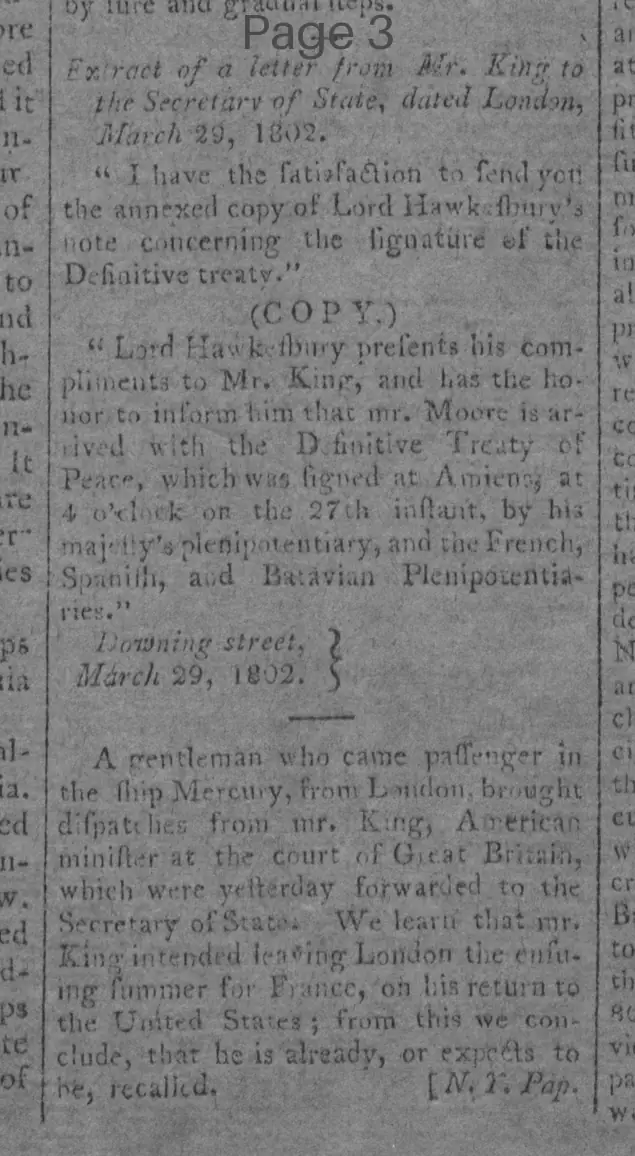
"I have the satisfaction to enclose you the annexed copy of Lord Hawkesbury's note concerning the signature of the Definitive treaty."
(COPY.)
"Lord Hawkesbury presents his compliments to Mr. King, and has the honor to inform him that Mr. Moore is arrived with the Definitive Treaty of Peace, which was signed at Amiens at 4 o'clock on the 27th instant, by his majesty's plenipotentiary, and the French, Spanish, and Batavian Plenipotentiaries."
Downing street,
March 29, 1802.
A gentleman who came passenger in the ship Mercury, from London, brought dispatches from Mr. King, American minister at the court of Great Britain, which were yesterday forwarded to the Secretary of State. We learn that Mr. King intended leaving London the ensuing summer for France, on his return to the United States; from this we conclude, that he is already, or expects to be, recalled.
[N. Y. Pap.
What sub-type of article is it?
What keywords are associated?
What entities or persons were involved?
Where did it happen?
Foreign News Details
Primary Location
Amiens
Event Date
March 27, 1802
Key Persons
Outcome
definitive treaty of peace signed by british, french, spanish, and batavian plenipotentiaries
Event Details
Mr. Moore arrived with the Definitive Treaty of Peace, signed at Amiens at 4 o'clock on March 27, 1802, by his majesty's plenipotentiary and the French, Spanish, and Batavian Plenipotentiaries. Mr. King enclosed Lord Hawkesbury's note on this and plans to leave London for France en route to the United States, possibly recalled.