Thank you for visiting SNEWPapers!
Sign up free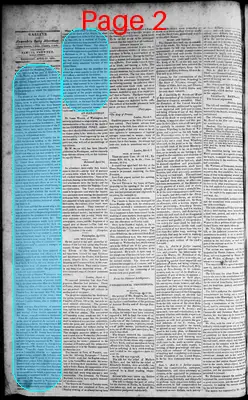
Letter to Editor
April 27, 1820
Alexandria Gazette & Daily Advertiser
Alexandria, Virginia
What is this article about?
A letter criticizes President Madison's appointment of Dr. Humphrey Peake from Virginia as collector of Alexandria port in the District of Columbia, arguing it disrespects local residents who ceded political rights. It contrasts with Washington and Adams' resident-focused policies and urges DC people to respectfully voice concerns to the President.
Clipping
OCR Quality
98%
Excellent
Full Text
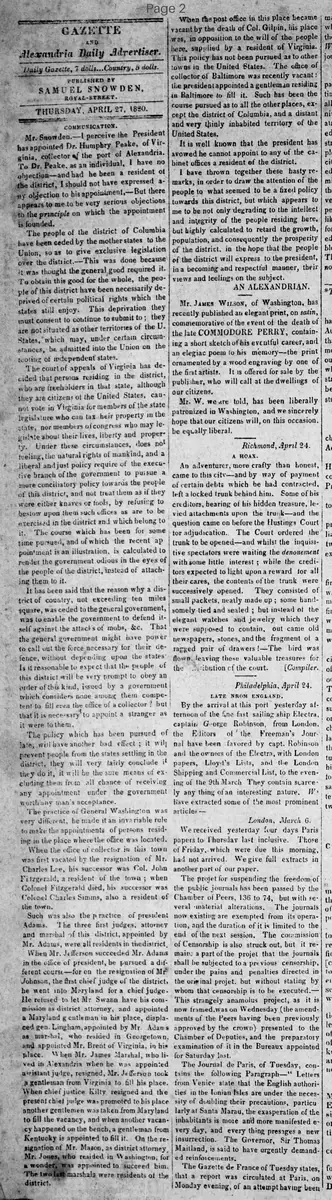
Mr. Snowden.--I perceive the President has appointed Dr. Humphrey Peake, of Virginia, collector of the port of Alexandria.
To Dr. Peake, as an individual, I have no objection--and had he been a resident of the district, I should not have expressed any objection to his appointment,--But there appears to me to be very serious objections to the principle on which the appointment is founded.
The people of the district of Columbia have been ceded by the mother states to the Union, so as to give exclusive legislation over the district.--This was done because it was thought the general good required it.
To obtain this good for the whole, the people of this district have been necessarily deprived of certain political rights which the states still enjoy. This deprivation they must consent to continue to submit to; they are not situated as other territories of the U. States, which may, under certain circumstances, be admitted into the Union on the footing of independent states.
The court of appeals of Virginia has decided that persons residing in the district, who are freeholders in that state, although they are citizens of the United States, cannot vote in Virginia for members of the state legislature who can tax their property in the state, nor members of congress who may legislate about their lives, liberty and property.
Under these circumstances, does not feeling, the natural rights of mankind, and a liberal and just policy require of the executive branch of the government to pursue a more conciliatory policy towards the people of this district, and not treat them as if they were either knaves or fools, by refusing to bestow upon them such offices as are to be exercised in the district and which belong to it.
The course which has been for some time pursued, and of which the recent appointment is an illustration, is calculated to render the government odious in the eyes of the people of the district, instead of attaching them to it.
It has been said that the reason why a district of country, not exceeding ten miles square, was ceded to the general government, was to enable the government to defend itself against the attacks of mobs, &c. That the general government might have power to call out the force necessary for their defence, without depending upon the states
Is it reasonable to expect that the people of this district will be very prompt to obey an order of this kind, issued by a government which considers none among them competent to fill even the office of a collector? but that it is necessary to appoint a stranger as it were to them.
The policy which has been pursued of late, will have another bad effect; it will prevent people from the states settling in the district, they will very fairly conclude it they do it, it will be the sure means of excluding them from all chance of receiving any appointment under the government worth any man's acceptance.
The practice of General Washington was very different, he made it an invariable rule to make the appointments of persons residing in the place where the office was located.
When the office of collector in this town was first vacated by the resignation of Mr. Charles Lee, his successor was Col. John Fitzgerald, a resident of the town; when Colonel Fitzgerald died, his successor was Colonel Charles Simms, also a resident of the town.
Such was also the practice of president Adams. The three first judges, attorney and marshal of this district, appointed by Mr. Adams, were all residents in the district
When Mr. Jefferson succeeded Mr. Adams in the office of president, he pursued a different course--for on the resignation of Mr. Johnson, the first chief judge of the district, he went into Maryland for a chief judge.
He refused to let Mr Swann have his commission as district attorney, and appointed a Maryland gentleman in his place, displaced gen. Lingham, appointed by Mr. Adams as marshal, who resided in Georgetown, and appointed Mr. Brent of Virginia, in his place.
When Mr. James Marshall, who lived in Alexandria when he was appointed assistant judge, resigned, Mr. Jefferson took a gentleman from Virginia to fill his place.
When chief justice Kilty resigned and the present chief judge was promoted to his place another gentleman was taken from Maryland to fill the vacancy, and when another vacancy happened on the bench, a gentleman from Kentucky is appointed to fill it.
On the resignation of Mr. Mason, as district attorney, Mr. Jones, who resided in Washington, for a wonder, was appointed to succeed him.
The two last marshals were residents of the district.
When the post office in this place became vacant by the death of Col. Gilpin, his place was, in opposition to the will of the people here, supplied by a resident of Virginia.
This policy has not been pursued as to other towns in the United States. The office of collector of Baltimore was recently vacant: the president appointed a gentleman residing in Baltimore to fill it.
Such has been the course pursued as to all the other places, except the district of Columbia, and a distant and very thinly inhabited territory of the United States.
It is well known that the president has avowed he cannot appoint to any of the cabinet offices a resident of the district.
I have thrown together these hasty remarks, in order to draw the attention of the people to what seemed to be a fixed policy towards this district, but which appears to me to be not only degrading to the intellect and integrity of the people residing here, but highly calculated to retard the growth, population, and consequently the prosperity of the district.
In the hope that the people of the district will express to the president, in a becoming and respectful manner, their views and feelings on the subject.
To Dr. Peake, as an individual, I have no objection--and had he been a resident of the district, I should not have expressed any objection to his appointment,--But there appears to me to be very serious objections to the principle on which the appointment is founded.
The people of the district of Columbia have been ceded by the mother states to the Union, so as to give exclusive legislation over the district.--This was done because it was thought the general good required it.
To obtain this good for the whole, the people of this district have been necessarily deprived of certain political rights which the states still enjoy. This deprivation they must consent to continue to submit to; they are not situated as other territories of the U. States, which may, under certain circumstances, be admitted into the Union on the footing of independent states.
The court of appeals of Virginia has decided that persons residing in the district, who are freeholders in that state, although they are citizens of the United States, cannot vote in Virginia for members of the state legislature who can tax their property in the state, nor members of congress who may legislate about their lives, liberty and property.
Under these circumstances, does not feeling, the natural rights of mankind, and a liberal and just policy require of the executive branch of the government to pursue a more conciliatory policy towards the people of this district, and not treat them as if they were either knaves or fools, by refusing to bestow upon them such offices as are to be exercised in the district and which belong to it.
The course which has been for some time pursued, and of which the recent appointment is an illustration, is calculated to render the government odious in the eyes of the people of the district, instead of attaching them to it.
It has been said that the reason why a district of country, not exceeding ten miles square, was ceded to the general government, was to enable the government to defend itself against the attacks of mobs, &c. That the general government might have power to call out the force necessary for their defence, without depending upon the states
Is it reasonable to expect that the people of this district will be very prompt to obey an order of this kind, issued by a government which considers none among them competent to fill even the office of a collector? but that it is necessary to appoint a stranger as it were to them.
The policy which has been pursued of late, will have another bad effect; it will prevent people from the states settling in the district, they will very fairly conclude it they do it, it will be the sure means of excluding them from all chance of receiving any appointment under the government worth any man's acceptance.
The practice of General Washington was very different, he made it an invariable rule to make the appointments of persons residing in the place where the office was located.
When the office of collector in this town was first vacated by the resignation of Mr. Charles Lee, his successor was Col. John Fitzgerald, a resident of the town; when Colonel Fitzgerald died, his successor was Colonel Charles Simms, also a resident of the town.
Such was also the practice of president Adams. The three first judges, attorney and marshal of this district, appointed by Mr. Adams, were all residents in the district
When Mr. Jefferson succeeded Mr. Adams in the office of president, he pursued a different course--for on the resignation of Mr. Johnson, the first chief judge of the district, he went into Maryland for a chief judge.
He refused to let Mr Swann have his commission as district attorney, and appointed a Maryland gentleman in his place, displaced gen. Lingham, appointed by Mr. Adams as marshal, who resided in Georgetown, and appointed Mr. Brent of Virginia, in his place.
When Mr. James Marshall, who lived in Alexandria when he was appointed assistant judge, resigned, Mr. Jefferson took a gentleman from Virginia to fill his place.
When chief justice Kilty resigned and the present chief judge was promoted to his place another gentleman was taken from Maryland to fill the vacancy, and when another vacancy happened on the bench, a gentleman from Kentucky is appointed to fill it.
On the resignation of Mr. Mason, as district attorney, Mr. Jones, who resided in Washington, for a wonder, was appointed to succeed him.
The two last marshals were residents of the district.
When the post office in this place became vacant by the death of Col. Gilpin, his place was, in opposition to the will of the people here, supplied by a resident of Virginia.
This policy has not been pursued as to other towns in the United States. The office of collector of Baltimore was recently vacant: the president appointed a gentleman residing in Baltimore to fill it.
Such has been the course pursued as to all the other places, except the district of Columbia, and a distant and very thinly inhabited territory of the United States.
It is well known that the president has avowed he cannot appoint to any of the cabinet offices a resident of the district.
I have thrown together these hasty remarks, in order to draw the attention of the people to what seemed to be a fixed policy towards this district, but which appears to me to be not only degrading to the intellect and integrity of the people residing here, but highly calculated to retard the growth, population, and consequently the prosperity of the district.
In the hope that the people of the district will express to the president, in a becoming and respectful manner, their views and feelings on the subject.
What sub-type of article is it?
Persuasive
Political
What themes does it cover?
Politics
Constitutional Rights
What keywords are associated?
District Of Columbia
Presidential Appointments
Resident Rights
Alexandria Collector
Political Policy
Washington Practice
Jefferson Appointments
What entities or persons were involved?
Mr. Snowden
Letter to Editor Details
Recipient
Mr. Snowden
Main Argument
the appointment of non-residents like dr. peake to district of columbia offices disrespects locals who sacrificed political rights, alienates them from government, and hinders district growth; presidents should prioritize resident appointments as washington and adams did.
Notable Details
References Virginia Court Decision On Dc Residents' Voting Rights
Contrasts Practices Of Washington, Adams, Jefferson, And Madison
Cites Specific Past Appointments In Alexandria, Dc Courts, And Post Office