Thank you for visiting SNEWPapers!
Sign up free
Editorial
January 31, 1861
Arkansas True Democrat
Little Rock, Pulaski County, Arkansas
What is this article about?
An open letter to Pulaski County voters by Ben F. Danley and John Pope, urging support for their candidacy as delegates to the Arkansas State Convention on March 4, 1861. They advocate immediate secession to join the six seceding southern states, citing northern violations of the Constitution, threats to slavery, and Republican policies under Lincoln as justification, rejecting submission or compromise.
Clipping
OCR Quality
98%
Excellent
Full Text
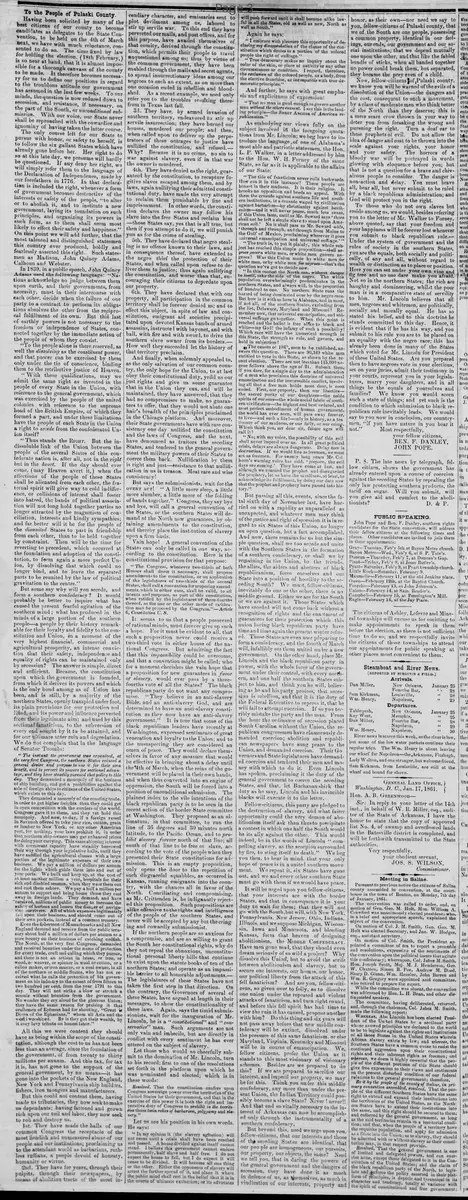
To the Voters of Pulaski County.
Having been solicited by many of the best citizens of our county to become candidates as delegates to the State Convention, to be held on the 4th of March next, we have with much reluctance, consented to do so. The time fixed by law for holding the election (18th February) is so near at hand, that it is almost impossible for a thorough canvass of the county to be made. It therefore becomes necessary for us to define our positions in regard to the troublous attitude our government has assumed in the last few weeks. To our minds, the question is now reduced down to secession, and resistance, if necessary, on the part of the South, or unconditional submission. With our voice, our State never shall be reproached with the cowardice and ignominy of having taken the latter course. The only course left for our State to pursue with honor, or safety to herself, is to follow the six gallant States which have already gone before her. Her right to do so at this late day, we presume will hardly be questioned. If any deny her right, we will simply refer them to the language of the Declaration of Independence, made by our forefathers in 1776. In that declaration is included the right, whenever a form of government becomes destructive of the interests or safety of the people, "to alter or to abolish it, and to institute a new government, laying its foundation on such principles, and organizing its powers in such form, as to them shall seem most likely to effect their safety and happiness."
On this point we will add further, that the most talented and distinguished statesmen this country ever produced, boldly and fearlessly asserted this right. Such statesmen as Madison, John Quincy Adams, Calhoun and Webster.
In 1839, in a public speech, John Quincy Adams used the following language: "Nations acknowledge no judge between them upon earth, and their governments, from necessity, must in their intercourse with each other, decide when the failure of one party to a contract to perform its obligations absolves the other from the reciprocal fulfillment of its own. But this last of earthly powers is not necessary to the freedom or independence of States, connected together by the immediate action of the people of whom they consist.
"To the people alone is there reserved, as well the dissolving as the constituent power, and that power can be exercised by them only under the tie of conscience, binding them to the retributive justice of Heaven.
"With these qualifications, may we admit the same right as invested in the people of every State in the Union, with reference to the general government, which was exercised by the people of the united colonies with reference to the supreme head of the British Empire, of which they formed a part, and under these limitations have the people of each State in the Union a right to secede from the confederated Union itself?
"Thus stands the Right. But the indissoluble link of the Union between the people of the several States of this confederate nation is, after all, not in the right but in the heart. If the day should ever come, (may Heaven avert it,) when the affections of the people of these States shall be alienated from each other, the fraternal spirit will give way to cold indifference, or collisions of interest shall foster into hatred, the bands of political association will not long hold together parties no longer attracted by the magnetism of conciliation, interests and kindly sympathies; and far better will it be for the people of the disunited States to part in friendship from each other, than to be held together by constraint. Then will be the time for reverting to precedent, which occurred at the foundation and adoption of the constitution, to form again a more perfect Union, by dissolving that which could no longer bind, and to leave the separated parts to be reunited by the law of political gravitation to the centre."
But some say why will you secede, and form a southern confederacy? It would probably be better to inquire what has caused the present fearful agitation of the southern mind; what has produced in the minds of a large portion of the southern people--a people by their history remarkable for their loyalty and fidelity to the constitution and Union, in a moment of the very highest financial, commercial and agricultural prosperity, an intense conviction that their safety, independence and equality of rights can be maintained only by secession? The answer is simple, direct and sufficient. Because, the constitution upon which the government is founded, from which it derives its powers and which is the only bond among us of Union has been, and is still, by a majority of the northern States, openly trampled under foot, its plain provisions for our protection nullified, and its power and influence perverted from their legitimate aim; and used by this sectional fanaticism, to the subversion of every end sought by it to be attained, and for our ultimate utter ruin and degradation.
We do not complain that in the language of Senator Toombs:
"The instant the government was organized, at the very first Congress, the northern States evinced a general desire and purpose to use it for their own benefit, and to pervert its powers for sectional advantage, and they have steadily pursued that policy to this day. They demanded a monopoly of the business of ship building, and got a prohibition against the sale of foreign ships to citizens of the United States, which exists to this day.
They demanded a monopoly of the coasting trade, in order to get higher freights than they could get in open competition with the carriers of the world. Congress gave it to them, and they yet hold this monopoly. And now, to-day, if a foreign vessel in Savannah offered to take your rice, cotton, grain or lumber to New York, or any other American port, for nothing, your laws prohibit it, in order that northern ship-owners may get enhanced prices for doing your carrying. This same shipping interest with cormorant rapacity have steadily burrowed their way through your legislative halls, until they have saddled the agricultural classes with a large portion of the legitimate expenses of their own business. We pay a million of dollars per annum for the lights which guide them into and out of your ports. We built and keep up, at the cost of at least another million a year, hospitals for their sick and disabled seamen, when they wear them out and cast them ashore. We pay a half a million per annum to support and bring home those they cast away in foreign lands. They demand, and have received, millions of public money to increase the safety of harbors and lessen the danger of navigation our rivers. All of which expenses legitimately fall upon their business, and should come out of their own pockets, instead of a common treasury.
Even the fishermen of Massachusetts and all New England demand and receive from the public treasury about half a million of dollars per annum as a pure bounty on their business of catching codfish.
The North, at the very first Congress, demanded and received bounties under the name of protection for every trade, craft and calling which they pursue, and there is not an artisan in brass, or iron, or wood, or weaver, or spinner in wool or cotton, or a calico maker, or iron master, or a coal owner, in all of the northern or middle States, who has not received what he calls the protection of his government on his industry to the extent of from fifteen to two hundred per cent. from the year 1791 to this day. They will not strike a blow or stretch a muscle without bounties from the government.
No wonder they cry aloud for the glorious Union; they have the same reason for praising it that the craftsmen of Ephesus had for shouting, "Great is Diana of the Ephesians," whom all Asia and the world worshiped. By it they got their wealth, by it they levy tribute on honest labor."
All this we were content they should have as being within the scope of the constitution, although the cost to us has not been less than an average, since the foundation of the government, of from twenty to thirty millions per annum. And this tax, for tax it is, has not gone to the support of the general government, by no means—it has gone into the pockets of the New England, New York and Pennsylvania ship builders, fishers, iron mongers and manufacturers.
But this could not content them, having made us tributaries, they now seek to make us dependants; having fattened and grown rich upon our toil and labor, they now seek to rob and destroy us.
1st. They have made the halls of our common Congress the receptacle of the most fiendish and unmeasured abuse of our people and our institutions; proclaiming us to the attendant world as barbarians, ruthless ruffians, a people devoid of honesty humanity or virtue.
2nd. They have for years, through their pulpits, through their newspapers, by means of abolition tracts of the most incendiary character, and emissaries sent to plot devilment among us, labored to stir up servile war. To this end they have perverted our mails, and post offices, and for this purpose, have availed themselves of that comity, derived through the constitution, which permits their people to travel unquestioned among us; thus by virtue of the common government, they have been enabled through the mails and secret agents, to spread insurrectionary ideas among our negroes to such an extent, as on more than one occasion ended in rebellion and bloodshed. As a recent example, we need only refer you to the troubles resulting therefrom in Texas last fall.
3d. They have, by armed invasion of southern territory, endeavored to stir up servile insurrection; they have burned our houses, murdered our people; and then, when called upon to deliver up the perpetrators of these outrages to justice have nullified the constitution, and refused. Why? Because it is no crime, no sin to war against slavery, even if in that war the owner is murdered.
4th. They have denied us the right, guaranteed by the constitution, to recapture fugitive slaves escaped among them, and by laws, again nullifying their admitted constitutional duty, have made the very attempt to reclaim them punishable by fine and imprisonment. In other words, the constitution declares the owner may follow his slave into the free States and reclaim him—those States say, yes that is all true, but then if you attempt to do it, we will punish you as for the crime of stealing.
5th. They have declared that negro stealing is no offence known to their laws, and in consequence thereof, have extended to the negro thief the protection of their States, and when called upon refuse to deliver them to justice; thus again nullifying the constitution, and worse than that, encouraging their citizens to depredate upon our property.
6th. They have declared that with our property, all participation in the common territory shall be forever denied us; and to effect this object, in spite of law and constitution, emigrant aid societies precipitated upon devoted Kansas bands of armed assassins, instructed with bayonet, and with ball, with fire and with sword, to drive the southern slave owner from its borders. How well they succeeded let the history of that territory proclaim.
And finally, when solemnly appealed to, as the only salvation of our common country, the only hope for the Union, to at last obey their constitutional duty, yield us our just rights and give us some guarantee that in the Union they can, and will be maintained, they have answered, that they had no compromises to make, no guarantees to offer, that they would not abate one hair's breadth of the principles proclaimed in the Chicago platform. And moreover, their State governments have with rare consistency one day nullified the constitution and the laws of Congress, and the next, have denounced as traitors the seceding States, and tendered to the general government the military powers of their States to coerce them back." Nullification by them is right and just—resistance to that nullification in us is treason. Most rare and wise consistency!
But says the submissionists, wait for the overt act! "A little more sleep, a little more slumber, a little more of the folding of hands together." Congress, they say by and by, will call a general convention of the States, or the southern States will demand of the North new guarantees, by obtaining amendments to the constitution, and thereby place the institution of slavery upon a firm basis.
Vain hope! A general convention of the States can only be called in one way, according to the constitution. Here is the constitutional provision for that purpose:
"The Congress, whenever two-thirds of both Houses shall deem it necessary, shall propose amendments to the constitution, or on application of the legislatures of two-thirds of the several States, shall call a convention for proposing amendments, which in either case, shall be valid, to all intents and purposes, as part of this constitution, when ratified by the legislatures of three-fourths thereof, as the one or the other mode of ratification may be proposed by the Congress."—Article 5, Constitution U. S.
It seems to us that a people possessed of rational minds, must forever give up such a hope. For it must be evident to all, that such a proposition never could receive a two-third vote in either house of the national Congress. But admitting the fact that this impossibility could be overcome, and that a convention might be called; who for a moment cherishes the vain hope that a proposition for new guarantees in favor of slavery, would ever pass by a three-fourths vote of all the States? The black republican party do not want any compromise. "They believe in an anti-slavery Bible, and an anti-slavery God, and are determined to have an anti-slavery constitution as they now have an anti-slavery government." It is true that some of the black republican leaders have recently at Washington, expressed sentiments of great veneration and loyalty to the Union; and to the unsuspecting they are considered an omen of peace. They would declare themselves in favor of any measure that would be effective in bringing about a delay until the 4th of March, when the reins of the government will be placed in their own hands, and when thus converted into an engine of oppression, the South will be forced into a position of unconditional submission. The plainest index to the vile intentions of the black republican party is to be seen in the recent action of the border State committee at Washington. They proposed as an ultimatum, in that committee, to run the line of 36 degrees and 30 minutes north latitude, to the Pacific Ocean, and to prohibit slavery forever north of that line; all south of that line to be free or slave, according to the vote of the people when they presented their State constitutions for admission. This is an empty proposition, only opens the door to the repetition of such disgraceful squabbles, as occurred in Kansas, running emigrants into the country, with the chances all in favor of the North. Conciliating and compromising, as Mr. Crittenden is, he indignantly rejected this proposition. Such propositions are alike offensive to the rights and intelligence of the people of the southern States, and never will be accepted by any but the cringing and cowardly submissionist.
If the northern people are so anxious for a compromise, and are so willing to grant the South her constitutional rights, why do they not repeal the obnoxious, unconstitutional personal liberty bills that continue to exist upon the statute books of ten of the northern States; and operate as an impassable barrier to all honorable adjustments. The legislatures of these States have not taken the first step in that direction. On the contrary, the Governors of several of these States, have argued at length in their messages, to show the constitutionality of these laws. Again, says the timid submissionists, wait for the inauguration of Mr. Lincoln, he is a "constitutional" and "conservative" man. Such arguments are not only vain and imbecile, but are directly in conflict with every sentiment he has ever uttered on the subject of slavery.
Let those who would so cheerfully submit to the domination of Mr. Lincoln, turn to his record; first to one of the resolutions set forth in the platform upon which he was nominated and elected; which is in these words:
Resolved, That the constitution confers upon Congress sovereign power over the territories of the United States for their government, and that in the exercise of this power it is both the right and imperative duty of Congress to prohibit in the territories those twin relics of barbarism, polygamy and slavery.
Let us see his position in his own words.
He says:
"In my opinion it (the slavery agitation) will not cease until a crisis shall have been reached and passed. A house divided against itself cannot stand. I believe this government cannot endure permanently, half slave and half free. I do not expect the house to fall, but I do expect it will cease to be divided. It will become all one thing or the other. Either the opponents of slavery will arrest the further spread of it, and place it where the public mind shall rest in the belief that it is in the course of ultimate extinction; or its advocates will push forward until it shall become alike lawful in all the States, old as well as new, North as well as South."
Again he says:
"I embrace with pleasure this opportunity of declaring my disapprobation of the clause of the constitution which denies to a portion of the colored people the right of suffrage."
"True democracy makes no inquiry about the color of the skin, or place of nativity or any other circumstances or condition. I regard, therefore, the exclusion of the colored people, as a body, from the elective franchise, as incompatible with true democratic principles."
And further, he says with great emphasis and explicitness of expression:
"That no man is good enough to govern another man without the others consent. I say this is the leading principle-the Sheet Anchor of American republicanism."
As embodying our views fully on the subject involved in the foregoing quotations from Mr. Lincoln; we beg leave to introduce the language of one of Alabama's most able and patriotic statesmen, the Hon. L. P. Walker, in a letter addressed by him to the Hon. W. H. Forney of the same State, so far as it is applicable to the affairs of our State:
"The tide of fanaticism never rolls backwards. How can it in this instance? These people are honest in their madness. It is their religion. It brooks no opposition and heeds no appeal. With them the crusade against southern life and southern institutions, is a crusade waged by civilization against barbarism--by christianity against heathenism—and it will never pause, much less cease, if this Union lasts, until as Mr. Seward says 'there shall not be left a single slave to stand upon American soil.' No it shall pass as Mr. Seward adds, through and through, and through from Maine to the Gulf of Mexico, proclaiming wherever it goes universal emancipation and universal suffrage.'"
"The truth is, to put it plainly, this whole subject has reached this simple proposition—shall negroes govern white men, or white men govern negroes? Was this Union made by white men for white men, or by white men for negroes—that's the question we've got to decide now."
"In this contest the North can, without danger to itself, take the side of the negro. The white population overwhelmingly predominates in the northern States, and always will, in the proportion of hundred to one. No northern State runs the hazard of being dominated over by the negro race.
But how is it with us here in Alabama, and in most, if not all, of the southern States, excluding from the list, Delaware, Maryland and Missouri? Remember now, that universal emancipation, and universal suffrage go together. When this point is reached and the ballot is free alike to black and white—my God! the infamy of such a possibility! Which race will have the numerical strength in this State, the strength to rule, and govern, and hold in subjection?
The census of 1860, soon to be published, answers this question. There are 90,349 white men entitled to vote in this State, as shown by the recent election. There are not less than 115,000 negro fellows above the age of 21. Submit then, if you dare, for a single day to the administration of a man who proclaims this doctrine of universal emancipation and the irrepressible conflict, involving all that a free man holds most dear, is soon ended. First, our property, then our liberties—the sacred purity of our daughters--the noble spirits of our sons-the whole social fabric of southern civilization-the highest and best ordered, and most perfect embodiment of human government, the world has ever seen, will pass away forever, to live—and such a life! only in history, as a testimony of our madness, or our folly, or our crime. Which think you, my dear sir, future ages will call it?
"No; with my voice, the possibility of this evil shall never impend over us. In all great political crisis, delays are always dangerous. Delay now is destruction. If we would live as freemen, we must act as freemen. For twenty long years Mr. Calhoun's warning voice has said, prepare, the evil days are coming.' They have come at last, and although we spurned the prophet and disregarded the prophecy, let us have the manliness, at least, to acknowledge its fulfillment, by doing our duty now that the prophet and prophecy have passed into history."
But passing all this, events, since the fatal sixth day of November last, have hurried on with a rapidity as unparalleled as unexpected, and whatever men may think of the justice and right of secession it is in regard to six States of this Union, no longer an open question, but a fact accomplished.
And now, there remains for us but the simple question, shall we too secede and unite with the Southern States in the formation of a southern confederacy, or shall we by remaining in the Union, be the friends, the allies, the aiders and abetters of black republicanism, force ourselves and our State into a position of hostility to the seceding South? We must, fellow-citizens, inevitably do one or the other, there is no middle ground. Either we are for the South or we are against it. Those States which have seceded will not come back without a recognition of rights and the enactment of guarantees for their protection which this union loving black republican party have time and time again the present winter refused. Those States are even now preparing to form a confederacy, and the fourth of March will, infallibly see them united under a new government. On the other hand, place Mr. Lincoln and the black republican party in power, with the whole force of the government under their control, with every northern, and one half the southern States subject to him, and think you he will, believing as he and his party profess, that secession is rebellion, and that it is the duty of the Federal Executive to repress it, that he will fail to attempt coercion. If so you terribly mistake the party and the man. From the hour the ordinance of secession placed South Carolina without the Union, the republican congressmen have clamorously demanded coercion; abolition and republican newspapers have sung peans to the Union, and demanded coercion. Their Governors and State legislatures have demanded coercion and tendered their men and money with which to do it. Even Lincoln has spoken, proclaiming it the duty of the general government to coerce the seceding States, and that, let Buchanan shirk that duty as he may, Lincoln and his invincible blacks will execute it to the letter.
Fellow-citizens, this party are pledged to the destruction of slavery, and what fairer opportunity could the very demon of abolitionism itself ask than thus to precipitate a contest in which one half the South would be its ally against the other. This would indeed, be in the words of Lincoln "compelling slavery, as the scorpion surrounded by fire, to sting itself to death." We beg you then, to bear in mind, that your only hope of peace is in a united southern movement. We repeat it, six States have gone out, and we and every other southern State must go with them if we would have peace.
It will be urged upon you fellow-citizens, that your interests are with the border States, and that in consequence it is your duty to wait for them; that they will not go with the South, but will, with New York, Pennsylvania, New Jersey, Ohio, Indiana, Illinois, and we suppose Michigan, Wisconsin, Iowa and Minnesota, and bleeding Kansas, form that heaven of designing abolitionism, the MIDDLE CONFEDERACY.
Have men gone mad, that they should even dream seriously of so wild a project? Why dissolve this Union, but to avoid the strife between abolitionism and slavery, but to secure our interests, our homes, our honor, our political liberty from the attack of this fell fanaticism? And are you, fellow-citizens, so given over to folly, as to dissolve one union under the repeated and violent attacks of fanaticism, and turn right round, and before this fell spirit has had time to view the ruin it has caused, propose another with him? Do this thing and six years will not pass away before that new middle confederacy will be extinct, dissolved under the pressure of this same fanaticism, or else Maryland, Virginia, Kentucky and Missouri will be in course of emancipation. We, fellow citizens, prefer the Union as it stands to this most visionary of visionary schemes. Besides are we prepared to do this? If we are prepared to sacrifice our interest, and imperil our property, we may be for this. Think you under this middle confederacy, any more than under the present Union, the Indian Territory could possibly become a slave State? Never! never!! And that end so vitally necessary to the interest of Arkansas can now be accomplished only through the instrumentality of a southern confederacy.
But beyond this, need we urge upon you, fellow-citizens, that our interests and those of the seceding States are identical, that our people are homogeneous, our pursuits, our property, our objects, the same? Need we tell you, that in daring the powers of the general government and the dangers of secession, they have done it as much in defence of us, as themselves, as much in vindication of our interests, property and honor, as their own—nor need we say to you, fellow-citizens of Pulaski county, that we of the South are one people, possessing a common property, identical in our feelings, our ends, our government and our social institutions: that we depend mutually one upon the other, and that like the fabled bundle of sticks, when all banded together no power could break them, but separated, they became the prey even of a child.
Now, fellow-citizens of Pulaski county, we know you will be warned of the evils of a dissolution of the Union—the dangers and the cost, consequent to such a movement, by a class of moderate men who think better of the North than they deserve; this is a mere scare crow thrown in your way to deter you from forsaking the wrong and pursuing the right. Turn a deaf ear to these prophets of evil. Do not allow the idea of danger and cost to be thrown into the scale against your rights, your honor and your safety. The horrors of a bloody war will be portrayed in words glowing with eloquence before you; but that is not a question for a brave and chivalrous people to consider. The danger is non-action and delay. You must brave all, bear all, but never submit to be ruled by a black republican administration; and God will protect you in the right.
To those who do not own slaves but reside among us, we would, besides referring you to the letter of Mr. Walker to Forney, above quoted, say that your freedom and your happiness will be forever lost whenever you submit to black republican rule. Under the system of government and the rules of society in the southern States, you are the equals, both socially and politically, of any and all, without regard to wealth or distinction as to place or position. Here you can sit under your own vine and fig tree and no one dare make you afraid. Not so in the northern States; the rich are haughty and domineering, whilst the poor man is in a comparative state of servility to him. Mr. Lincoln believes that all men, negroes and white men, are politically, socially and morally equal. He has so stated his belief, and to this doctrine he stands committed to this day. Hence, it is evident that if he has his way, and you submit to his rule you are to be placed on an equality with the negro race; this has already been done in many of the States which voted for Mr. Lincoln for President of these United States. Are you prepared then to have negroes vote in your elections, sit on your juries, admit their testimony in your courts, represent you in your legislatures, marry your daughters, and in all things be the equals of yourselves and families? We know you would scorn such a state of things; and yet such is the condition to which submission to black republican rule inevitably leads. We would say to you now in conclusion, our countrymen, "if you have nature in you bear it not."
Most respectfully,
your fellow citizens,
BEN. F. DANLEY
JOHN POPE.
P. S. The late news by telegraph, fellow citizen, shows the government has already entered upon a course of coercion against the seceding States by repealing the only law protecting southern products, the tariff on sugar. Will you submit, will you give aid and comfort to the abolitionists?
D. & P.
Having been solicited by many of the best citizens of our county to become candidates as delegates to the State Convention, to be held on the 4th of March next, we have with much reluctance, consented to do so. The time fixed by law for holding the election (18th February) is so near at hand, that it is almost impossible for a thorough canvass of the county to be made. It therefore becomes necessary for us to define our positions in regard to the troublous attitude our government has assumed in the last few weeks. To our minds, the question is now reduced down to secession, and resistance, if necessary, on the part of the South, or unconditional submission. With our voice, our State never shall be reproached with the cowardice and ignominy of having taken the latter course. The only course left for our State to pursue with honor, or safety to herself, is to follow the six gallant States which have already gone before her. Her right to do so at this late day, we presume will hardly be questioned. If any deny her right, we will simply refer them to the language of the Declaration of Independence, made by our forefathers in 1776. In that declaration is included the right, whenever a form of government becomes destructive of the interests or safety of the people, "to alter or to abolish it, and to institute a new government, laying its foundation on such principles, and organizing its powers in such form, as to them shall seem most likely to effect their safety and happiness."
On this point we will add further, that the most talented and distinguished statesmen this country ever produced, boldly and fearlessly asserted this right. Such statesmen as Madison, John Quincy Adams, Calhoun and Webster.
In 1839, in a public speech, John Quincy Adams used the following language: "Nations acknowledge no judge between them upon earth, and their governments, from necessity, must in their intercourse with each other, decide when the failure of one party to a contract to perform its obligations absolves the other from the reciprocal fulfillment of its own. But this last of earthly powers is not necessary to the freedom or independence of States, connected together by the immediate action of the people of whom they consist.
"To the people alone is there reserved, as well the dissolving as the constituent power, and that power can be exercised by them only under the tie of conscience, binding them to the retributive justice of Heaven.
"With these qualifications, may we admit the same right as invested in the people of every State in the Union, with reference to the general government, which was exercised by the people of the united colonies with reference to the supreme head of the British Empire, of which they formed a part, and under these limitations have the people of each State in the Union a right to secede from the confederated Union itself?
"Thus stands the Right. But the indissoluble link of the Union between the people of the several States of this confederate nation is, after all, not in the right but in the heart. If the day should ever come, (may Heaven avert it,) when the affections of the people of these States shall be alienated from each other, the fraternal spirit will give way to cold indifference, or collisions of interest shall foster into hatred, the bands of political association will not long hold together parties no longer attracted by the magnetism of conciliation, interests and kindly sympathies; and far better will it be for the people of the disunited States to part in friendship from each other, than to be held together by constraint. Then will be the time for reverting to precedent, which occurred at the foundation and adoption of the constitution, to form again a more perfect Union, by dissolving that which could no longer bind, and to leave the separated parts to be reunited by the law of political gravitation to the centre."
But some say why will you secede, and form a southern confederacy? It would probably be better to inquire what has caused the present fearful agitation of the southern mind; what has produced in the minds of a large portion of the southern people--a people by their history remarkable for their loyalty and fidelity to the constitution and Union, in a moment of the very highest financial, commercial and agricultural prosperity, an intense conviction that their safety, independence and equality of rights can be maintained only by secession? The answer is simple, direct and sufficient. Because, the constitution upon which the government is founded, from which it derives its powers and which is the only bond among us of Union has been, and is still, by a majority of the northern States, openly trampled under foot, its plain provisions for our protection nullified, and its power and influence perverted from their legitimate aim; and used by this sectional fanaticism, to the subversion of every end sought by it to be attained, and for our ultimate utter ruin and degradation.
We do not complain that in the language of Senator Toombs:
"The instant the government was organized, at the very first Congress, the northern States evinced a general desire and purpose to use it for their own benefit, and to pervert its powers for sectional advantage, and they have steadily pursued that policy to this day. They demanded a monopoly of the business of ship building, and got a prohibition against the sale of foreign ships to citizens of the United States, which exists to this day.
They demanded a monopoly of the coasting trade, in order to get higher freights than they could get in open competition with the carriers of the world. Congress gave it to them, and they yet hold this monopoly. And now, to-day, if a foreign vessel in Savannah offered to take your rice, cotton, grain or lumber to New York, or any other American port, for nothing, your laws prohibit it, in order that northern ship-owners may get enhanced prices for doing your carrying. This same shipping interest with cormorant rapacity have steadily burrowed their way through your legislative halls, until they have saddled the agricultural classes with a large portion of the legitimate expenses of their own business. We pay a million of dollars per annum for the lights which guide them into and out of your ports. We built and keep up, at the cost of at least another million a year, hospitals for their sick and disabled seamen, when they wear them out and cast them ashore. We pay a half a million per annum to support and bring home those they cast away in foreign lands. They demand, and have received, millions of public money to increase the safety of harbors and lessen the danger of navigation our rivers. All of which expenses legitimately fall upon their business, and should come out of their own pockets, instead of a common treasury.
Even the fishermen of Massachusetts and all New England demand and receive from the public treasury about half a million of dollars per annum as a pure bounty on their business of catching codfish.
The North, at the very first Congress, demanded and received bounties under the name of protection for every trade, craft and calling which they pursue, and there is not an artisan in brass, or iron, or wood, or weaver, or spinner in wool or cotton, or a calico maker, or iron master, or a coal owner, in all of the northern or middle States, who has not received what he calls the protection of his government on his industry to the extent of from fifteen to two hundred per cent. from the year 1791 to this day. They will not strike a blow or stretch a muscle without bounties from the government.
No wonder they cry aloud for the glorious Union; they have the same reason for praising it that the craftsmen of Ephesus had for shouting, "Great is Diana of the Ephesians," whom all Asia and the world worshiped. By it they got their wealth, by it they levy tribute on honest labor."
All this we were content they should have as being within the scope of the constitution, although the cost to us has not been less than an average, since the foundation of the government, of from twenty to thirty millions per annum. And this tax, for tax it is, has not gone to the support of the general government, by no means—it has gone into the pockets of the New England, New York and Pennsylvania ship builders, fishers, iron mongers and manufacturers.
But this could not content them, having made us tributaries, they now seek to make us dependants; having fattened and grown rich upon our toil and labor, they now seek to rob and destroy us.
1st. They have made the halls of our common Congress the receptacle of the most fiendish and unmeasured abuse of our people and our institutions; proclaiming us to the attendant world as barbarians, ruthless ruffians, a people devoid of honesty humanity or virtue.
2nd. They have for years, through their pulpits, through their newspapers, by means of abolition tracts of the most incendiary character, and emissaries sent to plot devilment among us, labored to stir up servile war. To this end they have perverted our mails, and post offices, and for this purpose, have availed themselves of that comity, derived through the constitution, which permits their people to travel unquestioned among us; thus by virtue of the common government, they have been enabled through the mails and secret agents, to spread insurrectionary ideas among our negroes to such an extent, as on more than one occasion ended in rebellion and bloodshed. As a recent example, we need only refer you to the troubles resulting therefrom in Texas last fall.
3d. They have, by armed invasion of southern territory, endeavored to stir up servile insurrection; they have burned our houses, murdered our people; and then, when called upon to deliver up the perpetrators of these outrages to justice have nullified the constitution, and refused. Why? Because it is no crime, no sin to war against slavery, even if in that war the owner is murdered.
4th. They have denied us the right, guaranteed by the constitution, to recapture fugitive slaves escaped among them, and by laws, again nullifying their admitted constitutional duty, have made the very attempt to reclaim them punishable by fine and imprisonment. In other words, the constitution declares the owner may follow his slave into the free States and reclaim him—those States say, yes that is all true, but then if you attempt to do it, we will punish you as for the crime of stealing.
5th. They have declared that negro stealing is no offence known to their laws, and in consequence thereof, have extended to the negro thief the protection of their States, and when called upon refuse to deliver them to justice; thus again nullifying the constitution, and worse than that, encouraging their citizens to depredate upon our property.
6th. They have declared that with our property, all participation in the common territory shall be forever denied us; and to effect this object, in spite of law and constitution, emigrant aid societies precipitated upon devoted Kansas bands of armed assassins, instructed with bayonet, and with ball, with fire and with sword, to drive the southern slave owner from its borders. How well they succeeded let the history of that territory proclaim.
And finally, when solemnly appealed to, as the only salvation of our common country, the only hope for the Union, to at last obey their constitutional duty, yield us our just rights and give us some guarantee that in the Union they can, and will be maintained, they have answered, that they had no compromises to make, no guarantees to offer, that they would not abate one hair's breadth of the principles proclaimed in the Chicago platform. And moreover, their State governments have with rare consistency one day nullified the constitution and the laws of Congress, and the next, have denounced as traitors the seceding States, and tendered to the general government the military powers of their States to coerce them back." Nullification by them is right and just—resistance to that nullification in us is treason. Most rare and wise consistency!
But says the submissionists, wait for the overt act! "A little more sleep, a little more slumber, a little more of the folding of hands together." Congress, they say by and by, will call a general convention of the States, or the southern States will demand of the North new guarantees, by obtaining amendments to the constitution, and thereby place the institution of slavery upon a firm basis.
Vain hope! A general convention of the States can only be called in one way, according to the constitution. Here is the constitutional provision for that purpose:
"The Congress, whenever two-thirds of both Houses shall deem it necessary, shall propose amendments to the constitution, or on application of the legislatures of two-thirds of the several States, shall call a convention for proposing amendments, which in either case, shall be valid, to all intents and purposes, as part of this constitution, when ratified by the legislatures of three-fourths thereof, as the one or the other mode of ratification may be proposed by the Congress."—Article 5, Constitution U. S.
It seems to us that a people possessed of rational minds, must forever give up such a hope. For it must be evident to all, that such a proposition never could receive a two-third vote in either house of the national Congress. But admitting the fact that this impossibility could be overcome, and that a convention might be called; who for a moment cherishes the vain hope that a proposition for new guarantees in favor of slavery, would ever pass by a three-fourths vote of all the States? The black republican party do not want any compromise. "They believe in an anti-slavery Bible, and an anti-slavery God, and are determined to have an anti-slavery constitution as they now have an anti-slavery government." It is true that some of the black republican leaders have recently at Washington, expressed sentiments of great veneration and loyalty to the Union; and to the unsuspecting they are considered an omen of peace. They would declare themselves in favor of any measure that would be effective in bringing about a delay until the 4th of March, when the reins of the government will be placed in their own hands, and when thus converted into an engine of oppression, the South will be forced into a position of unconditional submission. The plainest index to the vile intentions of the black republican party is to be seen in the recent action of the border State committee at Washington. They proposed as an ultimatum, in that committee, to run the line of 36 degrees and 30 minutes north latitude, to the Pacific Ocean, and to prohibit slavery forever north of that line; all south of that line to be free or slave, according to the vote of the people when they presented their State constitutions for admission. This is an empty proposition, only opens the door to the repetition of such disgraceful squabbles, as occurred in Kansas, running emigrants into the country, with the chances all in favor of the North. Conciliating and compromising, as Mr. Crittenden is, he indignantly rejected this proposition. Such propositions are alike offensive to the rights and intelligence of the people of the southern States, and never will be accepted by any but the cringing and cowardly submissionist.
If the northern people are so anxious for a compromise, and are so willing to grant the South her constitutional rights, why do they not repeal the obnoxious, unconstitutional personal liberty bills that continue to exist upon the statute books of ten of the northern States; and operate as an impassable barrier to all honorable adjustments. The legislatures of these States have not taken the first step in that direction. On the contrary, the Governors of several of these States, have argued at length in their messages, to show the constitutionality of these laws. Again, says the timid submissionists, wait for the inauguration of Mr. Lincoln, he is a "constitutional" and "conservative" man. Such arguments are not only vain and imbecile, but are directly in conflict with every sentiment he has ever uttered on the subject of slavery.
Let those who would so cheerfully submit to the domination of Mr. Lincoln, turn to his record; first to one of the resolutions set forth in the platform upon which he was nominated and elected; which is in these words:
Resolved, That the constitution confers upon Congress sovereign power over the territories of the United States for their government, and that in the exercise of this power it is both the right and imperative duty of Congress to prohibit in the territories those twin relics of barbarism, polygamy and slavery.
Let us see his position in his own words.
He says:
"In my opinion it (the slavery agitation) will not cease until a crisis shall have been reached and passed. A house divided against itself cannot stand. I believe this government cannot endure permanently, half slave and half free. I do not expect the house to fall, but I do expect it will cease to be divided. It will become all one thing or the other. Either the opponents of slavery will arrest the further spread of it, and place it where the public mind shall rest in the belief that it is in the course of ultimate extinction; or its advocates will push forward until it shall become alike lawful in all the States, old as well as new, North as well as South."
Again he says:
"I embrace with pleasure this opportunity of declaring my disapprobation of the clause of the constitution which denies to a portion of the colored people the right of suffrage."
"True democracy makes no inquiry about the color of the skin, or place of nativity or any other circumstances or condition. I regard, therefore, the exclusion of the colored people, as a body, from the elective franchise, as incompatible with true democratic principles."
And further, he says with great emphasis and explicitness of expression:
"That no man is good enough to govern another man without the others consent. I say this is the leading principle-the Sheet Anchor of American republicanism."
As embodying our views fully on the subject involved in the foregoing quotations from Mr. Lincoln; we beg leave to introduce the language of one of Alabama's most able and patriotic statesmen, the Hon. L. P. Walker, in a letter addressed by him to the Hon. W. H. Forney of the same State, so far as it is applicable to the affairs of our State:
"The tide of fanaticism never rolls backwards. How can it in this instance? These people are honest in their madness. It is their religion. It brooks no opposition and heeds no appeal. With them the crusade against southern life and southern institutions, is a crusade waged by civilization against barbarism--by christianity against heathenism—and it will never pause, much less cease, if this Union lasts, until as Mr. Seward says 'there shall not be left a single slave to stand upon American soil.' No it shall pass as Mr. Seward adds, through and through, and through from Maine to the Gulf of Mexico, proclaiming wherever it goes universal emancipation and universal suffrage.'"
"The truth is, to put it plainly, this whole subject has reached this simple proposition—shall negroes govern white men, or white men govern negroes? Was this Union made by white men for white men, or by white men for negroes—that's the question we've got to decide now."
"In this contest the North can, without danger to itself, take the side of the negro. The white population overwhelmingly predominates in the northern States, and always will, in the proportion of hundred to one. No northern State runs the hazard of being dominated over by the negro race.
But how is it with us here in Alabama, and in most, if not all, of the southern States, excluding from the list, Delaware, Maryland and Missouri? Remember now, that universal emancipation, and universal suffrage go together. When this point is reached and the ballot is free alike to black and white—my God! the infamy of such a possibility! Which race will have the numerical strength in this State, the strength to rule, and govern, and hold in subjection?
The census of 1860, soon to be published, answers this question. There are 90,349 white men entitled to vote in this State, as shown by the recent election. There are not less than 115,000 negro fellows above the age of 21. Submit then, if you dare, for a single day to the administration of a man who proclaims this doctrine of universal emancipation and the irrepressible conflict, involving all that a free man holds most dear, is soon ended. First, our property, then our liberties—the sacred purity of our daughters--the noble spirits of our sons-the whole social fabric of southern civilization-the highest and best ordered, and most perfect embodiment of human government, the world has ever seen, will pass away forever, to live—and such a life! only in history, as a testimony of our madness, or our folly, or our crime. Which think you, my dear sir, future ages will call it?
"No; with my voice, the possibility of this evil shall never impend over us. In all great political crisis, delays are always dangerous. Delay now is destruction. If we would live as freemen, we must act as freemen. For twenty long years Mr. Calhoun's warning voice has said, prepare, the evil days are coming.' They have come at last, and although we spurned the prophet and disregarded the prophecy, let us have the manliness, at least, to acknowledge its fulfillment, by doing our duty now that the prophet and prophecy have passed into history."
But passing all this, events, since the fatal sixth day of November last, have hurried on with a rapidity as unparalleled as unexpected, and whatever men may think of the justice and right of secession it is in regard to six States of this Union, no longer an open question, but a fact accomplished.
And now, there remains for us but the simple question, shall we too secede and unite with the Southern States in the formation of a southern confederacy, or shall we by remaining in the Union, be the friends, the allies, the aiders and abetters of black republicanism, force ourselves and our State into a position of hostility to the seceding South? We must, fellow-citizens, inevitably do one or the other, there is no middle ground. Either we are for the South or we are against it. Those States which have seceded will not come back without a recognition of rights and the enactment of guarantees for their protection which this union loving black republican party have time and time again the present winter refused. Those States are even now preparing to form a confederacy, and the fourth of March will, infallibly see them united under a new government. On the other hand, place Mr. Lincoln and the black republican party in power, with the whole force of the government under their control, with every northern, and one half the southern States subject to him, and think you he will, believing as he and his party profess, that secession is rebellion, and that it is the duty of the Federal Executive to repress it, that he will fail to attempt coercion. If so you terribly mistake the party and the man. From the hour the ordinance of secession placed South Carolina without the Union, the republican congressmen have clamorously demanded coercion; abolition and republican newspapers have sung peans to the Union, and demanded coercion. Their Governors and State legislatures have demanded coercion and tendered their men and money with which to do it. Even Lincoln has spoken, proclaiming it the duty of the general government to coerce the seceding States, and that, let Buchanan shirk that duty as he may, Lincoln and his invincible blacks will execute it to the letter.
Fellow-citizens, this party are pledged to the destruction of slavery, and what fairer opportunity could the very demon of abolitionism itself ask than thus to precipitate a contest in which one half the South would be its ally against the other. This would indeed, be in the words of Lincoln "compelling slavery, as the scorpion surrounded by fire, to sting itself to death." We beg you then, to bear in mind, that your only hope of peace is in a united southern movement. We repeat it, six States have gone out, and we and every other southern State must go with them if we would have peace.
It will be urged upon you fellow-citizens, that your interests are with the border States, and that in consequence it is your duty to wait for them; that they will not go with the South, but will, with New York, Pennsylvania, New Jersey, Ohio, Indiana, Illinois, and we suppose Michigan, Wisconsin, Iowa and Minnesota, and bleeding Kansas, form that heaven of designing abolitionism, the MIDDLE CONFEDERACY.
Have men gone mad, that they should even dream seriously of so wild a project? Why dissolve this Union, but to avoid the strife between abolitionism and slavery, but to secure our interests, our homes, our honor, our political liberty from the attack of this fell fanaticism? And are you, fellow-citizens, so given over to folly, as to dissolve one union under the repeated and violent attacks of fanaticism, and turn right round, and before this fell spirit has had time to view the ruin it has caused, propose another with him? Do this thing and six years will not pass away before that new middle confederacy will be extinct, dissolved under the pressure of this same fanaticism, or else Maryland, Virginia, Kentucky and Missouri will be in course of emancipation. We, fellow citizens, prefer the Union as it stands to this most visionary of visionary schemes. Besides are we prepared to do this? If we are prepared to sacrifice our interest, and imperil our property, we may be for this. Think you under this middle confederacy, any more than under the present Union, the Indian Territory could possibly become a slave State? Never! never!! And that end so vitally necessary to the interest of Arkansas can now be accomplished only through the instrumentality of a southern confederacy.
But beyond this, need we urge upon you, fellow-citizens, that our interests and those of the seceding States are identical, that our people are homogeneous, our pursuits, our property, our objects, the same? Need we tell you, that in daring the powers of the general government and the dangers of secession, they have done it as much in defence of us, as themselves, as much in vindication of our interests, property and honor, as their own—nor need we say to you, fellow-citizens of Pulaski county, that we of the South are one people, possessing a common property, identical in our feelings, our ends, our government and our social institutions: that we depend mutually one upon the other, and that like the fabled bundle of sticks, when all banded together no power could break them, but separated, they became the prey even of a child.
Now, fellow-citizens of Pulaski county, we know you will be warned of the evils of a dissolution of the Union—the dangers and the cost, consequent to such a movement, by a class of moderate men who think better of the North than they deserve; this is a mere scare crow thrown in your way to deter you from forsaking the wrong and pursuing the right. Turn a deaf ear to these prophets of evil. Do not allow the idea of danger and cost to be thrown into the scale against your rights, your honor and your safety. The horrors of a bloody war will be portrayed in words glowing with eloquence before you; but that is not a question for a brave and chivalrous people to consider. The danger is non-action and delay. You must brave all, bear all, but never submit to be ruled by a black republican administration; and God will protect you in the right.
To those who do not own slaves but reside among us, we would, besides referring you to the letter of Mr. Walker to Forney, above quoted, say that your freedom and your happiness will be forever lost whenever you submit to black republican rule. Under the system of government and the rules of society in the southern States, you are the equals, both socially and politically, of any and all, without regard to wealth or distinction as to place or position. Here you can sit under your own vine and fig tree and no one dare make you afraid. Not so in the northern States; the rich are haughty and domineering, whilst the poor man is in a comparative state of servility to him. Mr. Lincoln believes that all men, negroes and white men, are politically, socially and morally equal. He has so stated his belief, and to this doctrine he stands committed to this day. Hence, it is evident that if he has his way, and you submit to his rule you are to be placed on an equality with the negro race; this has already been done in many of the States which voted for Mr. Lincoln for President of these United States. Are you prepared then to have negroes vote in your elections, sit on your juries, admit their testimony in your courts, represent you in your legislatures, marry your daughters, and in all things be the equals of yourselves and families? We know you would scorn such a state of things; and yet such is the condition to which submission to black republican rule inevitably leads. We would say to you now in conclusion, our countrymen, "if you have nature in you bear it not."
Most respectfully,
your fellow citizens,
BEN. F. DANLEY
JOHN POPE.
P. S. The late news by telegraph, fellow citizen, shows the government has already entered upon a course of coercion against the seceding States by repealing the only law protecting southern products, the tariff on sugar. Will you submit, will you give aid and comfort to the abolitionists?
D. & P.
What sub-type of article is it?
Constitutional
Partisan Politics
Slavery Abolition
What keywords are associated?
Secession
Southern Confederacy
Slavery Protection
Constitutional Rights
Anti Abolition
Lincoln Opposition
Fugitive Slave Laws
Republican Party
What entities or persons were involved?
Abraham Lincoln
John C. Calhoun
John Quincy Adams
Daniel Webster
James Madison
Robert Toombs
L. P. Walker
William H. Seward
John J. Crittenden
James Buchanan
Black Republican Party
Northern States
Seceding States
South Carolina
Editorial Details
Primary Topic
Advocacy For Arkansas Secession To Protect Southern Rights And Slavery
Stance / Tone
Strongly Pro Secession And Anti Republican
Key Figures
Abraham Lincoln
John C. Calhoun
John Quincy Adams
Daniel Webster
James Madison
Robert Toombs
L. P. Walker
William H. Seward
John J. Crittenden
James Buchanan
Black Republican Party
Northern States
Seceding States
South Carolina
Key Arguments
Southern States Have The Right To Secede Based On The Declaration Of Independence And Statements By Historical Statesmen.
Northern States Have Violated The Constitution Through Economic Monopolies, Personal Liberty Laws, And Refusal To Return Fugitive Slaves.
Republican Policies Under Lincoln Threaten Slavery's Expansion And Aim For Its Ultimate Extinction.
Compromises Like Crittenden's Are Insufficient And Rejected By Republicans.
Immediate Secession Is Necessary To Avoid Coercion And Join The Southern Confederacy For Protection.
Submission Would Lead To Negro Equality, Loss Of White Supremacy, And Ruin Of Southern Society.
Border State Alliances Or Middle Confederacy Schemes Are Impractical And Doomed.
Non Slaveholders' Interests Are Best Served By Secession To Maintain Social Equality.