Thank you for visiting SNEWPapers!
Sign up free
Literary Cadet, And Saturday Evening Bulletin
Providence, Providence County, Rhode Island
What is this article about?
Biographical account of John Bradford, 84-year-old founder and editor of the Kentucky Gazette, the oldest newspaper west of the Alleghenies. Details his Virginia origins, pioneering settlement in Kentucky, invention of wooden type to start the paper, military service, medical recovery, scientific discoveries, and civic roles in Lexington.
Clipping
OCR Quality
Full Text
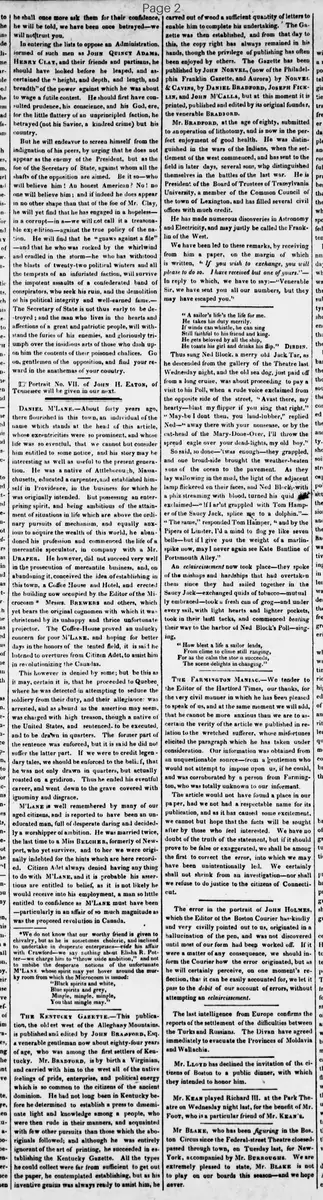
Mr. Bradford, at the age of eighty, submitted to an operation of lithotomy, and is now in the perfect enjoyment of good health. He was distinguished in the wars of the Indians, when the settlement of the west commenced, and has sent to the field in later days, several sons, who distinguished themselves in the battles of the last war. He is President of the Board of Trustees of Transylvania University, a member of the Common Council of the town of Lexington, and has filled several civil offices with much credit.
He has made numerous discoveries in Astronomy and Electricity, and may justly be called the Franklin of the West.
We have been led to these remarks, by receiving from him a paper, on the margin of which is written, "If you wish to exchange, you will please to do so. I have received but one of yours."—In reply to which, we have to say:—"Venerable Sir, we have sent you all our numbers, but they may have escaped you."
What sub-type of article is it?
What themes does it cover?
What keywords are associated?
What entities or persons were involved?
Where did it happen?
Story Details
Key Persons
Location
Kentucky, Lexington, West Of The Alleghany Mountains
Story Details
John Bradford, a Virginian settler in Kentucky, founded the Kentucky Gazette despite lacking printing knowledge by carving wooden types. At 84, he still edits it, having undergone surgery at 80, served in Indian wars, contributed sons to later conflicts, held civic positions including Transylvania University presidency, and made scientific discoveries.