Thank you for visiting SNEWPapers!
Sign up free
Story
October 17, 1811
Alexandria Daily Gazette, Commercial & Political
Alexandria, Virginia
What is this article about?
Historical overview from the Boston Gazette on philosophical and astronomical opinions about comets, from ancient Chaldeans, Greeks, Aristotle, and Pythagoras to modern thinkers like Boyle, including Procopius's account of a 6th-century comet as an omen of calamity.
Clipping
OCR Quality
97%
Excellent
Full Text
From the Boston Gazette.
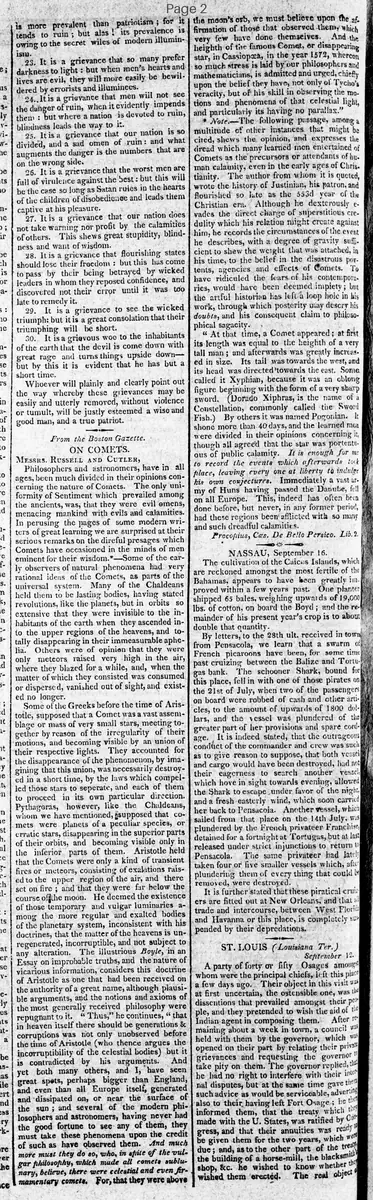
ON COMETS.
Messrs. RUSSELL And CUTLER,
Philosophers and astronomers, have in all ages, been much divided in their opinions concerning the nature of Comets. The only uniformity of Sentiment which prevailed among the ancients, was, that they were evil omens, menacing mankind with evils and calamities.
In perusing the pages of some modern writers of great learning we are surprised at their serious remarks on the direful presages which Comets have occasioned in the minds of men eminent for their wisdom.* Some of the early observers of natural phenomena had very rational ideas of the Comets, as parts of the universal system. Many of the Chaldeans held them to be lasting bodies, having stated revolutions, like the planets, but in orbits so extensive that they were invisible to the inhabitants of the earth when they ascended into the upper regions of the heavens, and totally disappearing in their immeasurable aphelia. Others were of opinion that they were only meteors raised very high in the air, where they blazed for a while, and, when the matter of which they consisted was consumed or dispersed, vanished out of sight, and existed no longer.
Some of the Greeks before the time of Aristotle, supposed that a Comet was a vast assemblage or mass of very small stars, meeting together by reason of the irregularity of their motions, and becoming visible by an union of their respective lights. They accounted for the disappearance of the phenomenon, by imagining that this union, was necessarily destroyed in a short time, by the laws which compelled those stars to separate, and each of them to proceed in its own particular direction.
Pythagoras, however, like the Chaldeans, whom we have mentioned, supposed that comets were planets of a peculiar species, or erratic stars, disappearing in the superior parts of their orbits, and becoming visible only in the inferior parts of them. Aristotle held that the Comets were only a kind of transient fires or meteors, consisting of exhalations raised to the upper region of the air, and there set on fire ; and that they were far below the course of the moon. He deemed the existence of those temporary and vulgar luminaries among the more regular and exalted bodies of the planetary system, inconsistent with his doctrines, that the matter of the heavens is ungenerated, incorruptible, and not subject to any alteration. The illustrious Boyle, in an Essay on improbable truths, and the nature of vicarious information, considers this doctrine of Aristotle as one that had been received on the authority of a great name, although plausible arguments, and the notions and axioms of the most generally received philosophy were repugnant to it. " Thus," he continues, " that in heaven itself there should be generations & corruptions was not only unobserved before the time of Aristotle (who thence argues the incorruptibility of the celestial bodies) but it is contradicted by his arguments. And yet both many others, and I, have seen great spots, perhaps bigger than England, and even than all Europe itself, generated and dissipated on, or near the surface of the sun ; and several of the modern philosophers and astronomers, having never had the good fortune to see any of them, they must take these phenomena upon the credit of such as have observed them. And much more must they do so, who, in spite of the vulgar philosophy, which made all comets sublunary, believe, there were celestial and even firmamentary comets. For, that they were above the moon's orb, we must believe upon the affirmation of those that observed them, which very few have done themselves. And the heighth of the famous Comet, or disappearing star, in Cassiopæa, in the year 1572, whereon so much stress is laid by our philosophers and mathematicians, is admitted and urged, chiefly upon the belief they have, not only of Tycho's veracity, but of his skill in observing the motions and phenomena of that celestial light and particularly its having no parallax."
* Note.--The following passage, among a multitude of other instances that might be cited, shews the opinion, and expresses the dread which many learned men entertained of Comets as the precursors or attendants of human calamity, even in the early ages of Christianity. The author from whom it is quoted, wrote the history of Justinian, his patron, and flourished so late as the 553d year of the Christian era. Although he dexterously evades the direct charge of superstitious credulity which his relation might create against him, he records the circumstances of the event he describes, with a degree of gravity sufficient to shew the weight that was attached, in his time, to the belief in the disastrous portents, agencies and effects of Comets. To have ridiculed the ears of his contemporaries, would have been deemed impiety; but the artful historian has left a loop hole in his work, through which posterity may descry his doubts, and his consequent claim to philosophical sagacity.
" At that time, a Comet appeared; at first its length was equal to the heighth of a very tall man ; and afterwards was greatly increased in size. Its tail was towards the west, and its head was directed towards the east. Some called it Xiphian, because it was an oblong figure beginning with the form of a very sharp sword. (Dorado Xiphias, is the name of a Constellation, commonly called the Sword Fish.) By others it was named Pogonian. It shone more than 40 days, and the learned men were divided in their opinions concerning it though all agreed that the star was portentous of public calamity. It is enough for me to record the events which afterwards took place, leaving every one at liberty to indulge his own conjectures. Immediately a vast army of Huns having passed the Danube, fell on all Europe. This, indeed has often been done before, but never, in any former period, had these regions been afflicted with so many and such dreadful calamities."
Procopius, Hist. De Bello Persico. Lib.2.
ON COMETS.
Messrs. RUSSELL And CUTLER,
Philosophers and astronomers, have in all ages, been much divided in their opinions concerning the nature of Comets. The only uniformity of Sentiment which prevailed among the ancients, was, that they were evil omens, menacing mankind with evils and calamities.
In perusing the pages of some modern writers of great learning we are surprised at their serious remarks on the direful presages which Comets have occasioned in the minds of men eminent for their wisdom.* Some of the early observers of natural phenomena had very rational ideas of the Comets, as parts of the universal system. Many of the Chaldeans held them to be lasting bodies, having stated revolutions, like the planets, but in orbits so extensive that they were invisible to the inhabitants of the earth when they ascended into the upper regions of the heavens, and totally disappearing in their immeasurable aphelia. Others were of opinion that they were only meteors raised very high in the air, where they blazed for a while, and, when the matter of which they consisted was consumed or dispersed, vanished out of sight, and existed no longer.
Some of the Greeks before the time of Aristotle, supposed that a Comet was a vast assemblage or mass of very small stars, meeting together by reason of the irregularity of their motions, and becoming visible by an union of their respective lights. They accounted for the disappearance of the phenomenon, by imagining that this union, was necessarily destroyed in a short time, by the laws which compelled those stars to separate, and each of them to proceed in its own particular direction.
Pythagoras, however, like the Chaldeans, whom we have mentioned, supposed that comets were planets of a peculiar species, or erratic stars, disappearing in the superior parts of their orbits, and becoming visible only in the inferior parts of them. Aristotle held that the Comets were only a kind of transient fires or meteors, consisting of exhalations raised to the upper region of the air, and there set on fire ; and that they were far below the course of the moon. He deemed the existence of those temporary and vulgar luminaries among the more regular and exalted bodies of the planetary system, inconsistent with his doctrines, that the matter of the heavens is ungenerated, incorruptible, and not subject to any alteration. The illustrious Boyle, in an Essay on improbable truths, and the nature of vicarious information, considers this doctrine of Aristotle as one that had been received on the authority of a great name, although plausible arguments, and the notions and axioms of the most generally received philosophy were repugnant to it. " Thus," he continues, " that in heaven itself there should be generations & corruptions was not only unobserved before the time of Aristotle (who thence argues the incorruptibility of the celestial bodies) but it is contradicted by his arguments. And yet both many others, and I, have seen great spots, perhaps bigger than England, and even than all Europe itself, generated and dissipated on, or near the surface of the sun ; and several of the modern philosophers and astronomers, having never had the good fortune to see any of them, they must take these phenomena upon the credit of such as have observed them. And much more must they do so, who, in spite of the vulgar philosophy, which made all comets sublunary, believe, there were celestial and even firmamentary comets. For, that they were above the moon's orb, we must believe upon the affirmation of those that observed them, which very few have done themselves. And the heighth of the famous Comet, or disappearing star, in Cassiopæa, in the year 1572, whereon so much stress is laid by our philosophers and mathematicians, is admitted and urged, chiefly upon the belief they have, not only of Tycho's veracity, but of his skill in observing the motions and phenomena of that celestial light and particularly its having no parallax."
* Note.--The following passage, among a multitude of other instances that might be cited, shews the opinion, and expresses the dread which many learned men entertained of Comets as the precursors or attendants of human calamity, even in the early ages of Christianity. The author from whom it is quoted, wrote the history of Justinian, his patron, and flourished so late as the 553d year of the Christian era. Although he dexterously evades the direct charge of superstitious credulity which his relation might create against him, he records the circumstances of the event he describes, with a degree of gravity sufficient to shew the weight that was attached, in his time, to the belief in the disastrous portents, agencies and effects of Comets. To have ridiculed the ears of his contemporaries, would have been deemed impiety; but the artful historian has left a loop hole in his work, through which posterity may descry his doubts, and his consequent claim to philosophical sagacity.
" At that time, a Comet appeared; at first its length was equal to the heighth of a very tall man ; and afterwards was greatly increased in size. Its tail was towards the west, and its head was directed towards the east. Some called it Xiphian, because it was an oblong figure beginning with the form of a very sharp sword. (Dorado Xiphias, is the name of a Constellation, commonly called the Sword Fish.) By others it was named Pogonian. It shone more than 40 days, and the learned men were divided in their opinions concerning it though all agreed that the star was portentous of public calamity. It is enough for me to record the events which afterwards took place, leaving every one at liberty to indulge his own conjectures. Immediately a vast army of Huns having passed the Danube, fell on all Europe. This, indeed has often been done before, but never, in any former period, had these regions been afflicted with so many and such dreadful calamities."
Procopius, Hist. De Bello Persico. Lib.2.
What sub-type of article is it?
Curiosity
Historical Event
What themes does it cover?
Fate Providence
Misfortune
What keywords are associated?
Comets
Astronomy
Omens
Historical Opinions
Calamities
Aristotle
Procopius
What entities or persons were involved?
Aristotle
Pythagoras
Boyle
Procopius
Story Details
Key Persons
Aristotle
Pythagoras
Boyle
Procopius
Event Date
Historical Periods Including 553 Ad And 1572
Story Details
Article surveys ancient and modern philosophical views on comets as omens or celestial bodies, citing Chaldeans, Greeks, Pythagoras, Aristotle, and Boyle; includes Procopius's 6th-century account of a comet preceding Hunnic invasions of Europe.