Thank you for visiting SNEWPapers!
Sign up free
New Haven Daily Herald
New Haven, New Haven County, Connecticut
What is this article about?
A letter corrects misconceptions about quote origins: 'God tempers the wind to the shorn lamb' from Laurence Sterne's 'Sentimental Journey'; Latin maxim 'Tempora mutantur...' from Epictetus; contrasts Bible verses 'he that is not for me is against me' and 'he that is not against me is for me.' Includes anecdote of Rev. John Lowell using the latter against J.Q. Adams in Boston.
Clipping
OCR Quality
Full Text
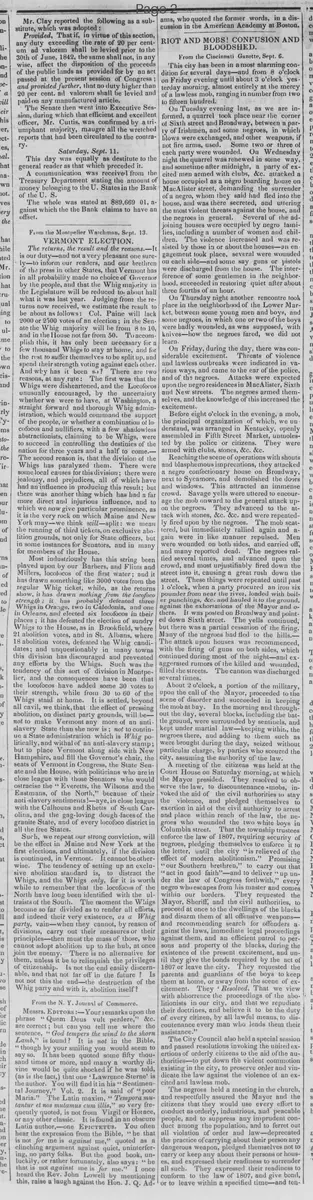
Messrs. Editors:—Your remarks upon the phrase "Quem Deus vult perdere," &c. are correct; but can you tell me where the sentence, "God tempers the wind to the shorn Lamb," is found? It is not in the Bible, though by your smiling you would seem to say so. It has been quoted some fifty thousand times or more, and many a worthy divine would be quite shocked if he was told, (as is the fact,) that one Lawrence Sterne is the author. You will find it in his "Sentimental Journey," Vol. 2. It is said of "poor Maria." The Latin maxim. "Tempora mutantur et nos mutamus cum illis." so very frequently quoted, is not from Virgil or Horace, or any other classic. It is found in an obscure Latin author,—one Epictetus. You often hear the expression from the Bible, "he that is not for me is against me," quoted as a clinching argument against quiet, uninterfering, no party folks. But the good book, unfortunately, or rather fortunately, also says: "he that is not against me is for me." I once heard the Rev. John Lowell by mentioning this, raise a laugh against the Hon. J. Q. Adams, who quoted the former words, in a discussion in the American Academy at Boston.
What sub-type of article is it?
What themes does it cover?
What keywords are associated?
What entities or persons were involved?
Letter to Editor Details
Recipient
Messrs. Editors
Main Argument
corrects sources of misattributed quotes: 'god tempers the wind to the shorn lamb' from laurence sterne, not bible; latin maxim from epictetus, not classics; contrasts bible verses on neutrality in politics, with anecdote of rev. john lowell using one against j.q. adams.
Notable Details