Thank you for visiting SNEWPapers!
Sign up free
The Liberator
Boston, Suffolk County, Massachusetts
What is this article about?
On July 4, 1837, Campton residents observed Independence Day with morning temperance talks and afternoon anti-slavery discussions in their meeting house. Writer N.P. Rogers lauds this local approach as vital for abolishing slavery and condemns pro-slavery clergy for obstructing progress toward a free, sober nation.
Clipping
OCR Quality
Full Text
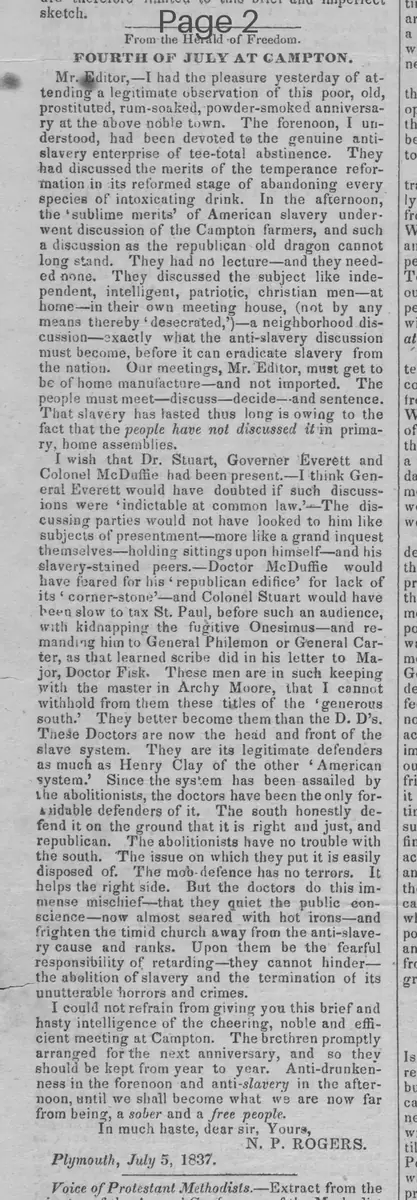
FOURTH OF JULY AT CAMPTON.
Mr. Editor,—I had the pleasure yesterday of attending a legitimate observation of this poor, old, prostituted, rum-soaked, powder-smoked anniversary at the above noble town. The forenoon, I understood, had been devoted to the genuine anti-slavery enterprise of tee-total abstinence. They had discussed the merits of the temperance reformation in its reformed stage of abandoning every species of intoxicating drink. In the afternoon, the 'sublime merits' of American slavery underwent discussion of the Campton farmers, and such a discussion as the republican old dragon cannot long stand. They had no lecture—and they needed none. They discussed the subject like independent, intelligent, patriotic, christian men—at home—in their own meeting house, (not by any means thereby 'desecrated,' )—a neighborhood discussion—exactly what the anti-slavery discussion must become, before it can eradicate slavery from the nation. Our meetings, Mr. Editor, must get to be of home manufacture—and not imported. 'The people must meet—discuss—decide—and sentence. That slavery has lasted thus long is owing to the fact that the people have not discussed it in primary, home assemblies.
I wish that Dr. Stuart, Governor Everett and Colonel McDuffie had been present.—I think General Everett would have doubted if such discussions were indictable at common law.'—The discussing parties would not have looked to him like subjects of presentment—more like a grand inquest themselves—holding sittings upon himself—and his slavery-stained peers.—Doctor McDuffie would have feared for his 'republican edifice' for lack of its 'corner-stone'—and Colonel Stuart would have been slow to tax St. Paul, before such an audience, with kidnapping the fugitive Onesimus—and remanding him to General Philemon or General Carter, as that learned scribe did in his letter to Major, Doctor Fisk. These men are in such keeping with the master in Archy Moore, that I cannot withhold from them these titles of the 'generous south.' They better become them than the D. D's. These Doctors are now the head and front of the slave system. They are its legitimate defenders as much as Henry Clay of the other American system.' Since the system has been assailed by the abolitionists, the doctors have been the only formidable defenders of it. The south honestly defend it on the ground that it is right and just, and republican. The abolitionists have no trouble with the south. The issue on which they put it is easily disposed of. The mob defence has no terrors. It helps the right side. But the doctors do this immense mischief—that they quiet the public conscience—now almost seared with hot irons—and frighten the timid church away from the anti-slavery cause and ranks. Upon them be the fearful responsibility of retarding—they cannot hinder—the abolition of slavery and the termination of its unutterable horrors and crimes.
I could not refrain from giving you this brief and hasty intelligence of the cheering, noble and efficient meeting at Campton. The brethren promptly arranged for the next anniversary, and so they should be kept from year to year. Anti-drunkenness in the forenoon and anti-slavery in the afternoon, until we shall become what we are now far from being, a sober and a free people.
In much haste, dear sir, Yours,
N. P. ROGERS.
Plymouth, July 5, 1837.
What sub-type of article is it?
What themes does it cover?
What keywords are associated?
What entities or persons were involved?
Letter to Editor Details
Author
N. P. Rogers
Recipient
Mr. Editor
Main Argument
the letter praises the fourth of july celebrations in campton, which featured temperance discussions in the morning and anti-slavery debates in the afternoon, arguing that such grassroots, home-based discussions are essential for eradicating slavery from the nation, and criticizes pro-slavery defenders like certain doctors for quieting public conscience and hindering abolition.
Notable Details