Thank you for visiting SNEWPapers!
Sign up free
The Hillsborough Recorder
Hillsboro, Orange County, North Carolina
What is this article about?
Editorial discusses the execution of Lemuel Lewis in Raleigh for aiding in the murder of Hinton Pugh, criticizes public executions as ineffective and immoral spectacles, links murder to vices like intemperance, advocates for a penitentiary for minor crimes to enable reform via solitary imprisonment and labor, supports retaining capital punishment for deliberate murder, and critiques North Carolina's legislature for denying funds for penal reform, citing barbarous alternatives like whipping.
Clipping
OCR Quality
Full Text
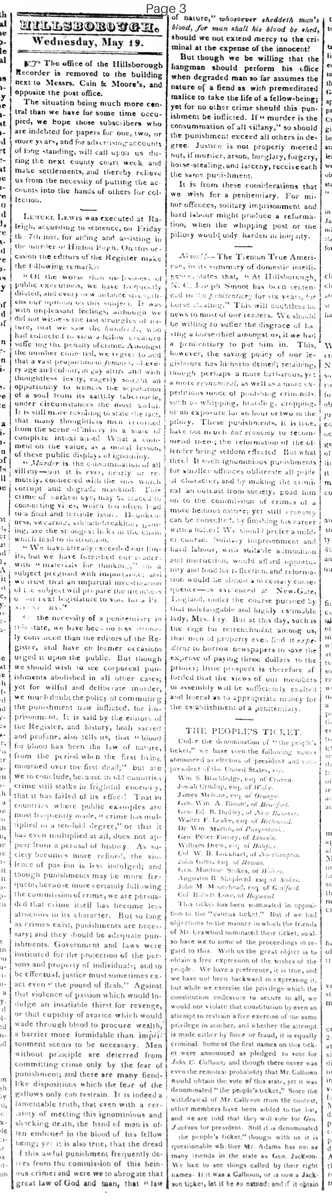
"Of the worse than uselessness of public executions, we have frequently dilated, and every new instance strengthens our opinion on this subject. It was with unpleasant feelings, although we did not witness the last struggles of nature, that we saw the hundred, who had collected to view a fellow creature suffering the penalty of crime. Amongst the number collected, we regret to add that a vast proportion of females, of every age and colour, in gay attire and with thoughtless levity, eagerly sought an opportunity to witness the separation of a soul from its earthly tabernacle, under circumstances the most awful. It is still more revolting to state the fact, that many thoughtless men returned from the scene of misery in a state of complete intoxication! What a comment on the value, as a moral lesson, of these public displays of ignominy.
Murder is the consummation of all villany out it is ever, nearly or remotely, connected with the sins which corrupt and degrade mankind. This king of darkest dye, may be traced to intemperance, which too often leads to a final and terrible issue. Drunkenness, swearing, sabbath-breaking, gaming, are the strongest links in the chain which lead to destruction.
We have already exceeded our limits, but we have furnished our reader with "materials for thinking," on a subject pregnant with importance; and we trust that an impartial investigation of the subject will prepare the members of our next legislature to vote for a penitentiary. Of the necessity of a penitentiary in this state, we have been no less strongly convinced than the editors of the Register, and have on former occasions urged it upon the public. But though we should wish to see corporeal punishments abolished in all other cases; yet for wilful and deliberate murder, we must doubt the policy of commuting the punishment now inflicted, for imprisonment. It is said by the editors of the Register, and history, both sacred and profane, also tells us, that "blood for blood has been the law of nature, from the period when the first living mourned over the first dead;" but are we to conclude, because in old countries crime still stalks in frightful enormity, that it has failed of its effect! That in countries where public examples are most frequently made, "crime has multiplied in a ten-fold degree," or that it has even multiplied at all, does not appear from a perusal of history. As society becomes more refined, the violence of passion is less indulged; and though punishments may be more frequent, because more certainly following the commission of crime, we are persuaded that crime itself has become less atrocious in its character. But so long as crimes exist, punishments are necessary; and they should be adequate punishments. Government and laws were instituted for the protection of the persons and property of individuals; and to be effectual, justice must sometimes exact even "the pound of flesh." Against that violence of passion which would indulge an insatiable thirst for revenge, or that cupidity of avarice which would wade through blood to procure wealth, a barrier more formidable than imprisonment seems to be necessary. Men without principle are deterred from committing crime only by the fear of punishment; and there are many fiend-like dispositions which the fear of the gallows only can restrain. It is indeed a lamentable truth, that even with a certainty of meeting this ignominious and shocking death, the hand of man is often embrued in the blood of his fellow being; yet it is also true, that the dread of this awful punishment frequently deters from the commission of this heinous crime: and were we to abrogate that great law of God and man, that "law of nature," whosoever sheddeth man's blood, by man shall his blood be shed, should we not extend mercy to the criminal at the expense of the innocent?
But though we be willing that the hangman should perform his office when degraded man so far assumes the nature of a fiend as with premeditated malice to take the life of a fellow-being; yet for no other crime should this punishment be inflicted. If "murder is the consummation of all villany," so should the punishment exceed all others in degree. Justice is not properly meted out, if murder, arson, burglary, forgery, horse-stealing, and larceny, receive each the same punishment.
It is from these considerations that we wish for a penitentiary. For minor offences, solitary imprisonment and hard labour might produce a reformation, when the whipping post or the pillory would only harden in iniquity.
As we see in The Trenton True American, in its summary of domestic intelligence, states that, "At Hillsborough, N. C. Joseph Smoot has been sentenced to the penitentiary for six years, for horse stealing." This will doubtless be news to most of our readers. We should be willing to suffer the disgrace of having a horse-thief amongst us, if we had a penitentiary to put him in. This however, the saving policy of our legislature has hitherto denied; retaining, though perhaps a more barbarous, yet a more economical, as well as a much more expeditious mode of punishing criminals, such as whipping, branding, cropping, or an exposure for an hour or two in the pillory. These punishments, it is true, have not much but economy to recommend them; the reformation of the offender being seldom effected. But what then? If such ignominious punishments for smaller offences obliterate all pride of character, and by making the criminal an outcast from society, goad him on to the commission of crimes of a more heinous nature; yet still economy, can be consulted, by finishing his career with a halter. We should prefer a milder course. Solitary imprisonment and hard labour, with suitable admonition and instruction, would afford opportunity and time for reflection, and reformation would be almost a necessary consequence as evidenced at Newgate, England, under the course pursued by that indefatigable and highly estimable lady, Mrs. Fry. But at this day, such is the rage for retrenchment among us, that men of property even find it expedient to borrow newspapers to save the expense of paying three dollars to the printer; little prospect is therefore afforded that the views of our members of assembly will be sufficiently exalted and liberal as to appropriate money for the establishment of a penitentiary.
What sub-type of article is it?
What keywords are associated?
What entities or persons were involved?
Editorial Details
Primary Topic
Critique Of Public Executions And Advocacy For Penitentiary While Retaining Capital Punishment For Murder
Stance / Tone
Critical Of Public Executions And Corporal Punishments, Supportive Of Penal Reform Via Penitentiary For Minor Crimes, Firm On Capital Punishment For Deliberate Murder
Key Figures
Key Arguments