Thank you for visiting SNEWPapers!
Sign up free
The Daily Alaska Empire
Juneau, Juneau County, Alaska
What is this article about?
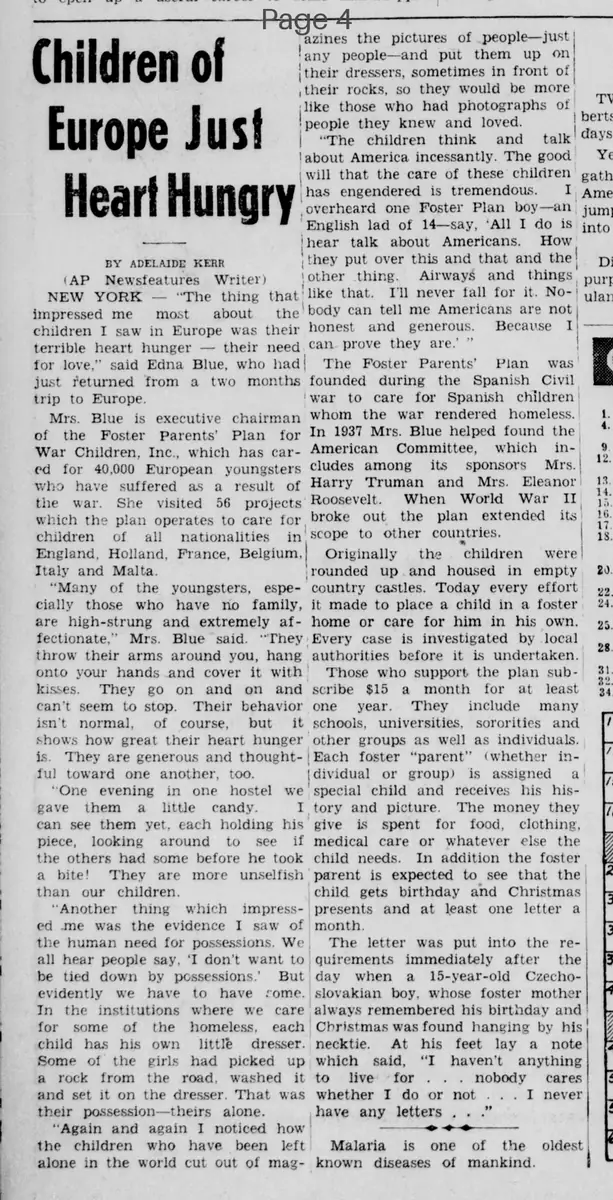
Edna Blue, executive chairman of the Foster Parents' Plan for War Children, shares observations from her European trip about war-orphaned children's emotional 'heart hunger,' unselfishness, need for possessions, and admiration for America. The plan, founded in 1937, aids 40,000 children across Europe with foster support.
Clipping
OCR Quality
Full Text
Europe Just
Heart Hungry
BY ADELAIDE KERR
(AP Newsfeatures Writer)
NEW YORK
"The thing that
impressed me
most
about
the
children I saw in Europe was their
terrible heart hunger - their need
for love," said Edna Blue, who had
just returned from a two months
trip to Europe.
Mrs. Blue is executive chairman
of the Foster Parents' Plan for
War Children. Inc., which has car-
ed for 40,000 European youngsters
who have suffered as a result of
the war. She visited 56 projects
which the plan operates to care for
children of
all nationalities
in
England, Holland. France. Belgium,
Italy and Malta.
"Many of the youngsters, espe-
cially those who have no family,
are high-strung and extremely af-
fectionate." Mrs. Blue said. "They
throw their arms around you, hang
onto your hands and cover it with
kisses.
They go on and on and
can't seem to stop.
Their behavior
isn't normal,
of course,
but
it
shows how great their heart hunger
is. They are generous and thought-
ful toward one another, too.
"One evening
in
one hostel
we
gave
them
a
little
candy.
I
can see them yet, each holding his
piece,
looking
around
to
see
if
the others had some before he took
a bite!
They are more unselfish
than our children.
"Another
thing
which
impress-
ed me was the evidence I saw of
the human need for possessions. We
all hear people say. 'I don't want to
be tied down by possessions.' But
evidently
we
have
to
have some.
In the institutions
where we care
for some
of
the
homeless, each
child has his own
little
dresser.
Some of the girls had picked up
a rock from the road, washed it
and set it on the dresser. That was
their possession-theirs alone.
"Again and again I noticed how
the children who have been left
alone in the world cut out of mag-
azines the pictures of people-just
any people-and put them up on
their dressers, sometimes in front of
their rocks. so they would be more
like those who had photographs of
people they knew and loved.
"The children think
and
talk
about America incessantly. The good
will that the care of these children
has engendered is tremendous.
I
overheard one Foster Plan boy-an
English lad of 14-say. 'All I do is
hear talk about Americans. How
they put over this and that and the
other thing. Airways and things
like that. I'll never fall for it. No-
body can tell me Americans are not
honest and generous. Because I
can prove they are.'
The Foster Parents'
Plan
was
founded during the Spanish Civil
war to care for Spanish children
whom the war rendered homeless.
In 1937 Mrs. Blue helped found the
American
Committee,
which
in-
cludes among
its
sponsors
Mrs.
Harry Truman
and
Mrs.
Eleanor
Roosevelt.
When
World
War
II
broke out
the plan extended
its
scope to other countries.
Originally
the
children
were
rounded up and housed in empty
country castles. Today every effort
it made to place a child in a foster
home or care for him in his own.
Every case is investigated by local
authorities before it is undertaken.
Those who support the plan sub-
scribe $15 a month for at least
one
year. They include many
schools. universities. sororities and
other groups as well as individuals.
Each foster "parent" (whether in-
dividual or group) is assigned
a
special child and receives his his-
tory and picture. The money they
give is spent for food, clothing.
medical care or whatever else the
child needs. In addition the foster
parent is expected to see that the
child gets birthday and Christmas
presents and at least one letter a
month.
The letter was put into the re-
quirements immediately after the
day when
a
15-year-old Czecho-
slovakian boy. whose foster mother
always remembered his birthday and
Christmas was found hanging by his
necktie.
At
his
feet lay a note
which
said,
"I
haven't
anything
to
live
for
. . . nobody
cares
whether
I do or not . . . I never
have any letters . . ."
What sub-type of article is it?
What themes does it cover?
What keywords are associated?
What entities or persons were involved?
Where did it happen?
Story Details
Key Persons
Location
Europe (England, Holland, France, Belgium, Italy, Malta)
Event Date
Post World War Ii
Story Details
Edna Blue recounts her impressions of war-orphaned children's emotional needs, unselfishness, attachment to possessions, and positive views of America from her recent European trip. She describes the Foster Parents' Plan's operations, history since 1937, and a tragic case underscoring the importance of correspondence.