Thank you for visiting SNEWPapers!
Sign up free
Story
July 30, 1872
The Wheeling Daily Register
Wheeling, Ohio County, West Virginia
What is this article about?
Satirical speech by Colonel Blaston at Long Branch praises Ulysses S. Grant as a model gentleman who amassed and spends a fortune elegantly, contrasting his social life with Washington duties and criticizing Andrew Johnson. Touches on Grant's potential second term and political maneuvering.
Clipping
OCR Quality
88%
Good
Full Text
The Grand Opening Social Democrat, oration for the Gentle Ulysses.
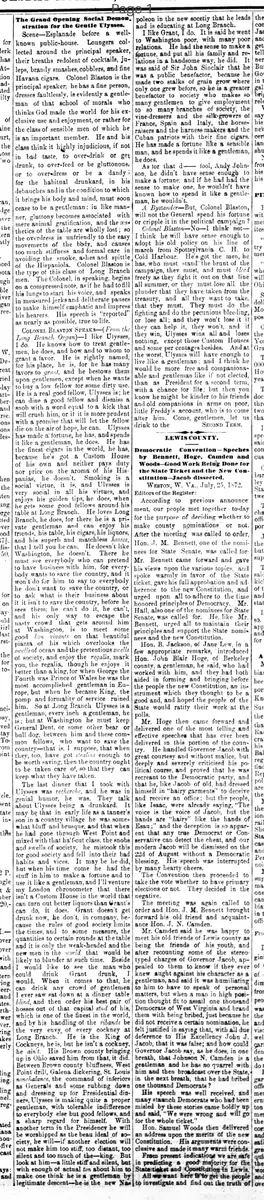
Scene—Esplanade before a well-known public-house. Loungers collected around the principal speaker, their breaths redolent of cocktails, juleps, brandy smashes, cobblers, and fine Havana cigars. Colonel Blaston is the principal speaker; he has a fine person, dresses faultlessly, is evidently a gentleman of that school of morals who thinks God made the world for his exclusive use and enjoyment, or rather for the class of sensible men of which he is an important member. He and his class think it highly injudicious, if not in bad taste, to over-drink or get drunk, to over-feed or be gluttonous, or to over-dress or be a dandy; for the habitual drunkard, in his debauches and in the condition to which it brings his body and mind, must soon cease to be a gentleman: in like manner, gluttony becomes associated with mere animal gratification, and the aesthetics of the table are wholly lost; so the overdress is unfriendly to the easy movements of the body, and causes too much stiffness and formal care in avoiding the smoke, ashes and spittle of the Havana. Colonel Blaston is the type of this class of Long Branch men. The Colonel, in speaking, begins on a compressed note, as if he had to fill his lungs to start his voice, and speaks in measured jerks and deliberate pauses to make himself emphatic and impress his hearers. His speech is "reported" as nearly as possible, true to life.
Colonel Blaston Speaks (From the Long Branch Organ)
I like Ulysses, I do. He knows how to treat gentlemen, he does, and how and to whom to grant a favor. He is rightly named, for his place, he is, for he has many favors to grant, and he bestows them upon gentlemen, except when he wants to buy a low fellow for some dirty use. He is a real good fellow, Ulysses is; he can dine a good fellow and dismiss a snob with a word equal to a kick that will crush him, or if it is more prudent with a promise that will let the fellow die on the air of hope, he can. Ulysses has made a fortune, he has, and spends it like a gentleman, he does. He has the finest cigars in the world, he has, because he's got a Custom House of his own and neither pays duty nor price on the aroma of his Havanias, he doesn't. Smoking is a social virtue, it is, and Ulysses is very social in all his virtues, and enjoys his golden tips, he does, when he gets some good fellows around his table at Long Branch. He loves Long Branch, he does, for there he is a private gentleman and can enjoy his friends, his table, his cigars, his liquors, and his superb and matchless horses, that I tell you he can. He doesn't like Washington, he doesn't. There he must see everybody who can pretend to have business with him, for everybody wants to save the country, and it won't do for him to say to everybody he don't want to save the country, or to ask what is their business about if it isn't to save the country, before he sees them; he can't do it, he can't, and his only way to escape the nasty crowd that gets around him at Washington, is to meet some good Long Branchians on that beautiful piazza of his which overlooks the swells of ocean and the pretentious swells of society, and enjoy the regalia, mark you, the regalia, though he enjoys it better than a king, for when George the Fourth was Prince of Wales he was the most accomplished gentleman in Europe, but when he became King, the pomp and formality of service ruined him. So at Long Branch Ulysses is a gentleman, every inch a gentleman, he is; but at Washington he must keep General Dent, or some other bear or bull dog, between him and these common fellows, who want to save the country—that is, I suppose, that when they, too, have got stealing enough to be worth saving, then the country ought to be taken care of, so that they can keep what they have taken.
The last dinner that I took with Ulysses was recherché, and he was in genial humor, he was. They talk about Ulysses being a drunkard. It may be that in early life as a tanner's son in a country village he was somewhat bluff and brusque, and that when he had gone through West Point and mixed with that half-cut class, the snobs and swells of society, he mistook this for good society and fell into their bad habits and vices. It may be he did, but when his time came he had the stuff in him to make a fortune and to use it like a gentleman, and I'll venture my London chronometer that there isn't a Custom House in the world that can turn out better liquors than Grant's can do, it does. Grant doesn't get drunk now, he don't, in company, because the rules of good society limit the times, and to some measure, the quantities to certain rounds at the table, and it is only the weak-headed and the new men in the world that would be likely to blunder at such time. Beside I would like to see the man who could drink Grant drunk, I would. When it comes to that, he can drink any crowd of gentlemen I ever saw sat down at a dinner table blind, and then order his best pair of horses out of that capital stud of his, which is one of the finest in the world, and by his handling of the ribands be the very envy of every cockney at Long Branch. He is the King of Cockneys, he is, but he isn't a cockney, he ain't. His Brown county bringing up in Ohio saved him from that, it did. Between Brown county bluffness, West Point drill, Galena dickering, St. Louis nonchalance, the command of inferiors as General and some rubbing down and dressing up for Presidential dinners, Ulysses is making quite a proper gentleman, with tolerable indifference to everybody else but good fellows, and a sharp regard for himself. With another term in the Presidency he will be worshipped as the beau ideal of society, he will—if another election will not make him too stiff, too distant, too silent and too much of the king. But look at him—a little stiff and silent, but with enough of actual iron about him to make one think he is a gentleman by legitimate descent—he is the new Napoleon in the new society that he leads and is educating at Long Branch.
I like Grant, I do. It is said he went to Washington poor, with many poor relations. He had the sense to make a fortune, and put all his family and relations in a handsome way, he did. It was said of Sir John Sinclair that he was a public benefactor, because he made two stalks of grain grow where only one grew before, so he is a greater benefactor to society who makes so many gentlemen to give employment to so many branches of society, the vine-dressers and the silk-growers of France, Spain and Italy, the horse-raisers and the harness-makers and the Cuban patriots with their fine cigars. He has made a fortune like a sensible man, and he spends it like a gentleman, he does.
As for that d--d fool, Andy Johnson, he didn't have sense enough to make a fortune: and if he had had the sense to make one, he wouldn't have known how to spend it like a gentleman, he wouldn't.
A Bystander—But, Colonel Blaston, will not the General spend his fortune or cripple it in the political campaign?
Colonel Blaston—No—I think not—I think he will have sense enough to adopt his old policy on his line of march from Spottsylvania C. H. to Cold Harbor. He's got the men, he has, who must stand the brunt of the campaign, they must, and must bleed freely as they fight it out on that line all summer, or they must lose all the plunder that they have taken from the treasury, and all they want to take, that they must. They must do the fighting and do the pecunious bleeding, or lose all; and they won't lose it if they can help it, they won't, and if they win, Ulysses wins all and loses nothing, except those Custom Houses and some percentages besides. And at the worst, Ulysses will have enough to live like a gentleman: and I think he would be more free and companionable and gentleman like if not elected than as President for a second term, with a chance for life; but then you know he might be kinder to his friends and old companions in arms on poor little Freddy's account, who is to come after him. "Come, gentlemen, let us drink to the Second Term."
Scene—Esplanade before a well-known public-house. Loungers collected around the principal speaker, their breaths redolent of cocktails, juleps, brandy smashes, cobblers, and fine Havana cigars. Colonel Blaston is the principal speaker; he has a fine person, dresses faultlessly, is evidently a gentleman of that school of morals who thinks God made the world for his exclusive use and enjoyment, or rather for the class of sensible men of which he is an important member. He and his class think it highly injudicious, if not in bad taste, to over-drink or get drunk, to over-feed or be gluttonous, or to over-dress or be a dandy; for the habitual drunkard, in his debauches and in the condition to which it brings his body and mind, must soon cease to be a gentleman: in like manner, gluttony becomes associated with mere animal gratification, and the aesthetics of the table are wholly lost; so the overdress is unfriendly to the easy movements of the body, and causes too much stiffness and formal care in avoiding the smoke, ashes and spittle of the Havana. Colonel Blaston is the type of this class of Long Branch men. The Colonel, in speaking, begins on a compressed note, as if he had to fill his lungs to start his voice, and speaks in measured jerks and deliberate pauses to make himself emphatic and impress his hearers. His speech is "reported" as nearly as possible, true to life.
Colonel Blaston Speaks (From the Long Branch Organ)
I like Ulysses, I do. He knows how to treat gentlemen, he does, and how and to whom to grant a favor. He is rightly named, for his place, he is, for he has many favors to grant, and he bestows them upon gentlemen, except when he wants to buy a low fellow for some dirty use. He is a real good fellow, Ulysses is; he can dine a good fellow and dismiss a snob with a word equal to a kick that will crush him, or if it is more prudent with a promise that will let the fellow die on the air of hope, he can. Ulysses has made a fortune, he has, and spends it like a gentleman, he does. He has the finest cigars in the world, he has, because he's got a Custom House of his own and neither pays duty nor price on the aroma of his Havanias, he doesn't. Smoking is a social virtue, it is, and Ulysses is very social in all his virtues, and enjoys his golden tips, he does, when he gets some good fellows around his table at Long Branch. He loves Long Branch, he does, for there he is a private gentleman and can enjoy his friends, his table, his cigars, his liquors, and his superb and matchless horses, that I tell you he can. He doesn't like Washington, he doesn't. There he must see everybody who can pretend to have business with him, for everybody wants to save the country, and it won't do for him to say to everybody he don't want to save the country, or to ask what is their business about if it isn't to save the country, before he sees them; he can't do it, he can't, and his only way to escape the nasty crowd that gets around him at Washington, is to meet some good Long Branchians on that beautiful piazza of his which overlooks the swells of ocean and the pretentious swells of society, and enjoy the regalia, mark you, the regalia, though he enjoys it better than a king, for when George the Fourth was Prince of Wales he was the most accomplished gentleman in Europe, but when he became King, the pomp and formality of service ruined him. So at Long Branch Ulysses is a gentleman, every inch a gentleman, he is; but at Washington he must keep General Dent, or some other bear or bull dog, between him and these common fellows, who want to save the country—that is, I suppose, that when they, too, have got stealing enough to be worth saving, then the country ought to be taken care of, so that they can keep what they have taken.
The last dinner that I took with Ulysses was recherché, and he was in genial humor, he was. They talk about Ulysses being a drunkard. It may be that in early life as a tanner's son in a country village he was somewhat bluff and brusque, and that when he had gone through West Point and mixed with that half-cut class, the snobs and swells of society, he mistook this for good society and fell into their bad habits and vices. It may be he did, but when his time came he had the stuff in him to make a fortune and to use it like a gentleman, and I'll venture my London chronometer that there isn't a Custom House in the world that can turn out better liquors than Grant's can do, it does. Grant doesn't get drunk now, he don't, in company, because the rules of good society limit the times, and to some measure, the quantities to certain rounds at the table, and it is only the weak-headed and the new men in the world that would be likely to blunder at such time. Beside I would like to see the man who could drink Grant drunk, I would. When it comes to that, he can drink any crowd of gentlemen I ever saw sat down at a dinner table blind, and then order his best pair of horses out of that capital stud of his, which is one of the finest in the world, and by his handling of the ribands be the very envy of every cockney at Long Branch. He is the King of Cockneys, he is, but he isn't a cockney, he ain't. His Brown county bringing up in Ohio saved him from that, it did. Between Brown county bluffness, West Point drill, Galena dickering, St. Louis nonchalance, the command of inferiors as General and some rubbing down and dressing up for Presidential dinners, Ulysses is making quite a proper gentleman, with tolerable indifference to everybody else but good fellows, and a sharp regard for himself. With another term in the Presidency he will be worshipped as the beau ideal of society, he will—if another election will not make him too stiff, too distant, too silent and too much of the king. But look at him—a little stiff and silent, but with enough of actual iron about him to make one think he is a gentleman by legitimate descent—he is the new Napoleon in the new society that he leads and is educating at Long Branch.
I like Grant, I do. It is said he went to Washington poor, with many poor relations. He had the sense to make a fortune, and put all his family and relations in a handsome way, he did. It was said of Sir John Sinclair that he was a public benefactor, because he made two stalks of grain grow where only one grew before, so he is a greater benefactor to society who makes so many gentlemen to give employment to so many branches of society, the vine-dressers and the silk-growers of France, Spain and Italy, the horse-raisers and the harness-makers and the Cuban patriots with their fine cigars. He has made a fortune like a sensible man, and he spends it like a gentleman, he does.
As for that d--d fool, Andy Johnson, he didn't have sense enough to make a fortune: and if he had had the sense to make one, he wouldn't have known how to spend it like a gentleman, he wouldn't.
A Bystander—But, Colonel Blaston, will not the General spend his fortune or cripple it in the political campaign?
Colonel Blaston—No—I think not—I think he will have sense enough to adopt his old policy on his line of march from Spottsylvania C. H. to Cold Harbor. He's got the men, he has, who must stand the brunt of the campaign, they must, and must bleed freely as they fight it out on that line all summer, or they must lose all the plunder that they have taken from the treasury, and all they want to take, that they must. They must do the fighting and do the pecunious bleeding, or lose all; and they won't lose it if they can help it, they won't, and if they win, Ulysses wins all and loses nothing, except those Custom Houses and some percentages besides. And at the worst, Ulysses will have enough to live like a gentleman: and I think he would be more free and companionable and gentleman like if not elected than as President for a second term, with a chance for life; but then you know he might be kinder to his friends and old companions in arms on poor little Freddy's account, who is to come after him. "Come, gentlemen, let us drink to the Second Term."
What sub-type of article is it?
Biography
Historical Event
Curiosity
What themes does it cover?
Social Manners
Triumph
Fortune Reversal
What keywords are associated?
Ulysses Grant
Long Branch
Colonel Blaston
Gentlemanly Society
Political Satire
Custom House
Second Term
Andrew Johnson
What entities or persons were involved?
Colonel Blaston
Ulysses S. Grant
Andy Johnson
General Dent
Where did it happen?
Long Branch, Washington
Story Details
Key Persons
Colonel Blaston
Ulysses S. Grant
Andy Johnson
General Dent
Location
Long Branch, Washington
Story Details
Colonel Blaston delivers a satirical speech lauding Ulysses S. Grant's rise from humble origins to a gentlemanly fortune-maker who enjoys luxuries at Long Branch, dismisses snobs, and navigates politics shrewdly, contrasting him favorably with Andrew Johnson and predicting success in a second term.