Thank you for visiting SNEWPapers!
Sign up free
The Radical
Bowling Green, Pike County, Missouri
What is this article about?
The May issue of Merchants' Magazine analyzes European national debts, noting Holland's crippling $650M burden per 3M people risking bankruptcy, Britain's $3.7B debt manageable via resources, and lighter loads in Norway, Prussia, and German states, underscoring Old World's financial hardships vs. America's relative ease. (248 characters)
Clipping
OCR Quality
Full Text
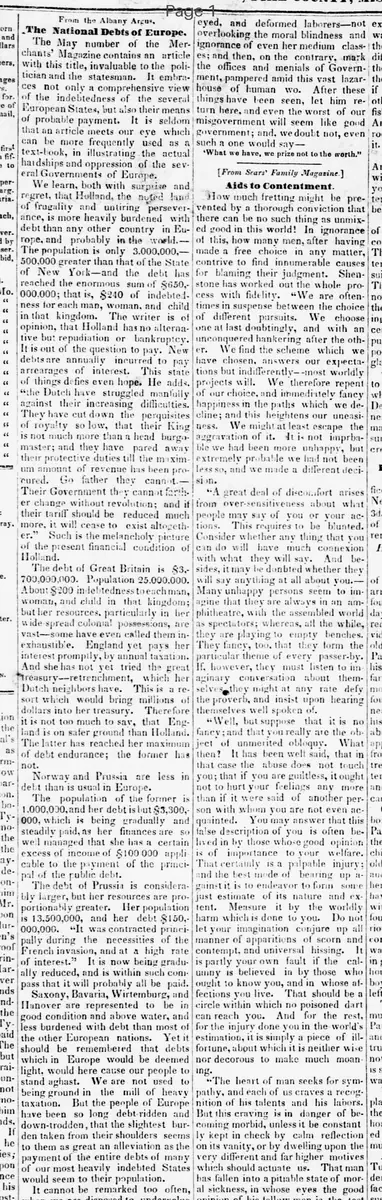
The National Debts of Europe.
The May number of the Merchants' Magazine contains an article with this title, invaluable to the politician and the statesman. It embraces not only a comprehensive view of the indebtedness of the several European States, but also their means of probable payment. It is seldom that an article meets our eye which can be more frequently used as a text-book, in illustrating the actual hardships and oppression of the several Governments of Europe.
We learn, both with surprise and regret, that Holland, the noted land of frugality and untiring perseverance, is more heavily burdened with debt than any other country in Europe, and probably in the world. The population is only 3,000,000.--500,000 greater than that of the State of New York--and the debt has reached the enormous sum of $650,000,000; that is, $240 of indebtedness for each man, woman, and child in that kingdom. The writer is of opinion, that Holland has no alternative but repudiation or bankruptcy. It is out of the question to pay. New debts are annually incurred to pay arrearages of interest. This state of things defies even hope. He adds, "the Dutch have struggled manfully against their increasing difficulties. They have cut down the perquisites of royalty so low, that their King is not much more than a head burgomaster: and they have pared away their protective duties till the maximum amount of revenue has been procured. Go farther they cannot.-- Their Government they cannot farther change without revolution; and if their tariff should be reduced much more, it will cease to exist altogether." Such is the melancholy picture of the present financial condition of Holland.
The debt of Great Britain is $3,700,000,000. Population 25,000,000. About $200 indebtedness to each man, woman, and child in that kingdom; but her resources, particularly in her wide-spread colonial possessions, are vast--some have even called them inexhaustible. England yet pays her interest promptly, by annual taxation. And she has not yet tried the great treasury--retrenchment, which her Dutch neighbors have. This is a resort which would bring millions of dollars into her treasury. Therefore it is not too much to say, that England is on safer ground than Holland. The latter has reached her maximum of debt endurance: the former has not.
Norway and Prussia are less in debt than is usual in Europe. The population of the former is 1,000,000, and her debt is but $3,300,000, which is being gradually and steadily paid, as her finances are so well managed that she has a certain excess of income of $100,000 applicable to the payment of the principal of the public debt.
The debt of Prussia is considerably larger, but her resources are proportionably greater. Her population is 13,500,000, and her debt $150,000,000. "It was contracted principally during the necessities of the French invasion, and at a high rate of interest." It is now being gradually reduced, and is within such compass that it will probably all be paid.
Saxony, Bavaria, Wirtemberg, and Hanover are represented to be in good condition and above water, and less burdened with debt than most of the other European nations. Yet it should be remembered that debts which in Europe would be deemed light, would here cause our people to stand aghast. We are not used to being ground in the mill of heavy taxation. But the people of Europe have been so long debt-ridden and down-trodden, that the slightest burden taken from their shoulders seems to them as great an alleviation as the payment of the entire debts of many of our most heavily indebted States would seem to their population.
It cannot be remarked too often, when we are disposed to undervalue the preeminent blessings of our Government, or disposed to denounce as robbery even our comparatively moderate taxation, that it would be wise to recur to the condition of even the most favored nations of the Old World. Cross the ocean to Europe; traverse that land in every direction; witness her half-clad peasantry, her rude hovels for her people, and her palaces for her rulers; go to her manufactories--the famed seats of her greatness and her power--and there witness her half-starved, blear-eyed, and deformed laborers---not overlooking the moral blindness and ignorance of even her medium classes; and then, on the contrary, mark the offices and menials of Government, pampered amid this vast lazar-house of human wo. After these things have been seen, let him return here, and even the worst of our misgovernment will seem like good government; and, we doubt not, even such a one would say--
'What we have, we prize not to the worth.'
What sub-type of article is it?
What keywords are associated?
Where did it happen?
Foreign News Details
Primary Location
Europe
Outcome
holland: $650,000,000 debt for 3,000,000 population ($240 per person), facing repudiation or bankruptcy; great britain: $3,700,000,000 debt for 25,000,000 population ($200 per person), pays interest promptly with vast resources; norway: $3,300,000 debt for 1,000,000 population, gradually paying off with excess income; prussia: $150,000,000 debt for 13,500,000 population, gradually reducing; saxony, bavaria, wurtemberg, hanover: good condition, less burdened.
Event Details
Article from Merchants' Magazine details European national debts and payment capacities. Holland is most indebted, unable to pay without new debts for interest, having reduced royal perks and duties to maximum revenue without revolution. Britain manages debt via taxation and untapped retrenchment, supported by colonies. Norway and Prussia have lower debts relative to population and are reducing them steadily. German states like Saxony are in better shape. Contrasts European debt oppression with lighter American burdens.