Thank you for visiting SNEWPapers!
Sign up free
Fowle's New Hampshire Gazette And General Advertiser
Portsmouth, Rockingham County, New Hampshire
What is this article about?
In Antigua, three newly purchased slaves—Swift, Alfred, and Edinburgh—attempted to murder Major Lockhart Russell, set fire to his estate, and incite a revolt but failed. Swift was killed by Alfred, who was executed; Edinburgh was spared. Nine slaves wounded.
Clipping
OCR Quality
Full Text
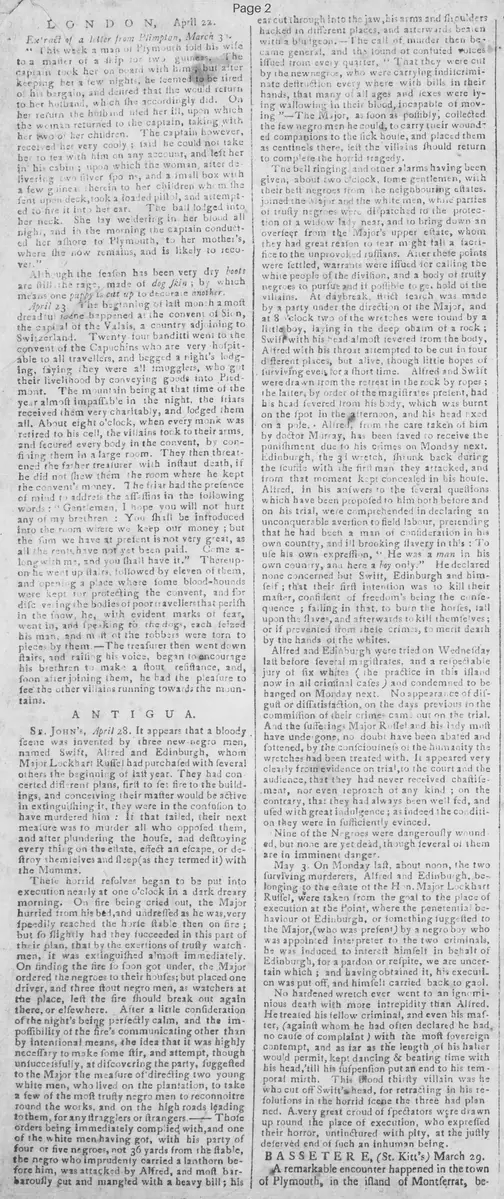
St. John's, April 28. It appears that a bloody scene was invented by three new-negro men, named Swift, Alfred and Edinburgh, whom Major Lockhart Russell had purchased with several others the beginning of last year. They had concerted different plans, first to set fire to the buildings, and conceiving their master would be active in extinguishing it, they were in the confusion to have murdered him: If that failed, their next measure was to murder all who opposed them, and after plundering the house, and destroying every thing on the estate, effect an escape, or destroy themselves and sleep (as they termed it) with the master.
These horrid resolves began to be put into execution nearly at one o'clock in a dark dreary morning. On fire being cried out, the Major hurried from his bed, and undressed as he was, very speedily reached the horse stable then on fire: But so slightly had they succeeded in this part of their plan, that by the exertions of trusty watchmen, it was extinguished almost immediately.
On finding the fire soon got under, the Major ordered the negroes to their houses; but placed one driver, and three stout negro men, as watchers at the place, lest the fire should break out again there, or elsewhere. After a little consideration of the night's being perfectly calm, and the impossibility of the fire's communicating other than by intentional means, the idea that it was highly necessary to make some stir, and attempt, though unsuccessfully, at discovering the party, suggested to the Major the measure of directing two young white men, who lived on the plantation, to take a few of the most trusty negro men to reconnoitre round the works, and on the high roads leading to them, for any stragglers or strangers.
Those orders being immediately complied with, and one of the white men having got, with his party of four or five negroes, not 36 yards from the stable, the negro who imprudently carried a lanthorn before him, was attacked by Alfred, and most barbarously cut and mangled with a heavy bill; his ear cut through into the jaw, his arms and shoulders hacked in different places, and afterwards beaten with a bludgeon.
The call of murder then became general, and the sound of confused voices issued from every quarter, "That they were cut by the new negros, who were carrying indiscriminate destruction every where with bills in their hands, that many of all ages and sexes were lying wallowing in their blood, incapable of moving".
The Major, as soon as possibly, collected the few negro men he could, to carry their wounded companions to the sick house, and placed them as sentinels there, lest the villains should return to complete the horrid tragedy.
The bell ringing and other alarms having been given, about two o'clock, some gentlemen, with their best negroes from the neighbouring estates, joined the major and the white men, whose parties of trusty negroes were dispatched to the protection of a widow lady near, and to bring down an overseer from the Major's upper estate, whom they had great reason to fear might fall a sacrifice to the unprovoked ruffians. After these points were settled, warrants were issued for calling the white people of the division, and a body of trusty negroes to pursue and if possible to get hold of the villains. At daybreak, a strict search was made by a party under the direction of the Major, and at 8 o'clock two of the wretches were found by a little boy, laying in the deep calm of a rock; Swift with his head almost severed from the body, Alfred with his throat attempted to be cut in four different places, but alive, though little hopes of surviving even for a short time. Alfred and Swift were drawn from the retreat in the rock by ropes; the latter, by order of the magistrates present, had his head severed from his body, which was burnt on the spot in the afternoon, and his head fixed on a pole. Alfred, from the care taken of him by doctor Murray, has been saved to receive the punishment due to his crimes on Monday next.
Edinburgh, the 3d wretch, shrunk back during the scuffle with the first man they attacked, and from that moment kept concealed in his house.
Alfred, in his answers to the several questions which have been proposed to him both before and on his trial, were comprehended in declaring an unconquerable aversion to field labour, pretending that he had been a man of consideration in his own country, and ill brooking slavery in this: To use his own expression, "He was a man in his own country, and here a boy only." He declared none concerned but Swift, Edinburgh and himself; that their first intention was to kill their master, confident of freedom's being the consequence; failing in that, to burn the horses, fall upon the slaves, and afterwards to kill themselves; or if prevented from these crimes, to meet death by the hands of the whites.
Alfred and Edinburgh were tried on Wednesday last before several magistrates, and a respectable jury of six whites (the practice in this island now in all criminal cases) and condemned to be hanged on Monday next. No appearance of disgust or dissatisfaction, on the days previous to the commission of their crimes came out on the trial.
And the sufferings Major Russell and his lady must have undergone, no doubt have been abated and softened, by the consciousness of the humanity the wretches had been treated with. It appeared very clearly from evidence on trial, to the court and the audience, that they had never received chastisement, nor even reproach of any kind; on the contrary, that they had always been well fed, and used with great indulgence; as indeed the condition they were in sufficiently evinced.
Nine of the Negroes were dangerously wounded, but none are yet dead, though several of them are in imminent danger.
May 3. On Monday last, about noon, the two surviving murderers, Alfred and Edinburgh, belonging to the estate of the Hon. Major Lockhart Russell, were taken from the goal to the place of execution at the Point, where the penitent behaviour of Edinburgh, or something suggested to the Major (who was present) by a negro boy who was appointed interpreter to the two criminals, he was induced to interest himself in behalf of Edinburgh, for a pardon or respite, we are uncertain which; and having obtained it, his execution was put off, and himself carried back to gaol.
No hardened wretch ever went to an ignominious death with more intrepidity than Alfred. He treated his fellow criminal, and even his master, (against whom he had often declared he had no cause of complaint) with the most sovereign contempt, and as far as the length of his halter would permit, kept dancing & beating time with his head, 'till his suspension put an end to his temporal mirth. This bold thirty villain was he who cut off Swift's head, for retracting in his resolutions in the horrid scene the three had planned.
A very great crowd of spectators were drawn up round the place of execution, who expressed their horror, untinctured with pity, at the justly deserved end of such an inhuman being.
What sub-type of article is it?
What keywords are associated?
What entities or persons were involved?
Where did it happen?
Foreign News Details
Primary Location
Antigua
Event Date
April 28
Key Persons
Outcome
nine negroes dangerously wounded; swift killed by alfred and body burned; alfred executed by hanging; edinburgh respited or pardoned.
Event Details
Three new-negro slaves, Swift, Alfred, and Edinburgh, plotted to murder Major Lockhart Russell by setting fire to his estate, killing opponents, plundering, and escaping or suiciding. The fire was quickly extinguished. Alfred attacked and wounded a negro with a bill and bludgeon, leading to alarms and pursuit. Swift and Alfred found hiding; Swift's head severed and body burned. Alfred and Edinburgh tried and condemned; Alfred executed on May 3, Edinburgh spared due to Major's intervention. Motive: aversion to slavery.