Thank you for visiting SNEWPapers!
Sign up free
Rhode Island American And Providence Gazette
Providence, Providence County, Rhode Island
What is this article about?
Report on the 20th Congress second session proceedings from December 29-31, 1828, covering Senate and House debates and votes on bills including drawback extensions, Mrs. Decatur's claim, refined sugar drawback, Oregon occupation, and various petitions and resolutions.
Clipping
OCR Quality
Full Text
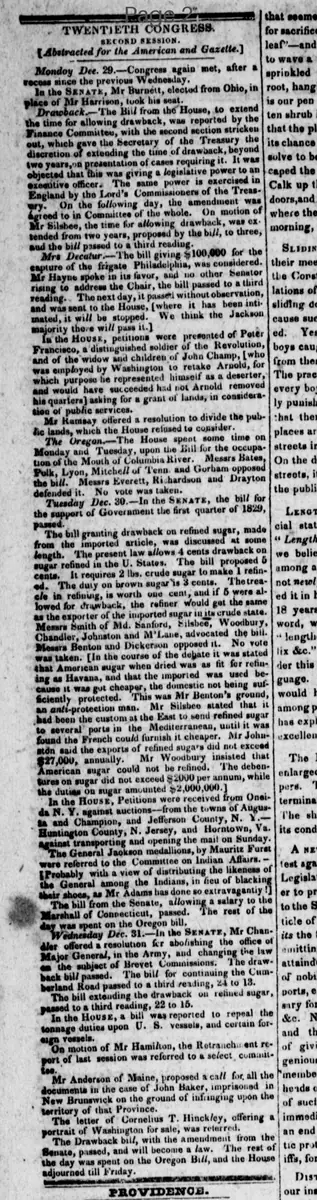
SECOND SESSION.
[Abstracted for the American and Gazette.]
Monday Dec. 29.—Congress again met, after a recess since the previous Wednesday.
In the SENATE, Mr. Burnet, elected from Ohio, in place of Mr. Harrison, took his seat.
Drawback.—The Bill from the House, to extend the time for allowing drawback, was reported by the Finance Committee, with the second section stricken out, which gave the Secretary of the Treasury the discretion of extending the time of drawback, beyond two years, on presentation of cases requiring it. It was objected that this was giving a legislative power to an Executive officer. The same power is exercised in England by the Lord's Commissioners of the Treasury. On the following day, the amendment was agreed to in Committee of the whole. On motion of Mr. Silsbee, the time for allowing drawback, was extended from two years, proposed by the bill, to three, and the bill passed to a third reading.
Mrs. Decatur.—The bill giving $100,000 for the capture of the frigate Philadelphia, was considered. Mr. Hayne spoke in its favor, and no other Senator rising to address the Chair, the bill passed to a third reading. The next day, it passed without observation, and was sent to the House, (where it has been intimated, it will be stopped. We think the Jackson majority there will pass it.)
In the House, petitions were presented of Peter Francisco, a distinguished soldier of the Revolution, and of the widow and children of John Champe, [who was employed by Washington to retake Arnold, for which purpose he represented himself as a deserter, and would have succeeded had not Arnold removed his quarters] asking for a grant of lands, in consideration of public services.
Mr. Ramsay offered a resolution to divide the public lands, which the House refused to consider.
The Oregon.—The House spent some time on Monday and Tuesday, upon the Bill for the Occupation of the Mouth of Columbia River. Messrs. Bates, Polk, Lyon, Mitchell of Tenn. and Gorham opposed the bill. Messrs. Everett, Richardson and Drayton defended it. No vote was taken.
Tuesday Dec. 30.—In the SENATE, the bill for the support of Government the first quarter of 1829, passed.
The bill granting drawback on refined sugar, made from the imported article, was discussed at some length. The present law allows 4 cents drawback on sugar refined in the U. States. The bill proposed 5 cents. It requires 2 lbs. crude sugar to make 1 refined. The duty on brown sugar is 3 cents. The treasure in refining, is worth one cent, and if 5 were allowed for drawback, the refiner would get the same as the exporter of the imported sugar in its crude state.
Messrs. Smith of Md. Sanford, Silsbee, Woodbury, Chandler, Johnston and M'Lane, advocated the bill.
Messrs. Benton and Dickerson opposed it. No vote was taken. [In the course of the debate it was stated that American sugar when dried was as fit for refining as Havana, and that the imported was used because it was got cheaper, the domestic not being sufficiently protected. This was Mr. Benton's ground, an anti-protection man. Mr. Silsbee stated that it had been the custom at the East to send refined sugar to several ports in the Mediterranean, until it was found the French could furnish it cheaper. Mr. Johnston said the exports of refined sugars did not exceed $27,000, annually. Mr. Woodbury insisted that American sugar could not be refined. The debentures on sugar did not exceed $2000 per annum, while the duties on sugar amounted $2,000,000.]
In the House, Petitions were received from Oneida N. Y. against auctions—from the towns of Augusta and Champion, and Jefferson County, N. Y.—Huntington County, N. Jersey, and Horntown, Va. against transporting and opening the mail on Sunday.
The General Jackson medallions, by Mauritz Furst were referred to the Committee on Indian Affairs.—[Probably with a view of distributing the likeness of the General among the Indians, in lieu of blacking their shoes, as Mr. Adams has done so extravagantly!]
The bill from the Senate, allowing a salary to the Marshall of Connecticut, passed. The rest of the day was spent on the Oregon bill,
Wednesday Dec. 31.—In the Senate, Mr. Chandler offered a resolution for abolishing the office of Major General, in the Army, and changing the law on the subject of Brevet Commissions. The drawback bill passed. The bill for continuing the Cumberland Road passed to a third reading, 24 to 13.
The bill extending the drawback on refined sugar, passed to a third reading.
In the House, a bill was reported to repeal the tonnage duties upon U. S. vessels, and certain foreign vessels.
On motion of Mr. Hamilton, the Retrenchment report of last session was referred to a select committee.
Mr. Anderson of Maine, proposed a call for all the documents in the case of John Baker, imprisoned in New Brunswick on the ground of infringing upon the territory of that Province.
The letter of Cornelius T. Hinckley, offering a portrait of Washington for sale, was referred.
The Drawback bill, with the amendment from the Senate, passed, and will become a law. The rest of the day was spent on the Oregon Bill, and the House adjourned till Friday.
What sub-type of article is it?
What keywords are associated?
What entities or persons were involved?
Domestic News Details
Event Date
December 29 31, 1828
Key Persons
Outcome
various bills passed or advanced including drawback extension to three years, mrs. decatur bill to house, government support bill passed, refined sugar drawback bill advanced, cumberland road bill to third reading 24-13, tonnage duties repeal reported, drawback bill passed into law; oregon bill debated without vote; petitions received and resolutions offered.
Event Details
Proceedings of the 20th Congress second session: Senate seating of Mr. Burnet; debates and votes on drawback bills, Mrs. Decatur claim, government support, refined sugar drawback, Cumberland Road; House petitions from Peter Francisco, John Champe widow/children, various against auctions and Sunday mail; resolution on public lands refused; Oregon bill debated; Jackson medallions referred; salary bill for Connecticut Marshall passed; resolution on Major General office; retrenchment report referred; call for John Baker documents; Washington portrait letter referred.