Thank you for visiting SNEWPapers!
Sign up free
Editorial
May 14, 1833
Richmond Enquirer
Richmond, Richmond County, Virginia
What is this article about?
An editorial in Richmond critiques a letter from the Columbia Telescope alleging Martin Van Buren believes state separation inevitable over tariff and slavery issues, plotting to force it. The piece defends Van Buren, urges fair tariff reform without dissolution, warns against slave emancipation attempts, and notes Northern denials of interference.
Clipping
OCR Quality
98%
Excellent
Full Text
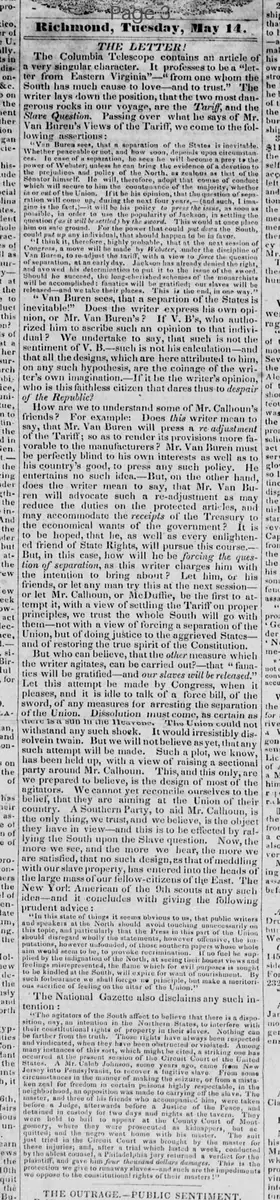
Richmond, Tuesday, May 14.
THE LETTER!
The Columbia Telescope contains an article of a very singular character. It professes to be a "letter from Eastern Virginia" from one whom the South has much cause to love—and to trust." The writer lays down the position, that the two most dangerous rocks in our voyage, are the Tariff, and the Slave Question. Passing over what he says of Mr. Van Buren's Views of the Tariff, we come to the following assertions:
"Van Buren sees, that a separation of the States is inevitable. Whether peaceable or not, and how soon, depends upon circumstances. In case of a separation, he sees he will become a prey to the power of Webster; unless he can bring the evidence of a devotion to the prejudices and policy of the North, as zealous as that of the Senator himself. He will, therefore, adopt that course of conduct which will secure to him the countenance of the majority, whether in or out of the Union. If it be his opinion, that the question of separation will come up, during the next four years,—(and such, I imagine is the fact,)—it will be his policy to press the issue, as soon as possible, in order to use the popularity of Jackson, in settling the question (as it will be settled) by the sword. This would at once place him on safe ground. For the power that could put down the South, could put up any individual, that should happen to be in favor.
"I think it, therefore, highly probable, that at the next session of Congress, a move will be made by Webster, under the discipline of Van Buren, to re-adjust the tariff, with a view to force the question of separation, at an early day. Jackson has already denied the right, and avowed his determination to put it to the issue of the sword. Should he succeed, the long-cherished schemes of the monarchists will be accomplished: fanatics will be gratified; our slaves will be released and we take their places. This is the end, in one way."
"Van Buren sees, that a separation of the States is inevitable!" Does the writer express his own opinion, or Mr. Van Buren's? If V. B's, who authorized him to ascribe such an opinion to that individual? We undertake to say, that such is not the sentiment of V. B.—such is not his calculation—and that all the designs, which are here attributed to him, on any such hypothesis, are the coinage of the writer's own imagination.—If it be the writer's opinion, who is this faithless citizen that dares thus to despair of the Republic?
How are we to understand some of Mr. Calhoun's friends? For example: Does this writer mean to say, that Mr. Van Buren will press a re-adjustment of the Tariff; so as to render its provisions more favorable to the manufacturers? Mr. Van Buren must be perfectly blind to his own interests as well as to his country's good, to press any such policy. He entertains no such idea.—But, on the other hand, does the writer mean to say, that Mr. Van Buren will advocate such a re-adjustment as may reduce the duties on the protected articles, and may accommodate the receipts of the Treasury to the economical wants of the government? It is to be hoped, that he, as well as every enlightened friend of State Rights, will pursue this course.—But, in this case, how will he be forcing the question of separation, as this writer charges him with the intention to bring about? Let him, or his friends, or let any man try this at the next session—or let Mr. Calhoun, or McDuffie, be the first to attempt it, with a view of settling the Tariff on proper principles, we trust the whole South will go with them—not with a view of forcing a separation of the Union, but of doing justice to the aggrieved States—and of restoring the true spirit of the Constitution.
But who can believe, that the other measure which the writer agitates, can be carried out?—that "fanatics will be gratified—and our slaves will be released." Let this attempt be made by Congress, when it pleases, and it is idle to talk of a force bill, of the sword, of any measures for arresting the separation of the Union. Dissolution must come, as certain as there is a sun in the heavens. The Union could not withstand any such shock. It would irresistibly dissolve in twain. But we will not believe as yet, that any such attempt will be made. Such a plot, we know, has been held up, with a view of raising a sectional party around Mr. Calhoun. This, and this only, are we prepared to believe, is the design of most of the agitators. We cannot yet reconcile ourselves to the belief, that they are aiming at the Union of their country. A Southern Party, to aid Mr. Calhoun, is the only thing, we trust, and we believe, is the object they have in view—and this is to be effected by rallying the South upon the Slave question. Now, the more we see, and the more we hear, the more we are satisfied, that no such design, as that of meddling with our slave property, has entered into the heads of the large mass of our fellow-citizens of the East. The New York American of the 9th scoffs at any such idea—and it concludes with giving the following prudent advice:
"In this state of things it seems obvious to us, that public writers and speakers at the North should avoid touching unnecessarily on this topic, and particularly that the Press in this part of the Union should disregard wholly the statements, however offensive, the imputations, however unfounded, of those southern papers whose whole aim would seem to be, to provoke recrimination. If no fuel be supplied by the indignation of the North, at seeing their honest views and feelings misrepresented, the flame which for evil purposes is sought to be kindled at the South, will expire for want of nourishment. By such forbearance we shall forego no principle, but make a meritorious sacrifice of feeling on the altar of the Union."
The National Gazette also disclaims any such intention:
"The agitators of the South affect to believe that there is a disposition, nay, an intention in the Northern States, to interfere with their constitutional rights of property in their slaves. Nothing can be farther from the truth. Those rights have always been respected and vindicated, when they have been obstructed or violated. Among many instances of this sort, which might be cited, a striking one has occurred at the present session of the Circuit Court of the United States. A Mr. Caleb Johnson, some years ago, came from New Jersey into Pennsylvania, to recover a fugitive slave From some circumstances in the manner of making the seizure, or from a mistaken zeal for freedom in certain persons highly respectable, in the neighborhood, an opposition was made to carrying off the slave. The master, and three of his friends who accompanied him, were taken before a Judge, afterwards before a Justice of the Peace, and detained in custody for two days and nights at the tavern. They were held to bail to appear at the County Court of Montgomery, where they were prosecuted as kidnappers, but acquitted; and the negro went home with his master. The suit just tried in the Circuit Court was brought by the master for these injuries; and, after a trial which lasted a week, conducted by the ablest counsel, a Philadelphia jury returned a verdict for the plaintiff, and gave him four thousand dollars damages. This is the protection we give to runaway slaves—and such are the impediments we oppose to the constitutional rights of their masters!"
THE LETTER!
The Columbia Telescope contains an article of a very singular character. It professes to be a "letter from Eastern Virginia" from one whom the South has much cause to love—and to trust." The writer lays down the position, that the two most dangerous rocks in our voyage, are the Tariff, and the Slave Question. Passing over what he says of Mr. Van Buren's Views of the Tariff, we come to the following assertions:
"Van Buren sees, that a separation of the States is inevitable. Whether peaceable or not, and how soon, depends upon circumstances. In case of a separation, he sees he will become a prey to the power of Webster; unless he can bring the evidence of a devotion to the prejudices and policy of the North, as zealous as that of the Senator himself. He will, therefore, adopt that course of conduct which will secure to him the countenance of the majority, whether in or out of the Union. If it be his opinion, that the question of separation will come up, during the next four years,—(and such, I imagine is the fact,)—it will be his policy to press the issue, as soon as possible, in order to use the popularity of Jackson, in settling the question (as it will be settled) by the sword. This would at once place him on safe ground. For the power that could put down the South, could put up any individual, that should happen to be in favor.
"I think it, therefore, highly probable, that at the next session of Congress, a move will be made by Webster, under the discipline of Van Buren, to re-adjust the tariff, with a view to force the question of separation, at an early day. Jackson has already denied the right, and avowed his determination to put it to the issue of the sword. Should he succeed, the long-cherished schemes of the monarchists will be accomplished: fanatics will be gratified; our slaves will be released and we take their places. This is the end, in one way."
"Van Buren sees, that a separation of the States is inevitable!" Does the writer express his own opinion, or Mr. Van Buren's? If V. B's, who authorized him to ascribe such an opinion to that individual? We undertake to say, that such is not the sentiment of V. B.—such is not his calculation—and that all the designs, which are here attributed to him, on any such hypothesis, are the coinage of the writer's own imagination.—If it be the writer's opinion, who is this faithless citizen that dares thus to despair of the Republic?
How are we to understand some of Mr. Calhoun's friends? For example: Does this writer mean to say, that Mr. Van Buren will press a re-adjustment of the Tariff; so as to render its provisions more favorable to the manufacturers? Mr. Van Buren must be perfectly blind to his own interests as well as to his country's good, to press any such policy. He entertains no such idea.—But, on the other hand, does the writer mean to say, that Mr. Van Buren will advocate such a re-adjustment as may reduce the duties on the protected articles, and may accommodate the receipts of the Treasury to the economical wants of the government? It is to be hoped, that he, as well as every enlightened friend of State Rights, will pursue this course.—But, in this case, how will he be forcing the question of separation, as this writer charges him with the intention to bring about? Let him, or his friends, or let any man try this at the next session—or let Mr. Calhoun, or McDuffie, be the first to attempt it, with a view of settling the Tariff on proper principles, we trust the whole South will go with them—not with a view of forcing a separation of the Union, but of doing justice to the aggrieved States—and of restoring the true spirit of the Constitution.
But who can believe, that the other measure which the writer agitates, can be carried out?—that "fanatics will be gratified—and our slaves will be released." Let this attempt be made by Congress, when it pleases, and it is idle to talk of a force bill, of the sword, of any measures for arresting the separation of the Union. Dissolution must come, as certain as there is a sun in the heavens. The Union could not withstand any such shock. It would irresistibly dissolve in twain. But we will not believe as yet, that any such attempt will be made. Such a plot, we know, has been held up, with a view of raising a sectional party around Mr. Calhoun. This, and this only, are we prepared to believe, is the design of most of the agitators. We cannot yet reconcile ourselves to the belief, that they are aiming at the Union of their country. A Southern Party, to aid Mr. Calhoun, is the only thing, we trust, and we believe, is the object they have in view—and this is to be effected by rallying the South upon the Slave question. Now, the more we see, and the more we hear, the more we are satisfied, that no such design, as that of meddling with our slave property, has entered into the heads of the large mass of our fellow-citizens of the East. The New York American of the 9th scoffs at any such idea—and it concludes with giving the following prudent advice:
"In this state of things it seems obvious to us, that public writers and speakers at the North should avoid touching unnecessarily on this topic, and particularly that the Press in this part of the Union should disregard wholly the statements, however offensive, the imputations, however unfounded, of those southern papers whose whole aim would seem to be, to provoke recrimination. If no fuel be supplied by the indignation of the North, at seeing their honest views and feelings misrepresented, the flame which for evil purposes is sought to be kindled at the South, will expire for want of nourishment. By such forbearance we shall forego no principle, but make a meritorious sacrifice of feeling on the altar of the Union."
The National Gazette also disclaims any such intention:
"The agitators of the South affect to believe that there is a disposition, nay, an intention in the Northern States, to interfere with their constitutional rights of property in their slaves. Nothing can be farther from the truth. Those rights have always been respected and vindicated, when they have been obstructed or violated. Among many instances of this sort, which might be cited, a striking one has occurred at the present session of the Circuit Court of the United States. A Mr. Caleb Johnson, some years ago, came from New Jersey into Pennsylvania, to recover a fugitive slave From some circumstances in the manner of making the seizure, or from a mistaken zeal for freedom in certain persons highly respectable, in the neighborhood, an opposition was made to carrying off the slave. The master, and three of his friends who accompanied him, were taken before a Judge, afterwards before a Justice of the Peace, and detained in custody for two days and nights at the tavern. They were held to bail to appear at the County Court of Montgomery, where they were prosecuted as kidnappers, but acquitted; and the negro went home with his master. The suit just tried in the Circuit Court was brought by the master for these injuries; and, after a trial which lasted a week, conducted by the ablest counsel, a Philadelphia jury returned a verdict for the plaintiff, and gave him four thousand dollars damages. This is the protection we give to runaway slaves—and such are the impediments we oppose to the constitutional rights of their masters!"
What sub-type of article is it?
Partisan Politics
Economic Policy
Slavery Abolition
What keywords are associated?
Van Buren Defense
Tariff Readjustment
Slave Question
State Separation
Calhoun Supporters
Union Preservation
What entities or persons were involved?
Van Buren
Jackson
Webster
Calhoun
Mcduffie
Columbia Telescope
Editorial Details
Primary Topic
Critique Of A Letter Alleging Van Buren's Views On Inevitable State Separation Over Tariff And Slavery
Stance / Tone
Skeptical Of Separation Agitators, Defensive Of Van Buren, Supportive Of Union Preservation
Key Figures
Van Buren
Jackson
Webster
Calhoun
Mcduffie
Columbia Telescope
Key Arguments
The Letter Falsely Attributes To Van Buren The Belief In Inevitable State Separation And A Policy To Force It Via Tariff Readjustment
Van Buren Does Not Seek To Gratify Northern Prejudices Or Press Separation Using Jackson's Popularity
Tariff Readjustment Should Reduce Duties To Benefit The South And Restore Constitutional Spirit, Not Force Dissolution
Any Attempt To Release Slaves Would Inevitably Dissolve The Union Without Need For Force
Southern Agitators Aim To Build A Sectional Party For Calhoun Around The Slave Question, Not Genuine Interference From The North
Northern Press Disclaims Intentions To Interfere With Southern Slave Property Rights