Thank you for visiting SNEWPapers!
Sign up free
Editorial
May 3, 1868
The Morning Star And Catholic Messenger
New Orleans, Orleans County, Louisiana
What is this article about?
The editorial critiques the disintegration of Protestantism in America, highlighting the lack of a common religious bond across social classes, especially in cities where religion is becoming a luxury for the rich. It argues that free seats won't suffice and proposes grand cathedrals as the solution to unite rich and poor in worship without humiliation.
Clipping
OCR Quality
95%
Excellent
Full Text
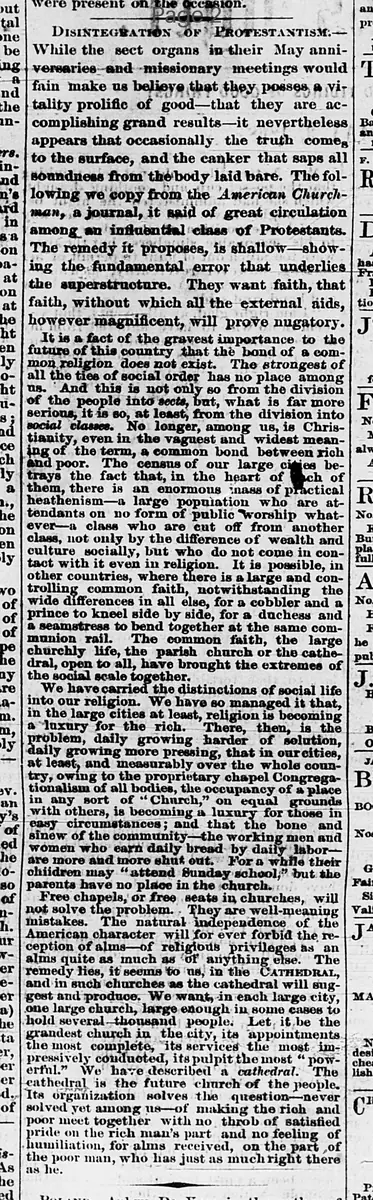
DISINTEGRATION OF PROTESTANTISM:
While the sect organs in their May anniversaries and missionary meetings would still make us believe that they possess a vitality prolific of good—that they are accomplishing grand results—it nevertheless appears that occasionally the truth comes to the surface, and the canker that saps all soundness from the body laid bare. The following we copy from the American Churchman, a journal, it is said of great circulation among an influential class of Protestants. The remedy it proposes, is shallow showing the fundamental error that underlies the superstructure. They want faith, that faith, without which all the external aids, however magnificent, will prove nugatory.
It is a fact of the gravest importance to the future of this country that the bond of a common religion does not exist. The strongest of all the ties of social order has no place among us. And this is not only so from the division of the people into sects, but, what is far more serious, it is so, at least, from the division into social classes. No longer, among us, is Christianity, even in the vaguest and widest meaning of the term, a common bond between rich and poor. The census of our large cities betrays the fact that, in the heart of each of them, there is an enormous mass of practical heathenism—a large population who are attendants on no form of public worship whatever—a class who are cut off from another class, not only by the difference of wealth and culture socially, but who do not come in contact with it even in religion. It is possible, in other countries, where there is a large and controlling common faith, notwithstanding the wide differences in all else, for a cobbler and a prince to kneel side by side, for a duchess and a seamstress to bend together at the same communion rail. The common faith, the large churchly life, the parish church or the cathedral, open to all, have brought the extremes of the social scale together.
We have carried the distinctions of social life into our religion. We have so managed it that, in the large cities at least, religion is becoming a luxury for the rich. There, then, is the problem, daily growing harder of solution, daily growing more pressing, that in our cities, at least, and measurably over the whole country, owing to the proprietary chapel Congregationalism of all bodies, the occupancy of a place in any sort of "Church," on equal grounds with others, is becoming a luxury for those in easy circumstances; and that the bone and sinew of the community—the working men and women who earn daily bread by daily labor—are more and more shut out. For a while their children may "attend Sunday school," but the parents have no place in the church.
Free chapels, or free seats in churches, will not solve the problem. They are well-meaning mistakes. The natural independence of the American character will forever forbid the reception of alms—of religious privileges as an alms quite as much as of anything else. The remedy lies, it seems to us, in the CATHEDRAL, and in such churches as the cathedral will suggest and produce. We want, in each large city, one large church, large enough in some cases to hold several thousand people. Let it be the grandest church in the city, its appointments the most complete, its services the most impressively conducted, its pulpit the most powerful. We have described a cathedral. The cathedral is the future church of the people. Its organization solves the question—never solved yet among us—of making the rich and poor meet together with no throb of satisfied pride on the rich man's part and no feeling of humiliation, for alms received, on the part of the poor man, who has just as much right there as he.
While the sect organs in their May anniversaries and missionary meetings would still make us believe that they possess a vitality prolific of good—that they are accomplishing grand results—it nevertheless appears that occasionally the truth comes to the surface, and the canker that saps all soundness from the body laid bare. The following we copy from the American Churchman, a journal, it is said of great circulation among an influential class of Protestants. The remedy it proposes, is shallow showing the fundamental error that underlies the superstructure. They want faith, that faith, without which all the external aids, however magnificent, will prove nugatory.
It is a fact of the gravest importance to the future of this country that the bond of a common religion does not exist. The strongest of all the ties of social order has no place among us. And this is not only so from the division of the people into sects, but, what is far more serious, it is so, at least, from the division into social classes. No longer, among us, is Christianity, even in the vaguest and widest meaning of the term, a common bond between rich and poor. The census of our large cities betrays the fact that, in the heart of each of them, there is an enormous mass of practical heathenism—a large population who are attendants on no form of public worship whatever—a class who are cut off from another class, not only by the difference of wealth and culture socially, but who do not come in contact with it even in religion. It is possible, in other countries, where there is a large and controlling common faith, notwithstanding the wide differences in all else, for a cobbler and a prince to kneel side by side, for a duchess and a seamstress to bend together at the same communion rail. The common faith, the large churchly life, the parish church or the cathedral, open to all, have brought the extremes of the social scale together.
We have carried the distinctions of social life into our religion. We have so managed it that, in the large cities at least, religion is becoming a luxury for the rich. There, then, is the problem, daily growing harder of solution, daily growing more pressing, that in our cities, at least, and measurably over the whole country, owing to the proprietary chapel Congregationalism of all bodies, the occupancy of a place in any sort of "Church," on equal grounds with others, is becoming a luxury for those in easy circumstances; and that the bone and sinew of the community—the working men and women who earn daily bread by daily labor—are more and more shut out. For a while their children may "attend Sunday school," but the parents have no place in the church.
Free chapels, or free seats in churches, will not solve the problem. They are well-meaning mistakes. The natural independence of the American character will forever forbid the reception of alms—of religious privileges as an alms quite as much as of anything else. The remedy lies, it seems to us, in the CATHEDRAL, and in such churches as the cathedral will suggest and produce. We want, in each large city, one large church, large enough in some cases to hold several thousand people. Let it be the grandest church in the city, its appointments the most complete, its services the most impressively conducted, its pulpit the most powerful. We have described a cathedral. The cathedral is the future church of the people. Its organization solves the question—never solved yet among us—of making the rich and poor meet together with no throb of satisfied pride on the rich man's part and no feeling of humiliation, for alms received, on the part of the poor man, who has just as much right there as he.
What sub-type of article is it?
Moral Or Religious
Social Reform
What keywords are associated?
Protestantism Disintegration
Religious Social Divisions
Cathedrals Solution
Rich Poor Church
American Christianity
Sectarianism Critique
What entities or persons were involved?
American Churchman
Protestants
Sects
Editorial Details
Primary Topic
Disintegration Of Protestantism And Social Divisions In Religion
Stance / Tone
Critical Of Sectarianism And Advocacy For Cathedrals To Unite Classes
Key Figures
American Churchman
Protestants
Sects
Key Arguments
Lack Of Common Religious Bond Divides Social Classes
Religion Becoming A Luxury For The Rich In Cities
Practical Heathenism Among Working Classes
Free Seats Insufficient Due To American Independence
Cathedrals As Grand, Inclusive Solution For Rich And Poor