Thank you for visiting SNEWPapers!
Sign up free
Literary
December 8, 1855
Saint Croix Union
Stillwater, Washington County, Minnesota
What is this article about?
An essay reflecting on causes of death beyond old age, such as passions, toil, and accidents. It compares human and animal lifespans, noting humans fall short of physiological averages due to irregular lives, labor, and irritability, per Blackwood's Magazine.
Clipping
OCR Quality
95%
Excellent
Full Text
Age.
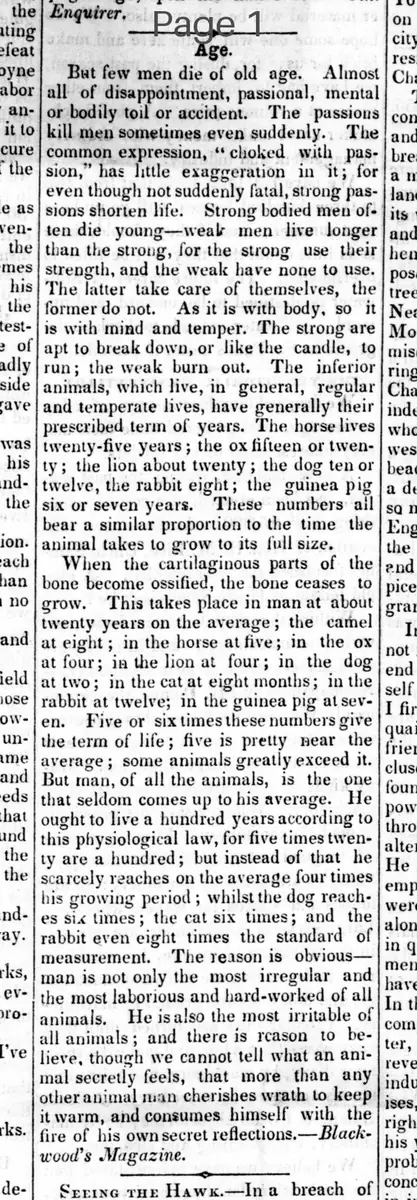
But few men die of old age. Almost all of disappointment, passional, mental or bodily toil or accident. The passions kill men sometimes even suddenly.. The common expression, " choked with passion," has little exaggeration in it; for even though not suddenly fatal, strong passions shorten life. Strong bodied men often die young-weak men live longer than the strong, for the strong use their strength, and the weak have none to use. The latter take care of themselves, the former do not. As it is with body, so it is with mind and temper. The strong are apt to break down, or like the candle, to run: the weak burn out. The inferior animals, which live, in general, regular and temperate lives, have generally their prescribed term of years. The horse lives twenty-five years; the ox fifteen or twenty; the lion about twenty; the dog ten or twelve, the rabbit eight; the guinea pig six or seven years. These numbers all bear a similar proportion to the time the animal takes to grow to its full size. When the cartilaginous parts of the bone become ossified, the bone ceases to grow. This takes place in man at about twenty years on the average: the camel at eight ; in the horse at five; in the ox at four; in the lion at four; in the dog at two; in the cat at eight months; in the rabbit at twelve; in the guinea pig at seven. Five or six times these numbers give the term of life; five is pretty near the average: some animals greatly exceed it. But man, of all the animals, is the one that seldom comes up to his average. He ought to live a hundred years according to this physiological law, for five times twenty are a hundred; but instead of that he scarcely reaches on the average four times his growing period ; whilst the dog reaches six times; the cat six times; and the rabbit even eight times the standard of measurement. The reason is obvious- man is not only the most irregular and the most laborious and hard-worked of all animals. He is also the most irritable of all animals: and there is reason to believe, though we cannot tell what an animal secretly feels, that more than any other animal man cherishes wrath to keep it warm, and consumes himself with the fire of his own secret reflections.-Blackwood's Magazine.
But few men die of old age. Almost all of disappointment, passional, mental or bodily toil or accident. The passions kill men sometimes even suddenly.. The common expression, " choked with passion," has little exaggeration in it; for even though not suddenly fatal, strong passions shorten life. Strong bodied men often die young-weak men live longer than the strong, for the strong use their strength, and the weak have none to use. The latter take care of themselves, the former do not. As it is with body, so it is with mind and temper. The strong are apt to break down, or like the candle, to run: the weak burn out. The inferior animals, which live, in general, regular and temperate lives, have generally their prescribed term of years. The horse lives twenty-five years; the ox fifteen or twenty; the lion about twenty; the dog ten or twelve, the rabbit eight; the guinea pig six or seven years. These numbers all bear a similar proportion to the time the animal takes to grow to its full size. When the cartilaginous parts of the bone become ossified, the bone ceases to grow. This takes place in man at about twenty years on the average: the camel at eight ; in the horse at five; in the ox at four; in the lion at four; in the dog at two; in the cat at eight months; in the rabbit at twelve; in the guinea pig at seven. Five or six times these numbers give the term of life; five is pretty near the average: some animals greatly exceed it. But man, of all the animals, is the one that seldom comes up to his average. He ought to live a hundred years according to this physiological law, for five times twenty are a hundred; but instead of that he scarcely reaches on the average four times his growing period ; whilst the dog reaches six times; the cat six times; and the rabbit even eight times the standard of measurement. The reason is obvious- man is not only the most irregular and the most laborious and hard-worked of all animals. He is also the most irritable of all animals: and there is reason to believe, though we cannot tell what an animal secretly feels, that more than any other animal man cherishes wrath to keep it warm, and consumes himself with the fire of his own secret reflections.-Blackwood's Magazine.
What sub-type of article is it?
Essay
What themes does it cover?
Death Mortality
Temperance
Moral Virtue
What keywords are associated?
Old Age
Passions
Animal Lifespan
Human Mortality
Temperance
Irritability
What entities or persons were involved?
Blackwood's Magazine
Literary Details
Title
Age
Author
Blackwood's Magazine
Key Lines
But Few Men Die Of Old Age. Almost All Of Disappointment, Passional, Mental Or Bodily Toil Or Accident.
He Ought To Live A Hundred Years According To This Physiological Law, For Five Times Twenty Are A Hundred; But Instead Of That He Scarcely Reaches On The Average Four Times His Growing Period
Man Cherishes Wrath To Keep It Warm, And Consumes Himself With The Fire Of His Own Secret Reflections.