Thank you for visiting SNEWPapers!
Sign up free
Story
March 20, 1917
Albuquerque Morning Journal
Albuquerque, Bernalillo County, New Mexico
What is this article about?
1917 article advising motorists on benefits of installing lighter aluminum-alloy pistons in old engines to reduce vibration, increase speed and power, with recommendations for consultation.
Clipping
OCR Quality
98%
Excellent
Full Text
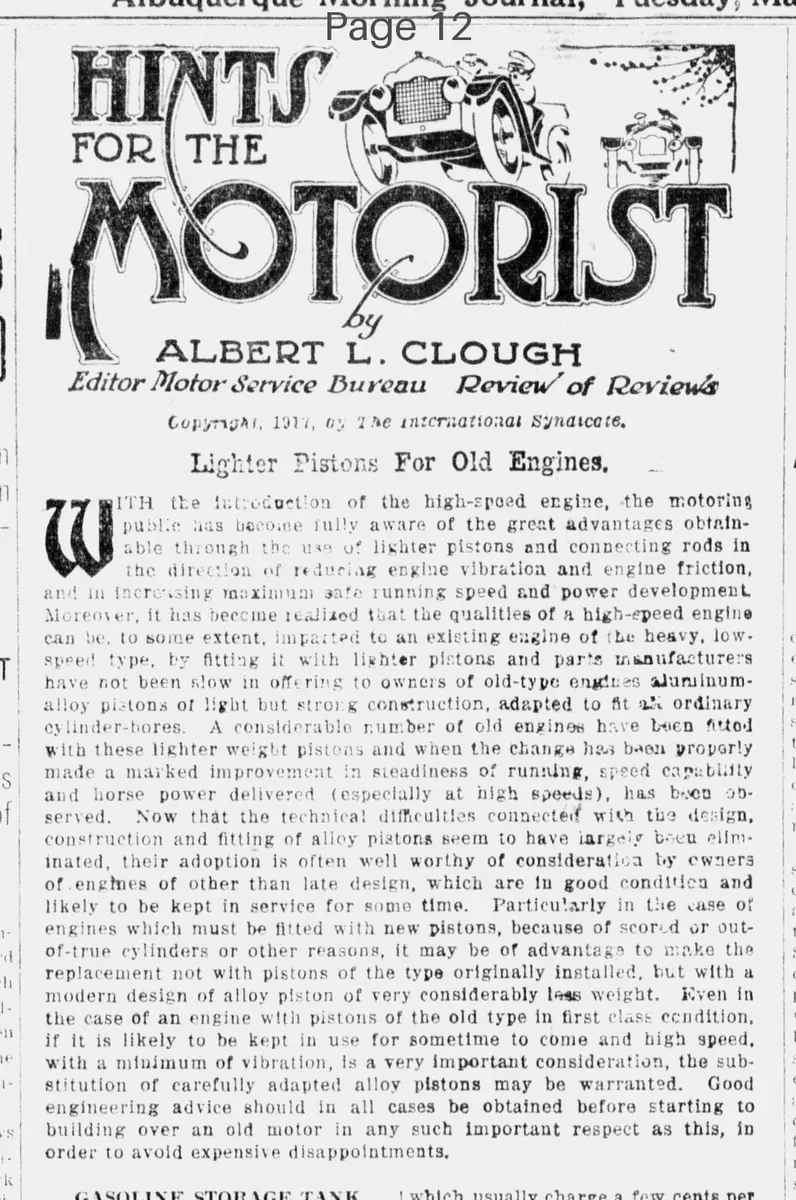
HINTS FOR THE MOTORIST
Editor Motor Service Bureau Review of Reviews
Copyright, 1917, by The International Syndicate.
Lighter Pistons For Old Engines.
With the introduction of the high-speed engine, the motoring public has become fully aware of the great advantages obtainable through the use of lighter pistons and connecting rods in the direction of reducing engine vibration and engine friction, and in increasing maximum safe running speed and power development.
Moreover, it has become realized that the qualities of a high-speed engine can be, to some extent, imparted to an existing engine of the heavy, low-speed type, by fitting it with lighter pistons and parts. Manufacturers have not been slow in offering to owners of old-type engines aluminum-alloy pistons of light but strong construction, adapted to fit ordinary cylinder-bores. A considerable number of old engines have been so equipped with these lighter weight pistons and when the change has been properly made a marked improvement in steadiness of running, speed capability and horse power delivered (especially at high speeds), has been observed.
Now that the technical difficulties connected with the design, construction and fitting of alloy pistons seem to have largely been eliminated, their adoption is often well worthy of consideration by owners of engines of other than late design, which are in good condition and likely to be kept in service for some time. Particularly in the case of engines which must be fitted with new pistons, because of scored or out-of-true cylinders or other reasons, it may be of advantage to make the replacement not with pistons of the type originally installed, but with a modern design of alloy piston of very considerably less weight. Even in the case of an engine with pistons of the old type in first class condition, if it is likely to be kept in use for some time to come and high speed, with a minimum of vibration, is a very important consideration, the substitution of carefully adapted alloy pistons may be warranted.
Good engineering advice should in all cases be obtained before starting to rebuild over an old motor in any such important respect as this, in order to avoid expensive disappointments.
Editor Motor Service Bureau Review of Reviews
Copyright, 1917, by The International Syndicate.
Lighter Pistons For Old Engines.
With the introduction of the high-speed engine, the motoring public has become fully aware of the great advantages obtainable through the use of lighter pistons and connecting rods in the direction of reducing engine vibration and engine friction, and in increasing maximum safe running speed and power development.
Moreover, it has become realized that the qualities of a high-speed engine can be, to some extent, imparted to an existing engine of the heavy, low-speed type, by fitting it with lighter pistons and parts. Manufacturers have not been slow in offering to owners of old-type engines aluminum-alloy pistons of light but strong construction, adapted to fit ordinary cylinder-bores. A considerable number of old engines have been so equipped with these lighter weight pistons and when the change has been properly made a marked improvement in steadiness of running, speed capability and horse power delivered (especially at high speeds), has been observed.
Now that the technical difficulties connected with the design, construction and fitting of alloy pistons seem to have largely been eliminated, their adoption is often well worthy of consideration by owners of engines of other than late design, which are in good condition and likely to be kept in service for some time. Particularly in the case of engines which must be fitted with new pistons, because of scored or out-of-true cylinders or other reasons, it may be of advantage to make the replacement not with pistons of the type originally installed, but with a modern design of alloy piston of very considerably less weight. Even in the case of an engine with pistons of the old type in first class condition, if it is likely to be kept in use for some time to come and high speed, with a minimum of vibration, is a very important consideration, the substitution of carefully adapted alloy pistons may be warranted.
Good engineering advice should in all cases be obtained before starting to rebuild over an old motor in any such important respect as this, in order to avoid expensive disappointments.
What sub-type of article is it?
Technical Advice
Automotive Tip
What keywords are associated?
Lighter Pistons
Old Engines
Aluminum Alloy
High Speed Engine
Engine Vibration
Power Development
Story Details
Event Date
1917
Story Details
Advises using lighter aluminum-alloy pistons in old engines to mimic high-speed engine benefits, reducing vibration and increasing power; recommends professional advice before replacement.