Thank you for visiting SNEWPapers!
Sign up free
Editorial
December 11, 1798
Gazette Of The United States, & Philadelphia Daily Advertiser
Philadelphia, Philadelphia County, Pennsylvania
What is this article about?
The editorial sarcastically critiques the Governor's speech for acknowledging unanimity against foreign powers while lamenting 'party spirit' as intolerant and vindictive. It attributes this spirit to Jacobins, democracy, and opponents of government measures, accusing them of undermining press freedom and public transactions.
Clipping
OCR Quality
95%
Excellent
Full Text
" SHEW VICE ITS OWN FEATURES."
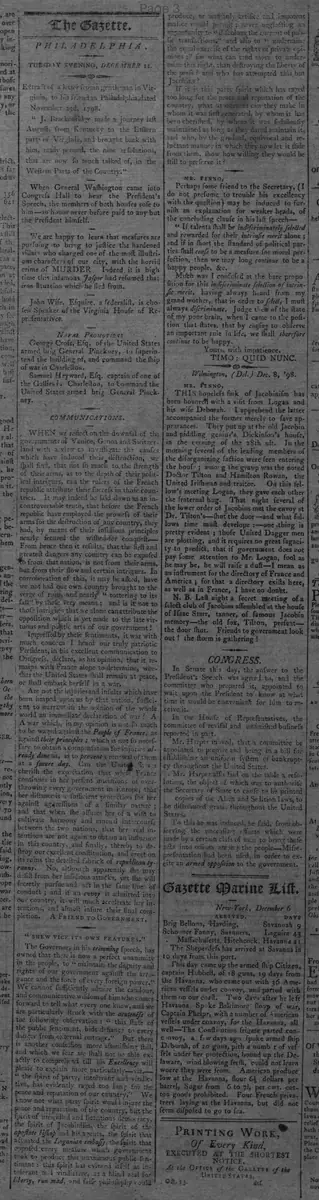
The Governor, in his trimming speech, has owned that there is now a perfect unanimity in the people, to " maintain the dignity and rights of our government against the arrogance and the force of every foreign power." We cannot sufficiently admire the candour, and communicative wisdom of him who comes forward to tell what every one knew, and we are particularly struck with the acuteness of the following observation : " this state of the public sentiment, bids defiance to every danger from external outrage." But there is another confession more astonishing still, and which we fear we shall not be able exactly to comprehend till his Excellency will please to explain more particularly—viz.— " the spirit of party, intolerant and vindictive, has evidently raged too long for the peace and reputation of our country."' We know not what party spirit would injure the peace and reputation of the country, but the spirit of unbridled and licentious democracy, the spirit of Jacobinism, the spirit of the apostate bishop and his agents, the spirit that actuated the Loganian embassy, the spirit that opposed every measure which government took to produce this unanimous public sentiment : this spirit has evinced itself as intolerant and vindictive, as a blind zeal for liberty, run mad, and false philosophy could produce, or unsanctified artifice and impotent malice would permit; never neglecting an opportunity to " discolour the current of public transactions." and also to " undermine the exercise of the rights of private opinions ;" for what can tend more to undermine this right, than destroying the liberty of the press ? and who has attempted this but Jacobins?
If it is this party spirit which has raged too long for the peace and reputation of the country, what atonement can they make in whom it was first generated, by whom it has been cherished, by whom it was sedulously maintained as long as they dared maintain it, and who, by the gradual, equivocal and reluctant manner in which they now let it slide from them, show how willing they would be still to preserve it?
The Governor, in his trimming speech, has owned that there is now a perfect unanimity in the people, to " maintain the dignity and rights of our government against the arrogance and the force of every foreign power." We cannot sufficiently admire the candour, and communicative wisdom of him who comes forward to tell what every one knew, and we are particularly struck with the acuteness of the following observation : " this state of the public sentiment, bids defiance to every danger from external outrage." But there is another confession more astonishing still, and which we fear we shall not be able exactly to comprehend till his Excellency will please to explain more particularly—viz.— " the spirit of party, intolerant and vindictive, has evidently raged too long for the peace and reputation of our country."' We know not what party spirit would injure the peace and reputation of the country, but the spirit of unbridled and licentious democracy, the spirit of Jacobinism, the spirit of the apostate bishop and his agents, the spirit that actuated the Loganian embassy, the spirit that opposed every measure which government took to produce this unanimous public sentiment : this spirit has evinced itself as intolerant and vindictive, as a blind zeal for liberty, run mad, and false philosophy could produce, or unsanctified artifice and impotent malice would permit; never neglecting an opportunity to " discolour the current of public transactions." and also to " undermine the exercise of the rights of private opinions ;" for what can tend more to undermine this right, than destroying the liberty of the press ? and who has attempted this but Jacobins?
If it is this party spirit which has raged too long for the peace and reputation of the country, what atonement can they make in whom it was first generated, by whom it has been cherished, by whom it was sedulously maintained as long as they dared maintain it, and who, by the gradual, equivocal and reluctant manner in which they now let it slide from them, show how willing they would be still to preserve it?
What sub-type of article is it?
Partisan Politics
Press Freedom
Moral Or Religious
What keywords are associated?
Party Spirit
Jacobinism
Governor Speech
Press Liberty
Public Sentiment
Democracy Critique
What entities or persons were involved?
Governor
Jacobins
Apostate Bishop
Loganian Embassy
Editorial Details
Primary Topic
Criticism Of Jacobin Party Spirit In Response To Governor's Speech
Stance / Tone
Sarcastically Anti Jacobin And Pro Government
Key Figures
Governor
Jacobins
Apostate Bishop
Loganian Embassy
Key Arguments
Governor's Speech Admits Public Unanimity Against Foreign Powers But Laments Party Spirit
Party Spirit Refers To Jacobinism, Unbridled Democracy, And Opposition To Government Measures
Jacobins Have Discolored Public Transactions And Undermined Private Opinions
Jacobins Attempt To Destroy Liberty Of The Press
Those Who Generated And Maintained This Spirit Show Reluctance To Abandon It