Thank you for visiting SNEWPapers!
Sign up free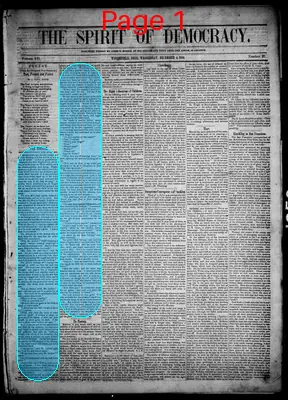
Story
December 4, 1850
The Spirit Of Democracy
Woodsfield, Monroe County, Ohio
What is this article about?
A ship's captain on a mercy mission from Boston to Cape Verde with flour for famine victims encounters a pirate vessel. The pirate, learning the cargo's charitable purpose, is moved and allows the ship to proceed unharmed, showcasing charity's influence even on villains.
Clipping
OCR Quality
98%
Excellent
Full Text
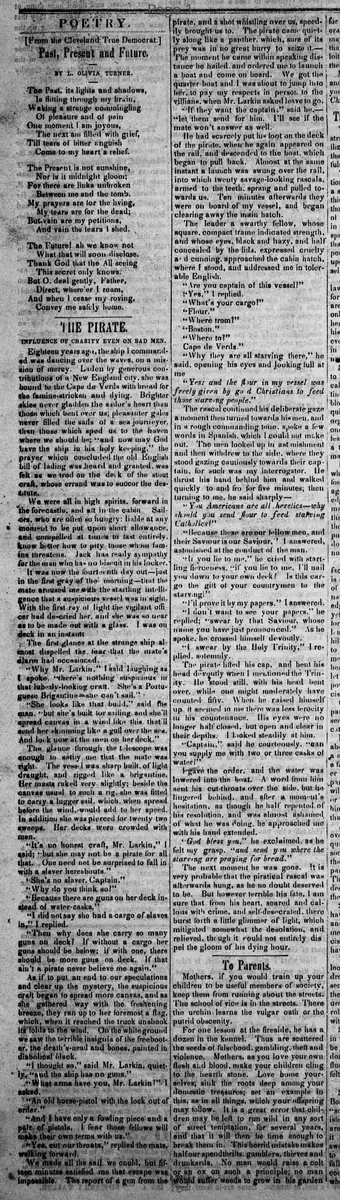
THE PIRATE.
INFLUENCE OF CHARITY EVEN ON BAD MEN.
Eighteen years ago, the ship I commanded was dancing over the waves, on a mission of mercy. Laden by generous contributions of a New England city, she was bound to the Cape de Verds with bread for the famine-stricken and dying. Brighter skies never gladden the sailor's heart than those which bent over us; pleasanter gales never filled the sails of a sea journeyer than those which sped us to the haven where we should be; "and now may God have the ship in his holy keeping," the prayer which concluded the old English bill-of-lading was heard and granted, was felt as we trod on the deck of the stout craft, whose errand was to succor the destitute.
We were all in high spirits, forward in the forecastle, and aft in the cabin. Sailors, who are often so hungry liable at any moment to be put upon short allowance and compelled at times to fast entirely, know better how to pity those whom famine threatens. Jack has ready sympathy for the man who has no biscuit in his locker.
It was now the fourteenth day out—just in the first gray of the morning—that the mate aroused me with the startling intelligence that a suspicious vessel was in sight. With the first ray of light the vigilant officer had descried her, and she was so near as to be made out with a glass. I was on deck in an instant.
The first glance at the strange ship almost dispelled the fear that the mate's alarm had occasioned. "Why Mr. Larkin," I said laughing as I spoke, "there's nothing suspicious in that lubberly-looking craft. She's a Portuguese Brigantine she can't sail."
"She looks like that build," said the man, "but she's built for sailing, and she'll spread canvas in a wind like this that'll send her skimming like a gull over the sea. And look now at the men on her deck."
The glance through the telescope was enough to satisfy me that the mate was right. The vessel was sharp built, of light draught, and rigged like a brigantine. Her masts raked very slightly; beside the canvas usual to such a rig, she was fitted to carry a lugger sail, which, when spread before the wind, would add to her speed. In addition she was pierced for twenty-two sweeps. Her decks were crowded with men.
"It's no honest craft, Mr. Larkin," I said; "but she may not be a pirate after all that. One need not be surprised to fall in with a slaver hereabouts."
"She's no slaver, Captain."
"Why do you think so?"
"Because there are guns on her deck instead of water-casks."
"I did not say she had a cargo of slaves in," I replied.
"Then why does she carry so many guns on deck? If without a cargo her guns should be below; if with one, there should be more guns on deck. If that ain't a pirate never believe me again."
As if to put an end to our speculations and clear up the mystery, the suspicious craft began to spread more canvas, and as she gathered way with the freshening breeze, they ran up to her foremast a flag, which, when it reached the truck, shook its folds to the wind. On the white ground we saw the terrible insignia of the freebooter, the death's-head and bones, painted in diabolical black.
"I thought so," said Mr. Larkin quietly. "And the ship has no guns."
"What arms have you, Mr. Larkin?" I asked.
"An old horse-pistol with the lock out of order."
"And I have only a fowling piece and a pair of pistols. I fear those fellows will make their own terms with us."
"Yes, cut our throats," replied the mate, walking forward.
We made all the sail we could, but fifteen minutes satisfied me that escape was impossible. The report of a gun from the pirate, and a shot whistling over us, speedily brought us to. The pirate came quietly along like a panther, which, sure of its prey was in no great hurry to seize it.
The moment he came within speaking distance he hailed, and ordered me to launch a boat and come on board. We got the quarter-boat and I was about to jump into her, to pay my respects in person to the villains, when Mr. Larkin asked leave to go.
"If they want the captain," said he, "let them send for him. I'll see if the mate won't answer as well."
He had scarcely put his foot on the deck of the pirate, when he again appeared on the rail, and descended to the boat, which began to pull back. Almost at the same instant a launch was swung over the rail, into which twenty savage-looking rascals, armed to the teeth, sprang and pulled towards us. Ten minutes afterwards they were on board of my vessel, and began clearing away the main hatch.
The leader a swarthy fellow, whose square, compact frame indicated strength, and whose eyes, black and hazy, and half concealed by the lids, expressed cruelty and cunning, approached the cabin hatch, where I stood, and addressed me in tolerable English.
"Are you captain of this vessel?"
"Yes," I replied.
"What's your cargo?"
"Flour."
"Where from?"
"Boston."
"Where to?"
"Cape de Verds."
"Why they are all starving there," he said, opening his eyes and looking full at me.
"Yes; and the flour in my vessel was freely given by good Christians to feed those starving people."
The rascal continued his deliberate gaze a moment then turned towards his men, and in a rough commanding tone, spoke a few words in Spanish, which I could not make out. The men looked up in astonishment and then withdrew to the side, where they stood gazing cautiously towards their captain, for such was my interrogator. He thrust his hand behind him and walked quickly to and fro for five minutes; then turning to me, he said sharply—
"You Americans are all heretics—why should you send flour to feed starving Catholics!"
"Because these are our fellow men, and their Saviour is our Saviour," I answered astonished at the conduct of the man.
"If you lie to me," he cried with starting fierceness, "if you lie to me, I'll nail you down to your own deck? Is this cargo the gift of your countrymen to the starving!"
"I'll prove it by my papers," I answered.
"I don't want to see your papers," he replied; "swear by that Saviour, whose name you have just pronounced." As he spoke, he crossed himself devoutly.
"I swear by the Holy Trinity," I replied solemnly.
The pirate lifted his cap, and bent his head devoutly when I mentioned the Trinity. He stood still, with his head bent over, while one might moderately have counted fifty. When he raised himself up, it seemed to me there was less ferocity in his countenance. His eyes were no longer half closed, but open and clear in their depths. I looked steadily at him.
"Captain," said he courteously, "can you supply me with two or three casks of water?"
I gave the order, and the water was lowered into the boat. A word from him sent his cut-throats over the side, but he lingered behind, and, after a moment's hesitation, as though he half repented of his resolution, and was almost ashamed of what he was doing, he approached me with his hand extended.
"God bless you," he exclaimed, as he felt my grasp, "and send you where the starving are praying for bread."
The next moment he was gone. It is very probable that the piratical rascal was afterwards hung, as he no doubt deserved to be. But however terrible his fate, I am sure that from his heart, seared and callous with crime, and self-desecrated, there burst forth a little glimmer of light, which mitigated somewhat the desolation, and relieved, though it could not entirely dispel the gloom of his dying hour.
INFLUENCE OF CHARITY EVEN ON BAD MEN.
Eighteen years ago, the ship I commanded was dancing over the waves, on a mission of mercy. Laden by generous contributions of a New England city, she was bound to the Cape de Verds with bread for the famine-stricken and dying. Brighter skies never gladden the sailor's heart than those which bent over us; pleasanter gales never filled the sails of a sea journeyer than those which sped us to the haven where we should be; "and now may God have the ship in his holy keeping," the prayer which concluded the old English bill-of-lading was heard and granted, was felt as we trod on the deck of the stout craft, whose errand was to succor the destitute.
We were all in high spirits, forward in the forecastle, and aft in the cabin. Sailors, who are often so hungry liable at any moment to be put upon short allowance and compelled at times to fast entirely, know better how to pity those whom famine threatens. Jack has ready sympathy for the man who has no biscuit in his locker.
It was now the fourteenth day out—just in the first gray of the morning—that the mate aroused me with the startling intelligence that a suspicious vessel was in sight. With the first ray of light the vigilant officer had descried her, and she was so near as to be made out with a glass. I was on deck in an instant.
The first glance at the strange ship almost dispelled the fear that the mate's alarm had occasioned. "Why Mr. Larkin," I said laughing as I spoke, "there's nothing suspicious in that lubberly-looking craft. She's a Portuguese Brigantine she can't sail."
"She looks like that build," said the man, "but she's built for sailing, and she'll spread canvas in a wind like this that'll send her skimming like a gull over the sea. And look now at the men on her deck."
The glance through the telescope was enough to satisfy me that the mate was right. The vessel was sharp built, of light draught, and rigged like a brigantine. Her masts raked very slightly; beside the canvas usual to such a rig, she was fitted to carry a lugger sail, which, when spread before the wind, would add to her speed. In addition she was pierced for twenty-two sweeps. Her decks were crowded with men.
"It's no honest craft, Mr. Larkin," I said; "but she may not be a pirate after all that. One need not be surprised to fall in with a slaver hereabouts."
"She's no slaver, Captain."
"Why do you think so?"
"Because there are guns on her deck instead of water-casks."
"I did not say she had a cargo of slaves in," I replied.
"Then why does she carry so many guns on deck? If without a cargo her guns should be below; if with one, there should be more guns on deck. If that ain't a pirate never believe me again."
As if to put an end to our speculations and clear up the mystery, the suspicious craft began to spread more canvas, and as she gathered way with the freshening breeze, they ran up to her foremast a flag, which, when it reached the truck, shook its folds to the wind. On the white ground we saw the terrible insignia of the freebooter, the death's-head and bones, painted in diabolical black.
"I thought so," said Mr. Larkin quietly. "And the ship has no guns."
"What arms have you, Mr. Larkin?" I asked.
"An old horse-pistol with the lock out of order."
"And I have only a fowling piece and a pair of pistols. I fear those fellows will make their own terms with us."
"Yes, cut our throats," replied the mate, walking forward.
We made all the sail we could, but fifteen minutes satisfied me that escape was impossible. The report of a gun from the pirate, and a shot whistling over us, speedily brought us to. The pirate came quietly along like a panther, which, sure of its prey was in no great hurry to seize it.
The moment he came within speaking distance he hailed, and ordered me to launch a boat and come on board. We got the quarter-boat and I was about to jump into her, to pay my respects in person to the villains, when Mr. Larkin asked leave to go.
"If they want the captain," said he, "let them send for him. I'll see if the mate won't answer as well."
He had scarcely put his foot on the deck of the pirate, when he again appeared on the rail, and descended to the boat, which began to pull back. Almost at the same instant a launch was swung over the rail, into which twenty savage-looking rascals, armed to the teeth, sprang and pulled towards us. Ten minutes afterwards they were on board of my vessel, and began clearing away the main hatch.
The leader a swarthy fellow, whose square, compact frame indicated strength, and whose eyes, black and hazy, and half concealed by the lids, expressed cruelty and cunning, approached the cabin hatch, where I stood, and addressed me in tolerable English.
"Are you captain of this vessel?"
"Yes," I replied.
"What's your cargo?"
"Flour."
"Where from?"
"Boston."
"Where to?"
"Cape de Verds."
"Why they are all starving there," he said, opening his eyes and looking full at me.
"Yes; and the flour in my vessel was freely given by good Christians to feed those starving people."
The rascal continued his deliberate gaze a moment then turned towards his men, and in a rough commanding tone, spoke a few words in Spanish, which I could not make out. The men looked up in astonishment and then withdrew to the side, where they stood gazing cautiously towards their captain, for such was my interrogator. He thrust his hand behind him and walked quickly to and fro for five minutes; then turning to me, he said sharply—
"You Americans are all heretics—why should you send flour to feed starving Catholics!"
"Because these are our fellow men, and their Saviour is our Saviour," I answered astonished at the conduct of the man.
"If you lie to me," he cried with starting fierceness, "if you lie to me, I'll nail you down to your own deck? Is this cargo the gift of your countrymen to the starving!"
"I'll prove it by my papers," I answered.
"I don't want to see your papers," he replied; "swear by that Saviour, whose name you have just pronounced." As he spoke, he crossed himself devoutly.
"I swear by the Holy Trinity," I replied solemnly.
The pirate lifted his cap, and bent his head devoutly when I mentioned the Trinity. He stood still, with his head bent over, while one might moderately have counted fifty. When he raised himself up, it seemed to me there was less ferocity in his countenance. His eyes were no longer half closed, but open and clear in their depths. I looked steadily at him.
"Captain," said he courteously, "can you supply me with two or three casks of water?"
I gave the order, and the water was lowered into the boat. A word from him sent his cut-throats over the side, but he lingered behind, and, after a moment's hesitation, as though he half repented of his resolution, and was almost ashamed of what he was doing, he approached me with his hand extended.
"God bless you," he exclaimed, as he felt my grasp, "and send you where the starving are praying for bread."
The next moment he was gone. It is very probable that the piratical rascal was afterwards hung, as he no doubt deserved to be. But however terrible his fate, I am sure that from his heart, seared and callous with crime, and self-desecrated, there burst forth a little glimmer of light, which mitigated somewhat the desolation, and relieved, though it could not entirely dispel the gloom of his dying hour.
What sub-type of article is it?
Piracy
Journey
Extraordinary Event
What themes does it cover?
Moral Virtue
Providence Divine
Fortune Reversal
What keywords are associated?
Pirate Encounter
Charity Mission
Mercy Voyage
Cape Verde Famine
Flour Cargo
Religious Influence
What entities or persons were involved?
Captain (Narrator)
Mr. Larkin
Pirate Captain
Where did it happen?
On The High Seas, Bound To Cape De Verds
Story Details
Key Persons
Captain (Narrator)
Mr. Larkin
Pirate Captain
Location
On The High Seas, Bound To Cape De Verds
Event Date
Eighteen Years Ago
Story Details
A mercy ship carrying flour from Boston to starving people in Cape de Verds encounters a pirate vessel on the fourteenth day out. The pirate boards but, upon swearing the cargo is charitable, is moved by the Christian act and lets the ship go, requesting only water.