Thank you for visiting SNEWPapers!
Sign up free
Literary
July 27, 1787
The New York Packet
New York, New York County, New York
What is this article about?
An essay extolling the virtues of benevolence, urging readers to alleviate human suffering through acts of kindness and charity. It reflects on the pleasures of helping the miserable, critiques insensibility, and contemplates fortune's changes, ending with a poetic stanza on philanthropy.
Clipping
OCR Quality
98%
Excellent
Full Text
MISCELLANY
On Benevolence.
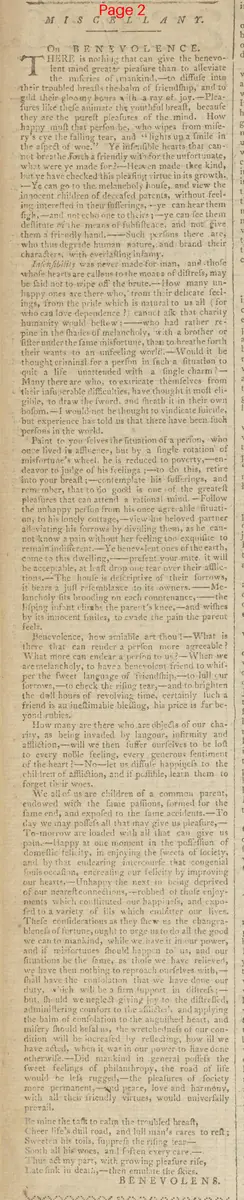
There is nothing that can give the benevolent mind greater pleasure than to alleviate the miseries of mankind,—to diffuse into their troubled breasts the balm of friendship, and to gild their gloomy hours with a ray of joy.—Pleasures like these animate the youthful breast, because they are the purest pleasures of the mind. How happy must that person be, who wipes from misery's eye the falling tear, and "lights up a smile in the aspect of woe." Ye insensible hearts that cannot breathe forth a friendly wish for the unfortunate, what were ye made for? Heaven made ye kind, but we have checked this pleasing virtue in its growth.—Ye can go to the melancholy house, and view the innocent children of deceased parents, without feeling interested in their sufferings,—ye can hear them sigh, and not echo one to theirs;—ye can see them destitute of the means of subsistence, and not give them a friendly hand.—Such persons there are, who thus degrade human nature, and brand their character with everlasting infamy. Insensibility was never made for man, and those whose hearts are callous to the moans of distress, may be said not to wipe off the brute.—How many unhappy ones are there who, from their delicate feelings, from the pride which is natural to us all (for who can love dependence?) cannot ask that charity humanity would bestow;—who had rather repine in the shades of melancholy, with a brother or sister under the same misfortune, than to breathe forth their wants to an unfeeling world!—Would it be thought criminal for a person in such a situation to quit a life unattended with a single charm?—Many there are who, to extricate themselves from their insuperable difficulties, have thought it most eligible, to draw the sword, and sheath it in their own bosom.—I would not be thought to vindicate suicide, but experience has told us that there have been such persons in the world. Paint to yourselves the situation of a person, who once lived in affluence, but by a single rotation of misfortune's wheel, he is reduced to poverty, endeavor to judge of his feelings;—to do this, retire into your breast;—contemplate his sufferings, and remember, that to do good is one of the greatest pleasures that can attend a rational mind.—Follow the unhappy person from his once agreeable situation, to his lonely cottage,—view his beloved partner alleviating his sorrows by dividing them, as he cannot know a pain without her feeling too exquisite to remain indifferent.—Ye benevolent ones of the earth, come to this dwelling,—present your mite, it will be acceptable, at least drop one tear over their afflictions.—The house is descriptive of their sorrows, it bears a just resemblance to its owners.—Melancholy is brooding on each countenance,—the lisping infant climbs the parent's knee,—and wishes by its innocent smiles, to evade the pain the parent feels. Benevolence, how amiable art thou!—What is there that can render a person more agreeable? What more can endear a person to us?—When we are melancholy, to have a benevolent friend to whisper the sweet language of friendship,—to lull our sorrows,—to check the rising tear,—and to brighten the dull hours of revolving time, certainly such a friend is an inestimable blessing, his price is far beyond rubies. How many are there who are objects of our charity, as being invaded by languor, infirmity and affliction,—will we then suffer ourselves to be lost to every noble feeling, every generous sentiment of the heart?—No—let us diffuse happiness to the children of affliction, and if possible, learn them to forget their woes. We all of us are children of a common parent, endowed with the same passions, formed for the same end, and exposed to the same accidents.—To-day we may possess all that may give us pleasure,—To-morrow are loaded with all that can give us pain.—Happy at one moment in the possession of domestic felicity, in enjoying the sweets of society, and by that endearing intercourse that congenial souls occasion, encreasing our felicity by improving our hearts. Unhappy the next in being deprived of our nearest connections,—robbed of those enjoyments which constituted our happiness, and exposed to a variety of ills which embitter our lives. These considerations as they shew us the changableness of fortune, ought to urge us to do all the good we can to mankind, while we have it in our power, and if misfortunes should happen to us, and our situations be the same, as those we have relieved, we have then nothing to reproach ourselves with,—shall have the consolation that we have done our duty, which will be a firm support in distress;—but, should we neglect giving joy to the distressed, administering comfort to the afflicted, and applying the balm of consolation to the anguished heart, and misery should befall us, the wretchedness of our condition will be increased by reflecting, how ill we have acted, when it was in our power to have done otherwise.—Did mankind in general possess the sweet feelings of philanthropy, the road of life would be less rugged,—the pleasures of society more permanent,—and peace, love and harmony, with all their friendly virtues, would universally prevail. Be mine the task to calm the troubled breast. Cheer life's dull road, and lull man's cares to rest; Sweeten his toils, suppress the rising tear— Sooth all his woes, and soften every care.— Thus act my part, with growing pleasure rise, Late sink in death,—then emulate the skies.
BENEVOLENCE.
On Benevolence.
There is nothing that can give the benevolent mind greater pleasure than to alleviate the miseries of mankind,—to diffuse into their troubled breasts the balm of friendship, and to gild their gloomy hours with a ray of joy.—Pleasures like these animate the youthful breast, because they are the purest pleasures of the mind. How happy must that person be, who wipes from misery's eye the falling tear, and "lights up a smile in the aspect of woe." Ye insensible hearts that cannot breathe forth a friendly wish for the unfortunate, what were ye made for? Heaven made ye kind, but we have checked this pleasing virtue in its growth.—Ye can go to the melancholy house, and view the innocent children of deceased parents, without feeling interested in their sufferings,—ye can hear them sigh, and not echo one to theirs;—ye can see them destitute of the means of subsistence, and not give them a friendly hand.—Such persons there are, who thus degrade human nature, and brand their character with everlasting infamy. Insensibility was never made for man, and those whose hearts are callous to the moans of distress, may be said not to wipe off the brute.—How many unhappy ones are there who, from their delicate feelings, from the pride which is natural to us all (for who can love dependence?) cannot ask that charity humanity would bestow;—who had rather repine in the shades of melancholy, with a brother or sister under the same misfortune, than to breathe forth their wants to an unfeeling world!—Would it be thought criminal for a person in such a situation to quit a life unattended with a single charm?—Many there are who, to extricate themselves from their insuperable difficulties, have thought it most eligible, to draw the sword, and sheath it in their own bosom.—I would not be thought to vindicate suicide, but experience has told us that there have been such persons in the world. Paint to yourselves the situation of a person, who once lived in affluence, but by a single rotation of misfortune's wheel, he is reduced to poverty, endeavor to judge of his feelings;—to do this, retire into your breast;—contemplate his sufferings, and remember, that to do good is one of the greatest pleasures that can attend a rational mind.—Follow the unhappy person from his once agreeable situation, to his lonely cottage,—view his beloved partner alleviating his sorrows by dividing them, as he cannot know a pain without her feeling too exquisite to remain indifferent.—Ye benevolent ones of the earth, come to this dwelling,—present your mite, it will be acceptable, at least drop one tear over their afflictions.—The house is descriptive of their sorrows, it bears a just resemblance to its owners.—Melancholy is brooding on each countenance,—the lisping infant climbs the parent's knee,—and wishes by its innocent smiles, to evade the pain the parent feels. Benevolence, how amiable art thou!—What is there that can render a person more agreeable? What more can endear a person to us?—When we are melancholy, to have a benevolent friend to whisper the sweet language of friendship,—to lull our sorrows,—to check the rising tear,—and to brighten the dull hours of revolving time, certainly such a friend is an inestimable blessing, his price is far beyond rubies. How many are there who are objects of our charity, as being invaded by languor, infirmity and affliction,—will we then suffer ourselves to be lost to every noble feeling, every generous sentiment of the heart?—No—let us diffuse happiness to the children of affliction, and if possible, learn them to forget their woes. We all of us are children of a common parent, endowed with the same passions, formed for the same end, and exposed to the same accidents.—To-day we may possess all that may give us pleasure,—To-morrow are loaded with all that can give us pain.—Happy at one moment in the possession of domestic felicity, in enjoying the sweets of society, and by that endearing intercourse that congenial souls occasion, encreasing our felicity by improving our hearts. Unhappy the next in being deprived of our nearest connections,—robbed of those enjoyments which constituted our happiness, and exposed to a variety of ills which embitter our lives. These considerations as they shew us the changableness of fortune, ought to urge us to do all the good we can to mankind, while we have it in our power, and if misfortunes should happen to us, and our situations be the same, as those we have relieved, we have then nothing to reproach ourselves with,—shall have the consolation that we have done our duty, which will be a firm support in distress;—but, should we neglect giving joy to the distressed, administering comfort to the afflicted, and applying the balm of consolation to the anguished heart, and misery should befall us, the wretchedness of our condition will be increased by reflecting, how ill we have acted, when it was in our power to have done otherwise.—Did mankind in general possess the sweet feelings of philanthropy, the road of life would be less rugged,—the pleasures of society more permanent,—and peace, love and harmony, with all their friendly virtues, would universally prevail. Be mine the task to calm the troubled breast. Cheer life's dull road, and lull man's cares to rest; Sweeten his toils, suppress the rising tear— Sooth all his woes, and soften every care.— Thus act my part, with growing pleasure rise, Late sink in death,—then emulate the skies.
BENEVOLENCE.
What sub-type of article is it?
Essay
What themes does it cover?
Moral Virtue
Friendship
What keywords are associated?
Benevolence
Charity
Misery
Philanthropy
Moral Virtue
Friendship
Human Suffering
Literary Details
Title
On Benevolence.
Form / Style
Prose Essay With Concluding Verse
Key Lines
How Happy Must That Person Be, Who Wipes From Misery's Eye The Falling Tear, And "Lights Up A Smile In The Aspect Of Woe."
Benevolence, How Amiable Art Thou!—What Is There That Can Render A Person More Agreeable? What More Can Endear A Person To Us?
Be Mine The Task To Calm The Troubled Breast. Cheer Life's Dull Road, And Lull Man's Cares To Rest; Sweeten His Toils, Suppress The Rising Tear— Sooth All His Woes, And Soften Every Care.— Thus Act My Part, With Growing Pleasure Rise, Late Sink In Death,—Then Emulate The Skies.