Thank you for visiting SNEWPapers!
Sign up free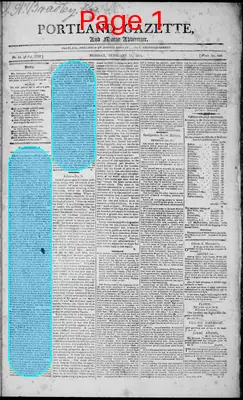
Letter to Editor
February 11, 1811
Portland Gazette, And Maine Advertiser
Portland, Cumberland County, Maine
What is this article about?
A letter praises Noah Webster's American Spelling Book for its superior handling of irregular orthography through dedicated tables, inclusion of American proper names, and simplicity. It also highlights Webster's educational contributions, including his history book and dictionary additions of American and scientific terms, urging public support for innovators.
Clipping
OCR Quality
95%
Excellent
Full Text
Communications.
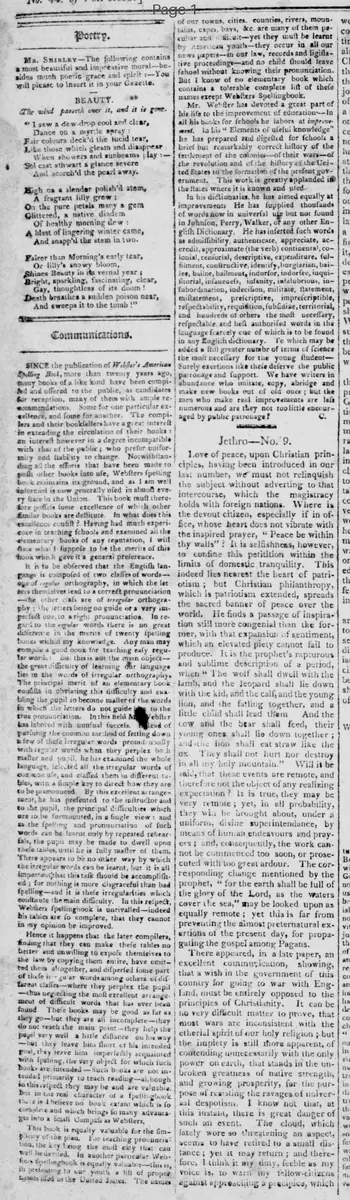
SINCE the publication of Webster's American Spelling Book, more than twenty years ago, many books of a like kind have been compiled and offered to the public, as candidates for reception, many of them with ample recommendations. Some for one particular excellence, and some for another. The compilers and their booksellers have a great interest in extending the circulation of their books: an interest however in a degree incompatible with that of the public; who prefer uniformity and stability to change. Notwithstanding all the efforts that have been made to push other books into use, Webster's spelling book maintains its ground, and as I am well satisfied is now generally used in almost every state in the Union. This book must therefore possess some excellence of which other similar books are destitute. In what does this excellence consist? Having had much experience in teaching schools and examined all the elementary books of any reputation, I will state what I suppose to be the merits of this book which gave it a general preference.
It is to be observed that the English language is composed of two classes of words—one of regular orthography, in which the letters themselves lead to a correct pronunciation the other class are of irregular orthography; the letters being no guide or a very imperfect one, to a right pronunciation. In regard to the regular words there is no great difference in the merits of twenty spelling books within my knowledge. Any man may compile a good book for teaching easy regular words: but this is not the main object—the great difficulty of learning our language lies in the words of irregular orthography The principal merit of an elementary book consists in obviating this difficulty and enabling the pupil to become master of the words in which the letters do not guide to the true pronunciation. In this field Mr. Webster has labored with unusual success.
Instead of pursuing the common method of setting down a few of these irregular words promiscuously with regular words when they perplex both master and pupil, he has examined the whole language, selected all the irregular words of common use, and classed them in different tables, with a simple key to direct how they are to be pronounced. By this excellent arrangement, he has presented to the instructor and to the pupil, the principal difficulties which are to be surmounted, in a single view: and as the spelling and pronunciation of such words can be learnt only by repeated rehearsals, the pupil may be made to dwell upon these tables, until he is fully master of them.
There appears to be no other way by which the irregular words can be learnt, but it is all important that this task should be accomplished; for nothing is more disgraceful than bad spelling—and it is these irregularities which constitute the main difficulty. In this respect, Webster's spelling book is unrivalled—indeed his tables are so complete, that they cannot in my opinion be improved.
Hence it happens that the later compilers, finding that they can make these tables no better and unwilling to expose themselves to the law by copying them entire, have omitted them altogether, and dispersed some part of these irregular words among others of different classes—where they perplex the pupil—thus neglecting the most excellent arrangement of difficult words that has ever been found These books may be good as far as they go—but they are all incomplete—they do not reach the main point—they help the pupil very well a little distance on his way—but they leave him short of his intended goal, they leave him imperfectly acquainted with spelling, the very object for which such books are intended—Such books are not intended primarily to teach reading—although in this respect they may be and are valuable. But in the real character of a spelling book there is I believe no book extant which is so complete and which brings so many advantages into a small compass as Webster's.
This book is equally valuable for the simplicity of the plan. For teaching pronunciation, the key being the most easy that can well be devised. In another particular Webster's Spelling Book is equally valuable—this is, in presenting to our youth a list of proper names used in the United States. The names of our towns, cities, counties, rivers, mountains, capes, bays, &c. are many of them peculiar and difficult—yet they must be learnt by American youth—they occur in all our news papers—in our law, records and legislative proceedings—and no child should leave school without knowing their pronunciation.
But I know of no elementary book which contains a tolerable complete list of these names except Webster's Spelling Book.
Mr. Webster has devoted a great part of his life to the improvement of education—In all his books for schools he labors at improvement. In his "Elements of useful knowledge" he has prepared and digested for schools a brief but remarkably correct history of the settlement of the colonies—of their wars—of the revolution and of the history of the United States to the formation of the present government. This work is greatly applauded in the states where it is known and used.
In his dictionaries, he has aimed equally at improvements He has supplied thousands of words now in universal use but not found in Johnson, Perry, Walker, or any other English Dictionary. He has inserted such words as admissibility, authenticate, appreciate, accredit, approximate (the verb) continental, colonial, censorial, descriptive, expenditure, fulfilment, constructive, identify, burglarian, bailee, bailor, bailment, indorsor, indorsee, inquisitorial, inference, insanity, insalubrious, insubordination, indecision, militate, statement, misstatement, prescriptive, imprescriptible, respectability, requisition, subsidize, territorial, and hundreds of others the most necessary, respectable, and best authorized words in the language scarcely one of which is to be found in any English dictionary. To which may be added a still greater number of terms of science the most necessary for the young student—
Surely exertions like these deserve the public patronage and support. We have writers in abundance who imitate, copy, abridge and make new books out of old ones; but the men who make real improvements are less numerous and are they not too little encouraged by public patronage?
c.
SINCE the publication of Webster's American Spelling Book, more than twenty years ago, many books of a like kind have been compiled and offered to the public, as candidates for reception, many of them with ample recommendations. Some for one particular excellence, and some for another. The compilers and their booksellers have a great interest in extending the circulation of their books: an interest however in a degree incompatible with that of the public; who prefer uniformity and stability to change. Notwithstanding all the efforts that have been made to push other books into use, Webster's spelling book maintains its ground, and as I am well satisfied is now generally used in almost every state in the Union. This book must therefore possess some excellence of which other similar books are destitute. In what does this excellence consist? Having had much experience in teaching schools and examined all the elementary books of any reputation, I will state what I suppose to be the merits of this book which gave it a general preference.
It is to be observed that the English language is composed of two classes of words—one of regular orthography, in which the letters themselves lead to a correct pronunciation the other class are of irregular orthography; the letters being no guide or a very imperfect one, to a right pronunciation. In regard to the regular words there is no great difference in the merits of twenty spelling books within my knowledge. Any man may compile a good book for teaching easy regular words: but this is not the main object—the great difficulty of learning our language lies in the words of irregular orthography The principal merit of an elementary book consists in obviating this difficulty and enabling the pupil to become master of the words in which the letters do not guide to the true pronunciation. In this field Mr. Webster has labored with unusual success.
Instead of pursuing the common method of setting down a few of these irregular words promiscuously with regular words when they perplex both master and pupil, he has examined the whole language, selected all the irregular words of common use, and classed them in different tables, with a simple key to direct how they are to be pronounced. By this excellent arrangement, he has presented to the instructor and to the pupil, the principal difficulties which are to be surmounted, in a single view: and as the spelling and pronunciation of such words can be learnt only by repeated rehearsals, the pupil may be made to dwell upon these tables, until he is fully master of them.
There appears to be no other way by which the irregular words can be learnt, but it is all important that this task should be accomplished; for nothing is more disgraceful than bad spelling—and it is these irregularities which constitute the main difficulty. In this respect, Webster's spelling book is unrivalled—indeed his tables are so complete, that they cannot in my opinion be improved.
Hence it happens that the later compilers, finding that they can make these tables no better and unwilling to expose themselves to the law by copying them entire, have omitted them altogether, and dispersed some part of these irregular words among others of different classes—where they perplex the pupil—thus neglecting the most excellent arrangement of difficult words that has ever been found These books may be good as far as they go—but they are all incomplete—they do not reach the main point—they help the pupil very well a little distance on his way—but they leave him short of his intended goal, they leave him imperfectly acquainted with spelling, the very object for which such books are intended—Such books are not intended primarily to teach reading—although in this respect they may be and are valuable. But in the real character of a spelling book there is I believe no book extant which is so complete and which brings so many advantages into a small compass as Webster's.
This book is equally valuable for the simplicity of the plan. For teaching pronunciation, the key being the most easy that can well be devised. In another particular Webster's Spelling Book is equally valuable—this is, in presenting to our youth a list of proper names used in the United States. The names of our towns, cities, counties, rivers, mountains, capes, bays, &c. are many of them peculiar and difficult—yet they must be learnt by American youth—they occur in all our news papers—in our law, records and legislative proceedings—and no child should leave school without knowing their pronunciation.
But I know of no elementary book which contains a tolerable complete list of these names except Webster's Spelling Book.
Mr. Webster has devoted a great part of his life to the improvement of education—In all his books for schools he labors at improvement. In his "Elements of useful knowledge" he has prepared and digested for schools a brief but remarkably correct history of the settlement of the colonies—of their wars—of the revolution and of the history of the United States to the formation of the present government. This work is greatly applauded in the states where it is known and used.
In his dictionaries, he has aimed equally at improvements He has supplied thousands of words now in universal use but not found in Johnson, Perry, Walker, or any other English Dictionary. He has inserted such words as admissibility, authenticate, appreciate, accredit, approximate (the verb) continental, colonial, censorial, descriptive, expenditure, fulfilment, constructive, identify, burglarian, bailee, bailor, bailment, indorsor, indorsee, inquisitorial, inference, insanity, insalubrious, insubordination, indecision, militate, statement, misstatement, prescriptive, imprescriptible, respectability, requisition, subsidize, territorial, and hundreds of others the most necessary, respectable, and best authorized words in the language scarcely one of which is to be found in any English dictionary. To which may be added a still greater number of terms of science the most necessary for the young student—
Surely exertions like these deserve the public patronage and support. We have writers in abundance who imitate, copy, abridge and make new books out of old ones; but the men who make real improvements are less numerous and are they not too little encouraged by public patronage?
c.
What sub-type of article is it?
Informative
Persuasive
What themes does it cover?
Education
What keywords are associated?
Webster Spelling Book
Irregular Orthography
American Education
Dictionary Improvements
Proper Names Pronunciation
Public Patronage
What entities or persons were involved?
C.
The Printer
Letter to Editor Details
Author
C.
Recipient
The Printer
Main Argument
webster's american spelling book excels in teaching irregular words through dedicated tables and includes american proper names; his other works improve education and lexicography, deserving public support over imitators.
Notable Details
Examined The Whole Language And Selected Irregular Words For Tables
Includes List Of U.S. Proper Names
Elements Of Useful Knowledge: History Of Colonies, Wars, Revolution, U.S. Government
Dictionary Additions: American And Scientific Terms Like 'Admissibility', 'Continental', 'Insubordination'