Thank you for visiting SNEWPapers!
Sign up free
The New Era
Portsmouth, Virginia
What is this article about?
Article details scandal in U.S. Navy engineering appointments under Chief Engineer Haswell, who allegedly demanded $50 fees from assistants, possibly as blackmail. Involves Williamson's complaint, Copeland's removal, and calls for Secretary Bancroft to probe and reform the department amid political silence.
Clipping
OCR Quality
Full Text
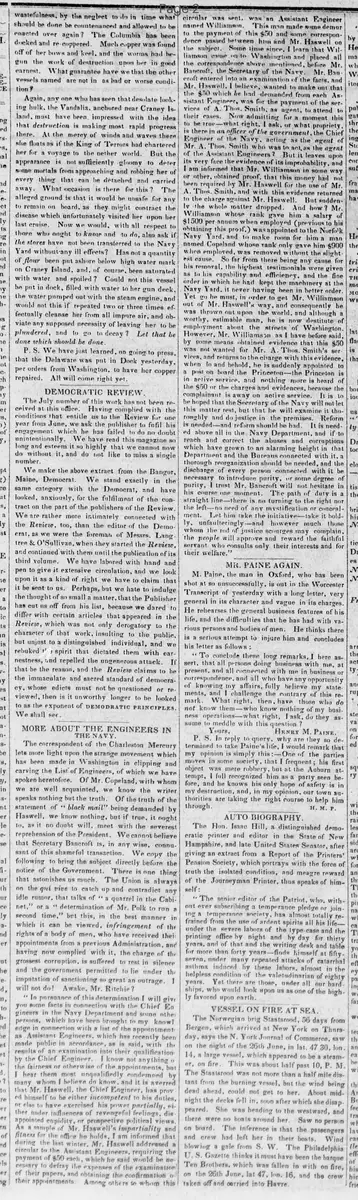
The correspondent of the Charleston Mercury lets more light upon the strange movement which has been made in Washington in clipping and carving the List of Engineers, of which we have spoken heretofore. Of Mr. Copeland, with whom we are well acquainted, we know the writer speaks nothing but the truth. Of the truth of the statement of "black mail" being demanded by Haswell, we know nothing, but if true, it ought, as it no doubt will, meet with the severest reprehension of the President. We cannot believe that Secretary Bancroft is, in any wise, connivant of this shameful transaction. We copy the following to bring the subject directly before the notice of the Government. There is one thing that astonishes us much. The Union is always on the qui vive to catch up and contradict any idle rumor, that talks of "a quarrel in the Cabinet," or a "determination of Mr. Polk to run a second time," but this, in the best manner in which it can be viewed, infringement of the rights of a body of men, who have received their appointments from a previous Administration, and having now complied with it, the charge of the grossest corruption, is suffered to rest in silence and the government permitted to lie under the imputation of sanctioning so great an outrage. It will not do! Awake, Mr. Ritchie?
"In pursuance of this determination I will give you some facts in connection with the Chief Engineers in the Navy Department and some other persons, which have been brought to my knowledge in connection with a list of the appointments as Assistant Engineers, which has recently been made public in accordance, as is said, with the results of an examination into their qualifications by the Chief Engineer. I know not anything of the fairness or otherwise of the appointments, but I hear them most unqualifiedly condemned by many whom I believe do know, and it is averred that Mr. Haswell, the Chief Engineer, has proved himself to be either incompetent to his duties, or else to have exercised his power partially, either under influences of revengeful feelings, disappointed cupidity, or prospective political views.
As a sample of Mr. Haswell's impartiality and fitness for the office he holds, I am informed that during the last winter, Mr. Haswell addressed a circular to the Assistant Engineers, requiring the payment of $50 each, which he said would be necessary to defray the expenses of the examination of their papers, and obtaining the confirmation of their appointments. Among others to whom this circular was sent, was an Assistant Engineer named Williamson. This man made some demur to the payment of this $50 and some correspondence passed between him and Mr. Haswell on the subject. Some time since, I learn that Williamson came on to Washington and placed all the correspondence above mentioned, before Mr. Bancroft, the Secretary of the Navy. Mr. Bancroft entered into an examination of the facts, and Mr. Haswell, I believe, wanted to make out that the $50 which he had demanded from each Assistant Engineer, was for the payment of the services of A. Thos. Smith, as agent, to attend to their cases. Now admitting for a moment this to be true—what right, I ask, or what propriety, is there in an officer of the government, the Chief Engineer of the Navy, acting as the agent of Mr. A. Thos. Smith who was to act, as the agent of the Assistant Engineers? But it leaves upon its very face the evidence of its improbability, and I am informed that Mr. Williamson in some way or other, obtained proof, that this money had not been required by Mr. Haswell for the use of Mr. A. Thos. Smith, and with this evidence returned to the charge against Mr. Haswell. But suddenly the whole matter dropped. And how? Mr. Williamson whose rank gave him a salary of $1500 per annum when employed (previous to his obtaining this proof,) was appointed to the Norfolk Navy Yard, and to make room for him a man named Copeland whose rank only gave him $900 when employed, was removed without the slightest cause. So far from there being any cause for his removal, the highest testimonials were given as to his capability and efficiency, and the fine order in which he had kept the machinery at the Navy Yard, it never having been in better order. Yet go he must, in order to get Mr. Williamson out of Mr. Haswell's way, and consequently he was thrown out upon the world, and although a worthy, estimable man, he is now destitute of employment about the streets of Washington.
However, Mr. Williamson as I have before said, by some means obtained evidence that this $50 was not wanted for Mr. A. Thos. Smith's services, and returns to the charge with this evidence, when lo and behold, he is suddenly appointed to a position board the Princeton—the Princeton is in active service, and nothing more is heard of the $50 or the charges and evidences, because the complainant is away on active service. It is to be hoped that the Secretary of the Navy will not let this matter rest, but that he will examine it thoroughly and do justice in the premises. Reform is needed—and reform should be had. It is needed above all in the Navy Department, and if to reach and correct the abuses and corruptions which have grown to an alarming height in that Department and the Bureaus connected with it, a thorough reorganization should be needed, and the discharge of every person connected with it be necessary to introduce purity, or some degree of purity, I trust Mr. Bancroft will not hesitate in his course one moment. The path of duty is a straight line—there is no turning to the right nor the left—no need of any mystification or concealment. Let him take the initiative—take it boldly, unfaulteringly—and however much those whom the rod of justice scourges may complain, the people will approve and reward the faithful servant who consults only their interests and for their welfare."
What sub-type of article is it?
What themes does it cover?
What keywords are associated?
What entities or persons were involved?
Where did it happen?
Story Details
Key Persons
Location
Washington, Navy Department, Norfolk Navy Yard
Event Date
Last Winter
Story Details
A correspondent exposes alleged corruption by Chief Engineer Haswell in Navy assistant engineer appointments, including demanding $50 from each for supposed examination fees, possibly blackmail. Williamson challenges this, leading to his reassignment and Copeland's unjust removal. Calls for Secretary Bancroft to investigate and reform the department.