Thank you for visiting SNEWPapers!
Sign up free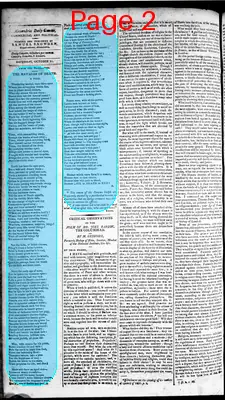
Poem
October 21, 1809
Alexandria Daily Gazette, Commercial & Political
Alexandria, Virginia
What is this article about?
A reflective poem contemplating the universal ravages of death across all ages, from infancy to old age, through wars, plagues, and natural disasters, emphasizing mortality's inevitability and the futility of human endeavors.
Clipping
OCR Quality
95%
Excellent
Full Text
From the Barometer.
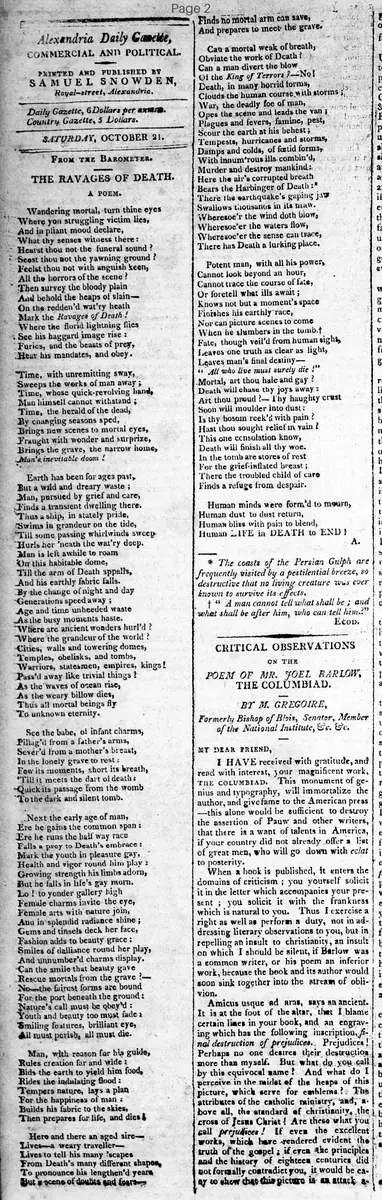
THE RAVAGES OF DEATH.
A POEM.
Wandering mortal, turn thine eyes
Where yon struggling victim lies,
And in pliant mood declare,
What thy senses witness there:
Hear'st thou not the funeral sound ?
Seest thou not the yawning ground ?
Feelst thou not with anguish keen,
All the horrors of the scene ?
Then survey the bloody plain
And behold the heaps of slain-
On the redden'd wat'ry heath
Mark the Ravages of Death !
Where the florid lightning flies
See his haggard image rise :
Furies, and the beasts of prey,
Hear his mandates, and obey.
Time, with unremitting sway,
Sweeps the works of man away ;
Time, whose quick-revolving hand,
Man himself cannot withstand;
Time, the herald of the dead,
By changing seasons sped,
Brings new scenes to mortal eyes,
Fraught with wonder and surprize,
Brings the grave, the narrow home
Man's inevitable doom !
Earth has been or ages past,
But a wild and dreary waste ;
Man, pursued by grief and care,
Finds a transient dwelling there.
Thus a ship, in stately pride,
Swims in grandeur on the tide,
Till some passing whirlwinds sweep
Hurls her 'neath the wat'ry deep.
Man is left awhile to roam
On this habitable dome,
Till the arm of Death appalls,
And his earthly fabric falls.
By the change of night and day
Generations speed away ;
Age and time unheeded waste
As the busy moments haste.
Whire are ancient wonders hurl'd ?
Where the grandeur of the world ?
Cities, walls and towering domes,
Temples, obelisks, and tombs,
Warriors, statesmen, empires, kings!
Pass'd away like trivial things !
As the waves of ocean rise,
As the weary billow dies,
Thus all mortal beings fly
To unknown eternity.
See the babe, of infant charms,
Pillag'd from a father's arms,
Sever'd from a mother's breast,
In the lonely grave to rest :
Few its moments, short its breath,
Till it meets the dart of death:
Quick its passage from the womb
To the dark and silent tomb.
Next the early age of man,
Ere he gains the common span:
Ere he runs the half way race
Falls a prey to Death's embrace :
Mark the youth in pleasure gay,
Health and vigor round him play :
Growing strength his limbs adorn,
But he falls in life's gay morn.
Lo ! to yonder gallery high
Female charms invite the eye,
Female arts with nature join,
And in splendid radiance shine ;
Gems and tinsels deck her face,
Fashion adds to beauty's grace :
Smiles of dalliance round her play,
And unnumber'd charms display.
Can the smile that beauty gave
Rescue mortals from the grave -
No! the fairest forms are bound
For the port beneath the ground :
Nature's call must be obey'd :
Youth and beauty too must fade :
Smiling features, brilliant eye,
All must perish, all must die.
Man, with reason far his guide,
Rules creation far and wide :
Bids the earth to yield him food,
Rides the undulating flood :
Tempers nature, lays a plan
For the happiness of man :
Builds his fabric to the skies,
Then prepares for life, and dies
Hero and there an aged sire--
Lives-a weary traveller--
Lives to tell his many 'scapes
From Death's many different shapes
To pronounce his lengthen'd years
But a scene of doubts and fears
Finds no mortal arm can save,
And prepares to meet the grave.
Can a mortal weak of breath
Obviate the work of Death ?
Of the King of Terrors ?--No!
Can a man divert the blow
Death, in many horrid forms,
Clouds the human course with storms
Opes the scene and leads the van
War, the deadly foe of man,
Plagues and fevers, famine, pest,
Scour the earth at his behest ;
Tempests, hurricanes and storms,
Damps and colds, of fetid forms,
With innum'rous ills combin'd,
Murder and destroy mankind:
Here the air's corrupted breath
Bears the Harbinger of Death :*
There the earthquake's gaping jaw
Swallows thousands in its maw.
Wheresoe'r the wind doth blow,
Wheresoe'er the waters flow,
Wheresoe'er the sense can trace,
There has Death a lurking place.
Potent man, with all his power,
Cannot look beyond an hour,
Cannot trace the course of fate,
Or foretell what ills await ;
Knows not but a moment's space
Finishes his earthly race,
Nor can picture scenes to come
When he slumbers in the tomb.
Fate, though veil'd from human sight,
Leaves one truth as clear as light,
Leaves man's final destiny-
" All who live must surely die !"
Mortal, art thou hale and gay ?
Death will chase thy joys away :
Art thou proud ?-- Thy haughty crust
Soon will moulder into dust :
Is thy bosom rack'd with pain ?
Hast thou sought relief in vain
This one consolation know,
Death will finish all thy woe.
In the tomb are stores of rest
For the grief-inflated breast;
There the troubled child of care
Finds a refuge from despair.
Human minds were form'd to mourn,
Human dust to dust return,
Human bliss with pain to blend,
Human LIFE in DEATH to END
A.
* The coasts of the Persian Gulph are
frequently visited by a pestilential breeze, so
destructive that no living creature was ever
known to survive its effects.
t " A man cannot tell what shall be ; and
what shall be after him, who can tell him.?"
Eccl.
THE RAVAGES OF DEATH.
A POEM.
Wandering mortal, turn thine eyes
Where yon struggling victim lies,
And in pliant mood declare,
What thy senses witness there:
Hear'st thou not the funeral sound ?
Seest thou not the yawning ground ?
Feelst thou not with anguish keen,
All the horrors of the scene ?
Then survey the bloody plain
And behold the heaps of slain-
On the redden'd wat'ry heath
Mark the Ravages of Death !
Where the florid lightning flies
See his haggard image rise :
Furies, and the beasts of prey,
Hear his mandates, and obey.
Time, with unremitting sway,
Sweeps the works of man away ;
Time, whose quick-revolving hand,
Man himself cannot withstand;
Time, the herald of the dead,
By changing seasons sped,
Brings new scenes to mortal eyes,
Fraught with wonder and surprize,
Brings the grave, the narrow home
Man's inevitable doom !
Earth has been or ages past,
But a wild and dreary waste ;
Man, pursued by grief and care,
Finds a transient dwelling there.
Thus a ship, in stately pride,
Swims in grandeur on the tide,
Till some passing whirlwinds sweep
Hurls her 'neath the wat'ry deep.
Man is left awhile to roam
On this habitable dome,
Till the arm of Death appalls,
And his earthly fabric falls.
By the change of night and day
Generations speed away ;
Age and time unheeded waste
As the busy moments haste.
Whire are ancient wonders hurl'd ?
Where the grandeur of the world ?
Cities, walls and towering domes,
Temples, obelisks, and tombs,
Warriors, statesmen, empires, kings!
Pass'd away like trivial things !
As the waves of ocean rise,
As the weary billow dies,
Thus all mortal beings fly
To unknown eternity.
See the babe, of infant charms,
Pillag'd from a father's arms,
Sever'd from a mother's breast,
In the lonely grave to rest :
Few its moments, short its breath,
Till it meets the dart of death:
Quick its passage from the womb
To the dark and silent tomb.
Next the early age of man,
Ere he gains the common span:
Ere he runs the half way race
Falls a prey to Death's embrace :
Mark the youth in pleasure gay,
Health and vigor round him play :
Growing strength his limbs adorn,
But he falls in life's gay morn.
Lo ! to yonder gallery high
Female charms invite the eye,
Female arts with nature join,
And in splendid radiance shine ;
Gems and tinsels deck her face,
Fashion adds to beauty's grace :
Smiles of dalliance round her play,
And unnumber'd charms display.
Can the smile that beauty gave
Rescue mortals from the grave -
No! the fairest forms are bound
For the port beneath the ground :
Nature's call must be obey'd :
Youth and beauty too must fade :
Smiling features, brilliant eye,
All must perish, all must die.
Man, with reason far his guide,
Rules creation far and wide :
Bids the earth to yield him food,
Rides the undulating flood :
Tempers nature, lays a plan
For the happiness of man :
Builds his fabric to the skies,
Then prepares for life, and dies
Hero and there an aged sire--
Lives-a weary traveller--
Lives to tell his many 'scapes
From Death's many different shapes
To pronounce his lengthen'd years
But a scene of doubts and fears
Finds no mortal arm can save,
And prepares to meet the grave.
Can a mortal weak of breath
Obviate the work of Death ?
Of the King of Terrors ?--No!
Can a man divert the blow
Death, in many horrid forms,
Clouds the human course with storms
Opes the scene and leads the van
War, the deadly foe of man,
Plagues and fevers, famine, pest,
Scour the earth at his behest ;
Tempests, hurricanes and storms,
Damps and colds, of fetid forms,
With innum'rous ills combin'd,
Murder and destroy mankind:
Here the air's corrupted breath
Bears the Harbinger of Death :*
There the earthquake's gaping jaw
Swallows thousands in its maw.
Wheresoe'r the wind doth blow,
Wheresoe'er the waters flow,
Wheresoe'er the sense can trace,
There has Death a lurking place.
Potent man, with all his power,
Cannot look beyond an hour,
Cannot trace the course of fate,
Or foretell what ills await ;
Knows not but a moment's space
Finishes his earthly race,
Nor can picture scenes to come
When he slumbers in the tomb.
Fate, though veil'd from human sight,
Leaves one truth as clear as light,
Leaves man's final destiny-
" All who live must surely die !"
Mortal, art thou hale and gay ?
Death will chase thy joys away :
Art thou proud ?-- Thy haughty crust
Soon will moulder into dust :
Is thy bosom rack'd with pain ?
Hast thou sought relief in vain
This one consolation know,
Death will finish all thy woe.
In the tomb are stores of rest
For the grief-inflated breast;
There the troubled child of care
Finds a refuge from despair.
Human minds were form'd to mourn,
Human dust to dust return,
Human bliss with pain to blend,
Human LIFE in DEATH to END
A.
* The coasts of the Persian Gulph are
frequently visited by a pestilential breeze, so
destructive that no living creature was ever
known to survive its effects.
t " A man cannot tell what shall be ; and
what shall be after him, who can tell him.?"
Eccl.
What sub-type of article is it?
Elegy
What themes does it cover?
Death Mourning
Moral Virtue
What keywords are associated?
Death
Mortality
Time
Fate
Grave
Human Destiny
Ravages
What entities or persons were involved?
A.
Poem Details
Title
The Ravages Of Death.
Author
A.
Subject
The Ravages Of Death
Form / Style
Rhymed Couplets
Key Lines
Mark The Ravages Of Death !
Brings The Grave, The Narrow Home Man's Inevitable Doom !
" All Who Live Must Surely Die !"
Human Life In Death To End