Thank you for visiting SNEWPapers!
Sign up free
Gazette Of The United States
New York, New York County, New York
What is this article about?
In the U.S. House of Representatives in Philadelphia, debate on November 10, 14, and 15, 1791, centered on the ratio of representation until the next census. Mr. Lawrence proposed one representative per 30,000 persons, opposed by motions to strike 'thirty.' Speakers like Gerry, Boudinot, Steele, and Baldwin argued for and against, citing adequacy, expense, and security of liberties. On November 15, the proposal passed 35-23. Various petitions and messages were also presented.
Merged-components note: These components form a continuous report on congressional proceedings, including the debate on the ratio of representation from November 10 to 15, 1791. The 'story' labels are adjusted to 'domestic_news' for consistency with congressional reporting.
Clippings
1 of 3
OCR Quality
Full Text
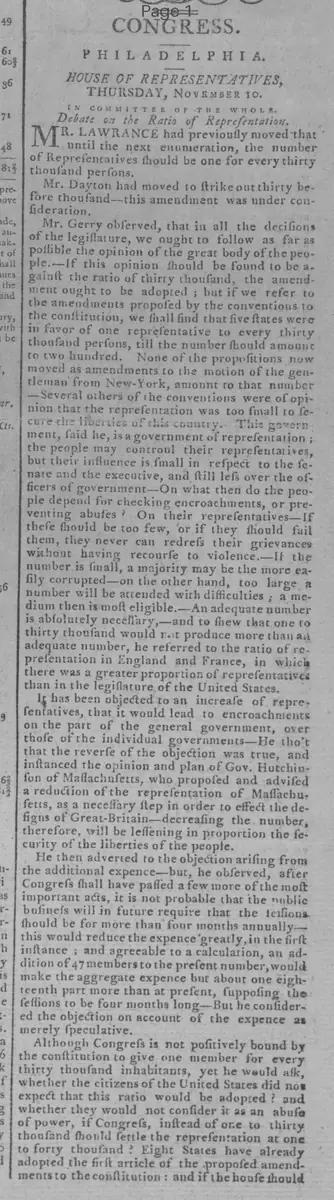
PHILADELPHIA
HOUSE OF REPRESENTATIVES,
THURSDAY, NOVEMBER 10.
IN COMMITTEE
OF THE WHOLE.
Debate on the Ratio of Representation.
Mr. LAWRENCE had previously moved that until the next enumeration, the number of Representatives should be one for every thirty thousand persons.
Mr. Dayton had moved to strike out thirty before thousand--this amendment was under consideration.
Mr. Gerry observed, that in all the decisions of the legislature, we ought to follow as far as possible the opinion of the great body of the people. If this opinion should be found to be against the ratio of thirty thousand, the amendment ought to be adopted; but if we refer to the amendments proposed by the conventions to the constitution, we shall find that five states were in favor of one representative to every thirty thousand persons, till the number should amount to two hundred. None of the propositions now moved as amendments to the motion of the gentleman from New-York, amount to that number—Several others of the conventions were of opinion that the representation was too small to secure the liberties of this country. This government, said he, is a government of representation; the people may control their representatives, but their influence is small in respect to the senate and the executive, and still less over the officers of government—On what then do the people depend for checking encroachments, or preventing abuses? On their representatives—If these should be too few, or if they should fail them, they never can redress their grievances without having recourse to violence. If the number is small, a majority may be the more easily corrupted—on the other hand, too large a number will be attended with difficulties; a medium then is most eligible. An adequate number is absolutely necessary, and to shew that one to thirty thousand would not produce more than an adequate number, he referred to the ratio of representation in England and France, in which there was a greater proportion of representatives than in the legislature of the United States.
It has been objected to an increase of representatives, that it would lead to encroachments on the part of the general government, over those of the individual governments. He thought that the reverse of the objection was true, and instanced the opinion and plan of Gov. Hutchinson of Massachusetts, who proposed and advised a reduction of the representation of Massachusetts, as a necessary step in order to effect the designs of Great-Britain—decreasing the number, therefore, will be lessening in proportion the security of the liberties of the people.
He then adverted to the objection arising from the additional expense—but, he observed, after Congress shall have passed a few more of the most important acts, it is not probable that the public business will in future require that the sessions should be for more than four months annually—this would reduce the expense greatly, in the first instance; and agreeable to a calculation, an addition of 47 members to the present number, would make the aggregate expense but about one eighteenth part more than at present, supposing the sessions to be four months long—But he considered the objection on account of the expense as merely speculative.
Although Congress is not positively bound by the constitution to give one member for every thirty thousand inhabitants, yet he would ask, whether the citizens of the United States did not expect that this ratio would be adopted? and whether they would not consider it as an abuse of power, if Congress, instead of one to thirty thousand should settle the representation at one to forty thousand: Eight States have already adopted the first article of the proposed amendments to the constitution: and if the house should
either settle the number of the representative body, as it now stands, or reduce it, or establish it at one hundred, perhaps they might, before the end of the session, be obliged to repeal their act; as they would be bound by the amendment, as soon as it is ratified by a sufficient number of States. If gentlemen thought it probable that the proposed amendment would be ratified by the several states, they ought already to consider it as a rule for their conduct, and be restrained by it, from giving less than one representative for thirty thousand inhabitants. After the representation amounts to one hundred, Congress will, no doubt, have a right to fix it there, until it is increased by the ratio of one to forty thousand: but that is a power, which, he presumed, Congress will not exercise; but that they then will establish some ratio, by which the increase of representation shall keep pace with the increase of population, until the house consists of two hundred members.
Mr. Boudinot was convinced of the propriety of striking out the word "thirty." The House ought to consider what would be an adequate number, for doing the business of the union: and that number ought not to be exceeded, except to answer some very valuable purpose. Business would proceed with difficulty, if the representation was so numerous, as it would become by the ratio of one to thirty thousand. The present representation of the United States is in a ratio very different from that of one to thirty thousand; and yet he thought it fully adequate. From a rough calculation, he said, that the ratio of thirty thousand would produce one hundred and thirteen members; thirty-five thousand would give ninety-seven; and forty thousand would produce eighty-one. If the number once settled was to rest there, he would not be over anxious to oppose the increase: but if gentlemen would take into view the increase consequent on the next enumeration, they would find that the number must by far exceed the due bounds. The increase of expense had been mentioned. He thought it would greatly exceed the calculation of the gentleman, and, for his part, although he was willing to tax the people for the necessary purposes of government, yet he would never consent to subject them to unnecessary burdens. Every man must see, that if the number was doubled, it would take almost double the time to do the business, as every member would have an equal right to deliver his sentiments, and thus protract their deliberations. He thought the people of the United States would be duly represented, and to their entire satisfaction, if the ratio was set higher than thirty thousand; nor could he imagine that such an exact proportion, between the representatives and the represented, was at all requisite to secure their liberties, or to do the necessary business of government. This indeed might be the case, if the power, vested in Congress, was proportionate to their number: but since the House would possess the same powers, whether it consisted of a greater or a smaller number, he thought the people equally secure in either case. The ratio of thirty-five thousand, which would produce ninety-seven members, would, in his opinion, be a very proper one. If however the people should think otherwise, they had it in their power to correct the mistake, by ratifying the proposed amendment. Their not having as yet ratified it, was to him an argument that they thought the ratio too low; or at least that they considered the question as doubtful. Some of the States, he observed, have postponed the consideration of the amendment; and eight only have as yet agreed to it. On the whole the house might safely adopt the ratio of one to thirty-five thousand; for that the increasing population of the United States would ever supply a representation sufficiently numerous to answer every good purpose.
Mr. Clarke observed that his objection was not merely on account of the pay of the members, but an increase in the representation would bring an additional expense on the people, by increasing the number of public offices, as almost every man would wish to see his friend provided for. The liberties of America, could be in no danger from the present ratio of representation. The doors of the House are open, and the people know what their representatives are doing.
Mr. Steele was in favor of the motion for striking out thirty. In discussing the important subject before the committee, he observed that there were two enquiries to be attended to—What is the proper number to constitute a representative body for the United States, and what ratio will leave the fewest fractions in the respective states—One member to thirty thousand he conceived would give too numerous a representation; according to the present number of inhabitants it will almost double the present number; it will divide and diminish the responsibility, make the House too unwieldy, retard public business, and increase the public expenses unnecessarily—An adequate representation he thought would be comprised within a much smaller number. Gentlemen have called our attention to the
(230-)
House of Commons of Great-Britain, and the National Assembly of France; but, said he, God forbid that we should draw our precedents from such examples as may be cited from European representation. He was opposed to thirty thousand as the ratio—it would in fractions throughout the United States, leave above three hundred and sixty-nine thousand citizens unrepresented. Thirty-five thousand he thought the most eligible number, as it would leave the fewest fractions. Some gentlemen seem to favor the ratio of thirty thousand, because that number has been recommended by some of the conventions, in their proposed amendments to the constitution; but he hoped that no decision would be founded on those subsequent amendments—It would be well to recollect the sentiments of gentlemen in the several conventions—In many of them, they were agreed to, without any wish or expectation that they should ever be taken into consideration, and therefore he thought that no argument ought to be drawn from them*—Neither ought Congress, said he, to be influenced by the example of the state governments—Business is so transacted in most of them, on account of their numerous representation, that there is very little permanency, or consistency in their systems. Too numerous an assembly is perpetually liable to disorder—and when that is the case, government becomes contemptible—this consideration had greater weight with him than an additional expenditure of a few dollars. He again objected to any example from Great-Britain or France; their assemblies, said he, are too numerous and unwieldy to transact business without confusion and compared with what he considered as an adequate number, are mere mobs. With respect to the proposed amendments, he said that they have not been adopted by three fourths of the states; and from thence he inferred that they would be finally rejected. He thought the amendment respecting the ratio of representatives, not so good as the original clause in the constitution—and said he would not hesitate to declare that it ought never to be adopted as a part of it. It has been said that the voice of America is in favor of the ratio of thirty thousand; were this the case, he would obey the voice of America—but he believed that the opinion of enlightened America was that forty or fifty thousand would not be too high a ratio—he should give the preference to either of those numbers to thirty or thirty five thousand, were it not on account of the fractions that would remain—he concluded, by saying he should vote for thirty-five thousand.
Mr. Lawrence agreed that an adequate number was the great object to be attended to but he contended that the original motion would give this number more completely than a larger ratio—and it ought to be considered that before the next enumeration, it will not be probably more than one to fifty thousand. As to the increase of expense, he observed that the great objects being accomplished, the future sessions will be short; besides which, the compensation of the members may be diminished—but he considered a necessary increase in the expense, to be fully counterbalanced by affording greater security to the liberties of the people. The firmness of a government depends on a strong executive—but this executive should be founded on a broad bottom—and the broader the basis, the more secure is the public freedom under a vigorous executive. The existence of the Union may depend on the fullness of the representation.—The inequality in the proportional increase of the number of inhabitants in different states, ought also to be taken into consideration,—for it was very probable that in a short time, while some of the smaller states had a representative for every thirty thousand, others would not have one to forty thousand— He said he was governed by general principles, and not by any calculations of fractional numbers—the constitution contemplates the ratio he had proposed, and therefore he hoped the motion for striking out would not obtain.
Mr. Goodhue observed, that the situation and circumstances of the government of the United States were so different from those of France or Great-Britain, that no parallel could be drawn respecting them—Nor is there, said he, an absolute similarity between this government and those of the state governments. The objects of legislation which come under the cognizance of Congress, are but few compared with those which engage the British House of Commons and the National Assembly of France—A much larger representation for them, and in our state legislatures is therefore proper, than is necessary for us in the general government.—He doubted the opinion that a large representation was less liable to corruption than a small one—some facts appear to confirm the former sentiment.—He did not consider the expense as a material objection, if an increase of this number was necessary to doing more ample justice, or for the greater security of the liberties of the people—but as he thought this was by no means the case, he was in favor of striking out 30, in order to insert a larger number.
Mr. Barnwell agreed with the gentleman last speaking; he said he should vote for striking out thirty, in order to substitute the largest number that had been mentioned.—Mr. Barnwell entered into an abstract and philosophical discussion of the principle of representation in government—the leading sentiment was, that a large proportion of representatives was not necessary to obtain the best objects of legislation, in expressing the wills of the people, or to secure the liberties of the constituent body—the great point, he observed, was to combine the greatest portion of honesty, with a due degree of activity—That number which would comprise a due proportion of these, would be competent to all the purposes of legislation, whether the number for which it legislates is ten thousand, or five hundred thousand. On this principle he was decidedly against a large number, and in favor of a small one. Adverting to the British House of Commons and the National Assembly of France, with respect to the former, he said, their corruption is in a great degree owing to their numbers, as to the latter, he observed, that the National Assembly had acted in his opinion politically and wisely—they set out with a large representation in conformity to the sentiments of the people at the moment; but on experience, finding the number too great, they have reduced it from twelve hundred to about 250. He believed, he said, that the general sense of the people was against a large representation in Congress—the inconveniencies experienced from numerous bodies in the state legislatures, has led several of the states to lessen the number—He instanced Georgia, South-Carolina and Pennsylvania.
Mr. Baldwin was opposed to the motion. One representative for thirty thousand appeared to him by no means a great representation. The opinion that, of late, had been so often advanced from the press, and in public discussion, for reducing the representative branch in government to a small number, he held to be full of dangerous error. He was sensible, that the terms great and small were so merely relative in their signification, that it was difficult precisely to understand each other in the use of them. Perhaps they may most properly, both of them, be considered as extremes. No doubt representation, which of late seems to be used as the character of republican government, is a great improvement upon democracy or legislation by the whole body of the people. He could conceive that a representation might be so large as to partake of the evils of assembling the whole body of the people; but it was a very improbable and not a dangerous extreme: the other extreme was full of danger. These observations acquire much force when applied particularly to the governments of this country; enfeeble the representative part of them, and you sap the very principles of life. They stand on a different basis from the governments which have gone before them, and may justly be said to be new experiments in government; time, as yet, has scarcely given room to judge of the probable issue; but this we may pronounce with much certainty, let the principles of representation languish, and they have no chance of success.
It had not been found practicable to ground representation in the federal constitution upon any other principle than that of numbers—but extent of territory is unquestionably one of the natural principles on which it rests, and would if possible be regarded. One for thirty-four or thirty-five thousand may be deemed a proper representation in the kingdom of France, or of Great-Britain, The four millions which compose the United States, compactly settled where there was great sameness in the country, and pretty equally distant from a common center, would be properly represented by a smaller number than in their present pare settlement :—But still farther, the settlement of the United States is a fillet stretched along the sea coast for seventeen hundred miles, comprehending as great a variety of climate and interests as one of the other quarters of the globe. It is difficult to conceive of a situation which calls for a greater extension of the principle of representation
It has been said that one for thirty thousand will make too large and unwieldy a body : he was sensible that was a point that did not admit of being determined by any conclusive reasoning; it was a mere matter of opinion, sound judgment only is to be used, time and experience will come on and confirm or correct the opinion. In such a case, said he, it is wise to enquire how this has been judged of by others who have had a representative body. In France 1200 was not thought too great a representation in forming their national assembly, and the number established by their new constitution for their stated legislature, was not 250, as the member last up had stated—but if he had not been misinformed by the publications in this country, it was nearly 750. In the kingdom of Great-Britain, 500 is not thought too great a representation: and can 113, which is the greatest number contended for, be considered in this country as a huge and impracticable mass of representation.
It had ever appeared to him to be among the strongest marks of our youth and inexperience, that we grew wise too suddenly He was afraid this instantaneous wisdom which sprung up so at once, and set at nought, or removed to the extreme of absurdity and folly, the deliberate and tried opinions of the most profound and enlightened among men, in circumstances peculiarly favorable to honest decision, will itself be left by time on that extreme. And how does this compare, he asked, with the opinion and experience of this country in the state governments ? The idea had before been called up, but in his opinion justice was by no means done to the comparison. It had been said that the states in general had found their representation too large, and were diminishing it. Let another view be taken of the comparison ; a state will not suffer the ordinary business of its own internal legislation to be intrusted to fewer representatives than from one to two hundred, and in some instances more, and yet in the federal government they are obliged to submit to a legislation which can much more substantially affect their happiness and property, and perhaps they have there but a single representative, or at most but five or six. The slightest comparison shews that there is no manner of proportion between them, that they are irreconcilably distorted; surely gentlemen of the opposite opinion will not have the effrontery to attempt to draw an argument from that source for diminishing the present representation.
The several state conventions which had thought proper to animadvert at all upon the federal constitution, had pretty uniformly expressed their wish that the representation should be increased. The artists in government, so far as he had been informed, had generally given their opinion that this part was too small, and out of proportion. He was as far from venerating mere theories of government as any man, and was sensible they must adjust themselves to the times and circumstances of the people. But it would not be useless to enquire, how does this appear in practice ? He could say for himself that it brought his own mind to the same conclusion, that it was the part of the federal constitution, of all others the house, seventeen was a majority, and equal to the decision of any question. Questions had already occurred, involving property to the amount of from fifty to eighty millions of dollars, and much of it in the hands of the most daring individuals, rendered desperate by their peculations. He did not say there had been any foundation for uneasy apprehensions from that quarter; but he did say, that in other countries it would be supposed to be a most dangerous experiment upon the passions and imperfections of human nature. "But it had been said, and with an unexpected assurance, that increasing the numbers did not increase the security against these evils. If so, why not reduce it at once to the venerable number thirteen, or indeed three, which would give us as great a security as the whole body of the people ? It is idle to pursue reasons."
The federal government, it must be admitted, is in act pretty highly seasoned with prerogative—practice has already evinced
the necessity, in many instances, of increasing it, by devolving much of the legislative power upon the executive department, arising from the difficulty of making particular provisions and details in our laws, and accommodating them to the various interests of so extensive a country.
The other branch of the legislature has many traits of a perpetual, at least of a very solid constituent part of the government.
He did not mention these as imperfections in the government, they are perfections if the other parts can be in due proportion; but it is surely a sound reason against taking positive measures at this time to diminish the representative branch; for his own part he was not well satisfied as to the intention. If there is any reason to apprehend that the government will depart from the point on which it was first placed, he could scarcely suppose that any one could be honestly alarmed with the fear that the departure would be towards democracy. He concluded by expressing his hopes that the representation to the next Congress would be fixed at one for thirty thousand, as it had hitherto been, and that the motion for striking out would not prevail.
MONDAY, NOVEMBER 14.
The Speaker laid before the house a memorial from General Moses Hazen, which was read and laid on the table.
Mr. Baldwin presented the petition of General James Jackson, stating that an improper and undue return has been made to the house of the election for the lower district of the state of Georgia—and praying that the house would postpone any determination on the election of General Anthony Wayne, for such reasonable period as may enable the petitioner to come forward with such proofs as the case may require.
Mr. Lawrence presented a petition of sundry inhabitants of the state of New-York, holders of the continental paper called new emission, or forty for one money—laid on the table.
A message was received from the President of the United States by Mr. Secretary Lear, with a copy of a resolution of the legislature of Virginia, ratifying the first article in the amendments proposed by Congress to the Constitution of the United States—also sundry papers relative to a purchase of land on the Great Miami, by John C. Symmes.
Mr. Seney presented a memorial from the distillers of Baltimore, praying a modification and a reduction of the duty on spirits of domestic manufacture—read, and referred to the Secretary of the Treasury.
Sundry petitions were read, praying for pensions and compensations—these were committed to the Secretary of War, to report thereon.
The petition of Stephen Zachary, merchant, of Baltimore, was read, stating that in consequence of an unintentional error in a bill of sale of a vessel purchased at Port-au-Prince, he had been obliged to pay extra tonnage duties, and prayed relief. On motion, this petition was referred to a select committee, consisting of Messrs. Fitzsimons, Huger and Gilman.
Mr. Baldwin moved that the petition of Gen. Jackson should be referred to the committee of elections. He offered several observations to shew the propriety of giving early attention to the business, particularly as the contested election took place in the remotest part of the remotest state in the Union.
It was observed that a reference to the committee appointed to bring in a bill for establishing an uniform mode of proceeding in cases of contested elections, appeared to be the most eligible. A reference to the committee of elections was objected to, as the subject did not come within their cognizance, as that committee can only determine respecting the certificate, &c. which are required from the executive of the state to entitle to a seat in the house. A reference to the committee appointed to report a bill, was also objected to, as that committee was not authorized to take notice of past transactions, or to report a retrospective regulation.
A select committee was mentioned, agreeable to the mode adopted in the two contested elections which occurred in the first Congress—but it being observed that the petition was unaccompanied with the requisite documents mentioned in it, Mr. Baldwin withdrew his motion, and the petition was laid on the table.
The message from the President of the United States being read, the papers respecting the purchase of land in the Western Territory, were referred to the committee appointed to bring in a bill providing for the sale of vacant lands.
A report, pursuant to orders of the house, was received and read, from the Board of Commissioners appointed to settle the accounts of the United States with the individual States. The report stated that those accounts may be settled by the first of July, 1793.
Mr. Parker laid before the house sundry papers respecting a Marine Hospital which had been erected in the State of Virginia; also an act of the Legislature of that United States—These being read, on motion of Mr. Parker, they were referred to the Secretary of the Treasury.
Two reports from the Secretary of State on petitions referred to him, were read—one on that of Colvin William Howe had leave to withdraw his petition—the other report was laid on the table.
The report of the Secretary of War, made to the late Congress, on the petition of Rufus Ha- milton, which was against the prayer of the petition, was, on motion of Mr. Ward, taken into consideration. A subsequent petition from the same person was also read—and on motion, it was voted that the prayer of said petition cannot be granted.
The order of the day, on the Census being called for, the house went into a committee of the whole.—Mr. Muhlenberg in the chair.
Mr. Heister moved that the Clerk should inform the house of the state of the ratifications of the amendments to the Constitution proposed by Congress to the several States.—It appeared that nine States had ratified the first article of these amendments.
The debate was then renewed on the amendment proposed to the motion of Mr. Lawrence, for striking out thirty before thousand.
Mr. Findley and Mr. Giles spoke largely against the motion for striking out—and Mr. Boudinot replied.
The committee rose without taking a vote, and had leave to sit again.
Adjourned.
TUESDAY, NOVEMBER 15.
Mr. Wayne presented the petition of J. Davis, a surgeon in the late army of the United States; which was read, and referred to the Secretary of war.
Mr. Sedgwick reported a bill respecting fugitives from justice, and from the service of Masters; which was read the first and second times, and ordered to be committed to a committee of the whole House on Friday next—100 copies to be printed for the accommodation of the members.
In committee of the whole, on the Schedule of the Census.
Mr. Muhlenberg in the chair.
The motion for striking out thirty, from the resolution proposed by Mr. Lawrence was further discussed; Mr. Page, Mr. Findley, Mr. Gerry, Mr. Kitchell and Mr. Heister opposed the motion for striking out. Mr. Steele, Mr. Clark, Mr. Hillhouse, Mr. Vining and Mr. Sedgwick, were in favor of the motion; the debate was continued till 3 o'clock, when the question being generally called for it was put and negatived—and the original motion, That until the next enumeration, the number of Representatives shall be one to every thirty thousand persons was agreed to.
The committee then rose and reported the resolution to the House, and on the motion to agree to the same, the ayes and noes being demanded are as follow:
AYES.
Messrs. Baldwin, Benson, Brown, Findley, Fitzsimons, Gerry, Giles, Gordon, Gregg, Griffin, Heister, Huger, Jacobs, Kitchell, Kittera, Lawrence, Learned, Lee, Muhlenberg, Madison, Moore, Murray, Page, Parker, Seney, Sheredine, Sumter, Sylvester, Treadwell, Tucker, Venable, Wadsworth, Wayne, White, Willis—35.
NOES.
Messrs. Ames, Foster, Barnwell, Boudinot, S. Bourne, B. Bourne, Clarke, Gilman, Goodhue, Grove, Hillhouse, Livermore, Macon, Niles, Sedgwick, J. Smith, I. Smith, W. Smith, Steele, Sturges, Thatcher, Vining, Ward—23.
A committee consisting of Messrs. Page, Murray and Macon, was appointed to report a bill pursuant to the above resolution.
Adjourned.
What sub-type of article is it?
What keywords are associated?
What entities or persons were involved?
Where did it happen?
Domestic News Details
Primary Location
Philadelphia
Event Date
Thursday, November 10; Monday, November 14; Tuesday, November 15
Key Persons
Outcome
the house agreed to one representative per 30,000 persons until the next enumeration, passing 35-23. various petitions were referred to committees or secretaries; some prayers denied or withdrawn.
Event Details
Debate in committee of the whole on Mr. Lawrence's motion for one representative per 30,000 persons, opposed by amendment to strike 'thirty' from Mr. Dayton. Speakers argued on adequacy of representation, expense, corruption risks, comparisons to state and foreign legislatures, and constitutional amendments. Debate continued over sessions, with ratification status noted (nine states for first amendment). On November 15, amendment negatived; original motion agreed. Additional proceedings included presentation and referral of memorials, petitions (e.g., Gen. Jackson's contested election, distillers' duty reduction, pensions), presidential message on Virginia ratification and land purchase, reports from secretaries, and bill on fugitives.