Thank you for visiting SNEWPapers!
Sign up free
Gazette Of The United States, & Daily Advertiser
Philadelphia, Philadelphia County, Pennsylvania
What is this article about?
A New England householder counters opposition to the direct tax by citing congressional debates where antifederalists advocated direct taxes over indirect ones, including proposals by Mr. Findley, while federalists resisted until necessary for defense against France.
Clipping
OCR Quality
Full Text
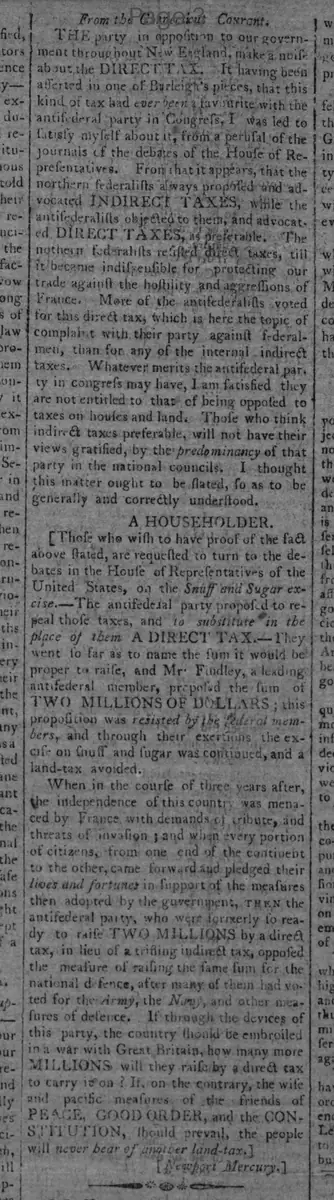
A HOUSEHOLDER.
Those who wish to have proof of the fact above stated, are requested to turn to the debates in the House of Representatives of the United States, on the Snuff and Sugar excise.--The antifederal party proposed to repeal those taxes, and to substitute in the place of them A DIRECT TAX.--They went so far as to name the sum it would be proper to raise, and Mr. Findley, a leading antifederal member, proposed the sum of TWO MILLIONS OF DOLLARS; this proposition was resisted by the federal members, and through their exertions the excise on snuff and sugar was continued, and a land-tax avoided.
When in the course of three years after, the independence of this country was menaced by France with demands of tribute, and threats of invasion; and when every portion of citizens, from one end of the continent to the other, came forward and pledged their lives and fortunes in support of the measures then adopted by the government, Then the antifederal party, who were formerly so ready to raise TWO MILLIONS by a direct tax, in lieu of a trifling indirect tax, opposed the measure of raising the same sum for the national defence, after many of them had voted for the Army, the Navy, and other measures of defence. If through the devices of this party, the country should be embroiled in a war with Great Britain, how many more MILLIONS will they raise by a direct tax to carry it on? If, on the contrary, the wise and pacific measures of the friends of PEACE, GOOD ORDER, and the CONSTITUTION, should prevail, the people will never hear of another land-tax.
[Newport Mercury.]
What sub-type of article is it?
What keywords are associated?
What entities or persons were involved?
Where did it happen?
Domestic News Details
Primary Location
New England
Key Persons
Event Details
Opposition party in New England complains about direct tax; author reviews congressional debates showing antifederalists favored direct taxes over indirect ones like snuff and sugar excise, proposing two million dollars; federalists resisted until needed for defense against France; later antifederalists opposed similar tax for national defense despite supporting army and navy.